

Which ASIC earns the most net income per day: 19 models ranked, 23.09.2026 snapshot
People usually ask "which miner is the most profitable" as if one answer fits everyone. It doesn't. Revenue depends only on hashrate, but net income, meaning revenue minus power, depends on your tariff. At 5 cents per kWh every one of the nineteen models below is in the black. At 10 cents two of them are losing money and three more clear less than half a dollar a day.
So what follows is not a single winner but a table with three tariffs and a breakeven column: the price of a kilowatt-hour at which the machine stops earning. Only models whose manufacturer published both hashrate and wall power for a specific bin made it into the calculation. Models where the datasheet lists a watt range, or leaves the power fields empty, are excluded, and they are listed separately further down with the reason.
POOL BTC does not sell hardware and is not a mining pool. It is a comparison site, and the table below is built from public manufacturer specifications plus one public hashprice source.
Which ASIC earns the most net income per day?
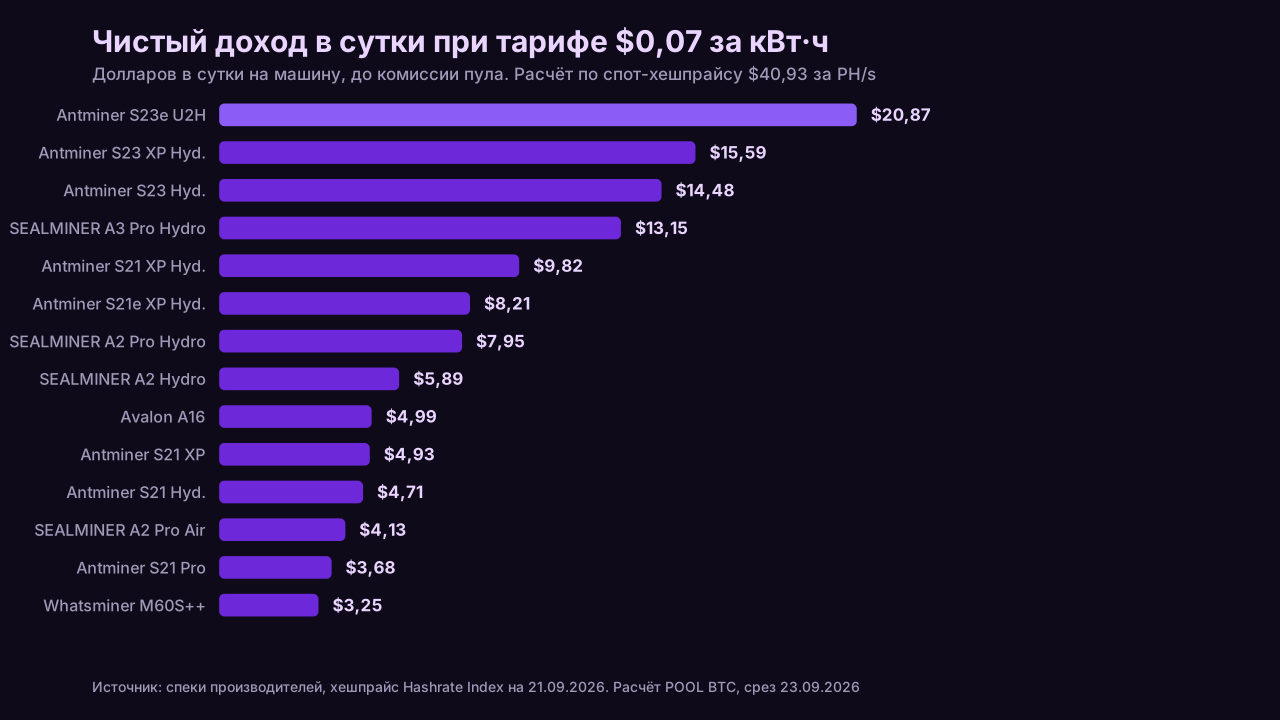
Per the POOL BTC calculation of 23.09.2026, at $0.07 per kWh the highest net income comes from the Antminer S23e U2H: $20.87 a day on $35.40 of revenue. Behind it sit the S23 XP Hyd. at $15.59 and the Antminer S23 Hyd. at $14.48. The best air-cooled unit in the list, the Avalon A16, returns $4.99.
| # | Model | Vendor | TH/s | W | J/TH | Cooling | Revenue/day | Net at $0.05 | Net at $0.07 | Net at $0.10 | Breakeven $/kWh |
|---|---|---|---|---|---|---|---|---|---|---|---|
| 1 | Antminer S23e U2H | Bitmain | 865 | 8650 | 10.0 | hydro 2U | $35.40 | $25.02 | $20.87 | $14.64 | $0.171 |
| 2 | Antminer S23 XP Hyd. | Bitmain | 600 | 5340 | 8.9 | hydro | $24.56 | $18.15 | $15.59 | $11.74 | $0.192 |
| 3 | Antminer S23 Hyd. | Bitmain | 580 | 5510 | 9.5 | hydro | $23.74 | $17.13 | $14.48 | $10.52 | $0.180 |
| 4 | SEALMINER A3 Pro Hydro | Bitdeer | 660 | 8250 | 12.5 | hydro | $27.01 | $17.11 | $13.15 | $7.21 | $0.136 |
| 5 | Antminer S21 XP Hyd. | Bitmain | 473 | 5676 | 12.0 | hydro | $19.36 | $12.55 | $9.82 | $5.74 | $0.142 |
| 6 | Antminer S21e XP Hyd. | Bitmain | 430 | 5590 | 13.0 | hydro | $17.60 | $10.89 | $8.21 | $4.18 | $0.131 |
| 7 | SEALMINER A2 Pro Hydro | Bitdeer | 500 | 7450 | 14.9 | hydro | $20.46 | $11.52 | $7.95 | $2.58 | $0.114 |
| 8 | SEALMINER A2 Hydro | Bitdeer | 446 | 7359 | 16.5 | hydro | $18.25 | $9.42 | $5.89 | $0.59 | $0.103 |
| 9 | Avalon A16 | Canaan | 282 | 3900 | 13.8 | air | $11.54 | $6.86 | $4.99 | $2.18 | $0.123 |
| 10 | Antminer S21 XP | Bitmain | 270 | 3645 | 13.5 | air | $11.05 | $6.68 | $4.93 | $2.30 | $0.126 |
| 11 | Antminer S21 Hyd. | Bitmain | 335 | 5360 | 16.0 | hydro | $13.71 | $7.28 | $4.71 | $0.85 | $0.107 |
| 12 | SEALMINER A2 Pro Air | Bitdeer | 260 | 3874 | 14.9 | air | $10.64 | $5.99 | $4.13 | $1.34 | $0.114 |
| 13 | Antminer S21 Pro | Bitmain | 234 | 3510 | 15.0 | air | $9.58 | $5.37 | $3.68 | $1.15 | $0.114 |
| 14 | Whatsminer M60S++ | MicroBT | 218 | 3379 | 15.5 | air | $8.92 | $4.87 | $3.25 | $0.81 | $0.110 |
| 15 | Antminer S21+ | Bitmain | 235 | 3878 | 16.5 | air | $9.62 | $4.96 | $3.10 | $0.31 | $0.103 |
| 16 | SEALMINER A2 | Bitdeer | 226 | 3729 | 16.5 | air | $9.25 | $4.78 | $2.99 | $0.30 | $0.103 |
| 17 | Avalon A15 Pro | Canaan | 218 | 3662 | 16.8 | air | $8.92 | $4.53 | $2.77 | $0.13 | $0.102 |
| 18 | Whatsminer M60S+ | MicroBT | 188 | 3384 | 18.0 | air | $7.69 | $3.63 | $2.01 | $-0.43 | $0.095 |
| 19 | Antminer T21 | Bitmain | 190 | 3610 | 19.0 | air | $7.78 | $3.44 | $1.71 | $-0.89 | $0.090 |
POOL BTC calculation, snapshot of 23.09.2026, before pool fees. Revenue uses the spot hashprice of $40.93 per PH/s per day (Hashrate Index report of 21.09.2026). Network inputs: difficulty 132.76 T, in force since 19.09.2026; BTC price $85,824 (CoinWarz, 23.09.2026, 10:12 UTC); block subsidy 3.125 BTC. Specifications come from Bitmain support pages and product manuals, shop.whatsminer.com, shop.canaan.io, bitdeer.com/shop, and the official Bitmain announcement of 28.08.2026. Rows are sorted by net income at $0.07.
Three rows need a footnote. The specs for the S21+, S21e XP Hyd. and S23 Hyd. come from Bitmain PDF manuals, but those files are hosted on distributor servers rather than bitmain.com. By format and content they are genuine manufacturer documents, while the store listings for those models were marked Sold Out at the time of checking and returned no spec table. The S23 XP Hyd. and S23e U2H have no dedicated spec page at Bitmain either; their figures are confirmed by the company's own posts of 28.08.2026.
How is net income calculated and where does the hashprice come from?
Daily revenue = hashrate in TH/s multiplied by $0.04093. Daily cost = watts divided by 1000, multiplied by 24 and by the tariff. Net = revenue minus cost. The $0.04093 per TH/s per day figure is the $40.93 per PH/s per day spot hashprice from the Hashrate Index report of 21.09.2026, divided by a thousand.
Two things get mixed up more often than anything else.
First, the hashprice already includes transaction fees, not the block subsidy alone. It is calculated from total network revenue per day, meaning 3.125 BTC per block plus the fees inside blocks, divided by network hashrate and converted to dollars. Adding a separate "plus transaction fees" line would count them twice.
Second, this is income before pool fees. The table contains neither a pool percentage nor a payout scheme. FPPS pays the miner both subsidy and fees, PPLNS pays on found blocks and is far noisier over short windows. The mechanics are covered in the piece on FPPS and PPLNS, and what a fee actually takes out of these numbers is calculated below.
Network difficulty and network hashrate do not enter the formula directly: they are already baked into the hashprice. When difficulty rises and the BTC price stays flat, hashprice falls and the whole revenue column falls with it. That relationship is unpacked in the article on hashprice.
At what electricity price does a model go negative?
The breakeven column is the price of a kilowatt-hour at which net income hits zero. It equals daily revenue divided by daily consumption in kWh. Across the table the range runs from $0.090 on the Antminer T21 to $0.192 on the S23 XP Hyd., more than a twofold spread.
How to apply it to your own site:
- Take the real tariff from your electricity bill, not the headline rate. It has to include every surcharge, grid component and tax you actually pay per kilowatt-hour.
- Add site losses. Air conditioners, ventilation and pumps consume power that you pay for and that no miner datasheet lists.
- Compare the result with the breakeven column. Any machine whose breakeven sits below your tariff is running at a loss at the current hashprice.
- Leave headroom. If your tariff is within a cent or two of the breakeven, any downward move in hashprice flips the machine negative that same day.
Per the POOL BTC calculation of 23.09.2026, at $0.10 per kWh the T21 returns minus $0.89 a day and the Whatsminer M60S+ minus $0.43. Four more models in that column clear less than $0.35 a day, which in practice is zero: a short outage, rejected shares or a couple of extra degrees of heat eat that margin.
Air or hydro: which nets more?
In absolute terms hydro wins by a wide margin. All nine hydro machines in the table return between $4.71 and $20.87 a day at $0.07, while the ten air units land between $1.71 and $4.99. The gap comes mostly from size rather than efficiency: a hydro unit simply packs more hashrate into one chassis.
| At $0.07 per kWh | Hydro (9 models) | Air (10 models) |
|---|---|---|
| Best model | S23e U2H, $20.87 | Avalon A16, $4.99 |
| Weakest model | S21 Hyd., $4.71 | Antminer T21, $1.71 |
| Breakeven range | $0.103 to $0.192 | $0.090 to $0.126 |
Tolerance to expensive power is a different story. The SEALMINER A2 Hydro breaks even at $0.103, exactly the same as the air-cooled Antminer S21+, and lower than the air-cooled S21 XP at $0.126. Hydro by itself does not make a machine resilient to a high tariff. J/TH does.
And the big omission: the loop, the heat exchanger, the pumps, the dry coolers and the room plumbing. None of that appears in the machine's watt rating or in its price. For one or two units at home hydro rarely pays that infrastructure back; for a site of several hundred kilowatts the arithmetic changes. It is left out here on purpose, because the table compares machine income, not project cost.
Why doesn't the most efficient machine make the most money?
Because efficiency and income answer different questions. J/TH tells you how much power one unit of work costs, while daily income also depends on how much of that work the machine does. The most efficient unit in the table earns less than the largest one.
The top two rows show it cleanly. The S23 XP Hyd. runs at 8.9 J/TH, the best figure in the whole list, and returns $15.59 a day at $0.07. The S23e U2H at 10.0 J/TH is noticeably less efficient, but its 865 TH/s against 600 TH/s produce $20.87. That is $5.28 a day in favour of the less efficient machine.
The gap narrows as the tariff climbs: $6.87 at $0.05, $5.28 at $0.07, only $2.90 at $0.10. Further up, the U2H runs into its $0.171 breakeven while the S23 XP Hyd. keeps earning up to $0.192. Expensive power gradually strips the advantage from the big machine and hands it to the efficient one.
The SEALMINER A3 Pro Hydro makes the same point from the other side. It is second by revenue at $27.01 a day, ahead of the S23 XP Hyd. On net income it is only fourth, and the gap widens with the tariff: at $0.05 it trails third place by $0.02, at $0.10 by $3.31. The reason is draw, 8250 W against 5340 W on the S23 XP Hyd. Ranking by revenue and ranking by net income only agree when power is very cheap.
The air segment shows it too. The Avalon A16 beats the S21 XP at $0.05 and $0.07, then they swap at $0.10: $2.18 against $2.30. Same reason, the S21 XP has the higher breakeven.
How much of that does a pool fee take?
A fee is charged on revenue, not on net income, so its absolute size does not depend on your tariff while its share of what you keep grows with the tariff. At a 2% rate and the revenue figures from the table:
| Model | Revenue/day | 2% per day | 2% per year | Share of net at $0.07 |
|---|---|---|---|---|
| Antminer S23e U2H | $35.40 | $0.71 | $258 | about 3.4% |
| SEALMINER A3 Pro Hydro | $27.01 | $0.54 | $197 | about 4.1% |
| Antminer S23 XP Hyd. | $24.56 | $0.49 | $179 | about 3.2% |
| Antminer S21 XP | $11.05 | $0.22 | $81 | about 4.5% |
| Antminer T21 | $7.78 | $0.16 | $57 | about 9.1% |
The 2% rate is used here as arithmetic, not as any particular pool's number: real terms differ by percentage, by scheme and by whether transaction fees are passed through. Current rates and schemes are collected in the pool comparison, and the annual figure for your own hashrate and your own rate is quicker to check in the mining profitability calculator.
Look at the last column. On the T21 at $0.07 the same 2% already consumes roughly a ninth of net income, and on the S21 XP at $0.10 it is about 9.6%. The closer a machine sits to its breakeven, the harder a flat fee hits what remains, even though the rate never moved.
Why will this table look different in a week?
Because hashprice is not a constant. The spot value on 21.09.2026 was $40.93 per PH/s per day, while the 7-day average on the same date was $38.49 and the 30-day average $39.08. That is roughly 4.7% between spot and the monthly average, and the whole revenue column moves with it.
Two forces push it further.
Difficulty. The current 132.76 T was set on 19.09.2026, up 4.16% from the previous epoch. The next adjustment is expected around 03.10.2026, estimated at minus 1.80% at the time of checking. Falling difficulty at a flat BTC price lifts hashprice, which helps every row in the table.
Network hashrate. Moving averages as of 21.09.2026 were 946 EH/s over seven days and 934 EH/s over thirty. The daily reading of 832 EH/s on 23.09.2026 looks like a collapse, but that is an artefact of estimating hashrate from block intervals rather than machines switching off: the same source showed 908 EH/s on 22.09 and around 995 EH/s on 21.09. Weekly or monthly averages are the sane input for any calculation. The metric itself is covered in the piece on Bitcoin network hashrate.
Then there is the BTC price, $85,824 at the snapshot. It revalues the entire revenue column directly and moves more often than anything else here.
Which models are missing from the table, and why?
Only models with both hashrate and wall power published by the manufacturer for a specific bin qualified. The rest are not dismissed as irrelevant; they simply lack a number that can go into the formula without invention.
The manufacturer publishes only a watt range per bin:
- SEALMINER A3 Air, 240-280 TH/s at 3360-3920 W;
- SEALMINER A3 Pro Air, 260-320 TH/s at 3250-4000 W;
- SEALMINER A3 Hydro, 460-540 TH/s at 6210-7290 W.
Bitdeer does give headline centre values and a J/TH ratio for these, but not a watt figure tied to a bin that could be dropped into the table.
The manufacturer does not publish this at all:
- Whatsminer M63S+. The 390-450 TH/s range and 17 J/TH are confirmed by the MicroBT manual, but the nominal wall power fields in that manual are blank. The 7208 W and 7650 W figures appear only on reseller pages.
- Whatsminer M66S+ Hydro. The official M6X series manual shows 18.5 J/TH, but the hashrate range could not be tied specifically to the "+" suffix version within the document.
- Whatsminer M70S. A detailed PDF exists, but the manufacturer marked it Prototype data for reference only. Prototype numbers have no place in an income table.
- Whatsminer M73S+. No dedicated datasheet or whatsminer.com page was found; the figures exist only in trade press coverage of a MicroBT event.
- Avalon A15XP and A16XP. Canaan press releases give hashrate and J/TH but no watts. Multiplying TH by J/TH and presenting the result as published power was not an option.
- Auradine Teraflux. The official press release lists TH/s and J/TH per mode, no watts, and no retail prices either.
A separate note on the air-cooled Antminer S23. The 318 TH/s at 3498 W and 11.0 J/TH bin matches across several aggregators, but no direct Bitmain page with that bin could be found, and a regional storefront lists a different bin, 305 TH/s at 3355 W. The discrepancy is unresolved, so only the hydro S23 variants appear in the table. The Antminer S21+ Hyd. specification could not be verified either: the text matches Bitmain's own table format word for word, yet no confirmation exists on bitmain.com itself.
What is not included in the calculation?
The table answers exactly one question: how much a machine brings in per day at a given tariff. Outside that scope:
- The price of the machine and shipping. Payback is not calculated here; it is a separate topic covered in the article on ASIC payback period.
- Infrastructure. Panels, cabling, ventilation, sound insulation, and for hydro the loop, the heat exchanger and the pumps.
- PSU losses and site PUE. Datasheet watts are at the wall for the machine alone; room cooling is not in them.
- Downtime, faulty boards, rejected shares and repair time. Even 2% downtime is about a week of production a year.
- Taxes and the cost of converting to fiat, both heavily jurisdiction dependent.
- Manufacturer tolerance. Bitmain states ±3% on hashrate and ±5% on power, Bitdeer ±10% on hashrate and ±5% on J/TH. Your specific unit can therefore land a few percent either side of the table, and that is normal rather than a defect.
On prices. Manufacturers rarely publish them openly. Among the models in the table: the Antminer S21 XP at $17 per terahash, or $4,590 per unit; the S23 XP Hyd. at $25.5 per terahash, $15,300, a preorder price with shipping from November 2026; the S23e U2H at a promotional $11 per terahash for one month from 28.08.2026, around $9,515 per unit, against a regular price of roughly $22 per terahash according to a third party breakdown rather than Bitmain itself; the Whatsminer M60S+ at $16 per terahash and the M60S++ at $10 per terahash in the MicroBT store. Everything else Bitmain lists as Sold Out, Canaan and Bitdeer do not show prices openly, and Auradine sells on request. That looks like standard practice for those companies rather than a gap in the research.
How do you verify the number for your own machine?
Step by step:
- Take the rated TH/s and watts for your bin from the manufacturer's own page. Store listings and aggregators often round figures and blend bins.
- Check them against reality. Read hashrate from your pool's 24-hour statistics rather than the miner's web interface, and measure power with a plug meter. A 3-5% gap is normal; a 15% gap points to firmware, temperature or a bad board.
- Multiply your actual hashrate in TH/s by the current hashprice per TH/s per day. On 21.09.2026 that was $0.04093, but use a fresh value on the day you calculate.
- Work out the cost: kW multiplied by 24 and by your full tariff from the bill.
- Subtract the pool fee from revenue, not from what is left after power.
- Run the same inputs through the POOL BTC mining calculator with your tariff and your fee, then compare against what actually lands in the wallet over a week. A weekly window smooths variance; a single day almost always lies.
To line specific models up against each other before buying, there is the ASIC miner ranking and a head to head on the Antminer S21 Pro versus Whatsminer M60S.
Frequently asked questions
Which model nets the most at $0.07 per kWh?
The Antminer S23e U2H, $20.87 a day on $35.40 of revenue. Per the POOL BTC calculation of 23.09.2026 that is first place among nineteen models with published power figures.
Which models go negative first?
The Antminer T21 at a $0.090 breakeven and the Whatsminer M60S+ at $0.095. At a $0.10 tariff they return minus $0.89 and minus $0.43 a day.
What does the breakeven column mean?
It is the kilowatt-hour price at which net income reaches zero, given a hashprice of $40.93 per PH/s per day. Above that price the machine loses money, below it the machine earns.
Are pool fees included?
No. Every figure is before fees. At a 2% rate they run from $0.16 a day on the T21 to $0.71 on the S23e U2H, so $57 to $258 a year.
Are transaction fees counted?
Yes, inside the hashprice. Hashprice is derived from total network revenue including the fees in blocks, so they must not be added again as a separate line.
Why are the SEALMINER A3 and the Whatsminer M63S+ missing?
Bitdeer publishes only a watt range per bin for the A3 series, and the nominal power fields in MicroBT's M63S+ manual are blank. Without published power, a net income figure is guesswork.
Can this table be used for payback calculations?
No. It contains no hardware price, shipping, infrastructure or tax, and hashprice will move many times over any payback horizon.
How long will these numbers hold?
Over the past month hashprice moved between $38.49 and $40.93 per PH/s per day across averages and spot. The next difficulty adjustment is expected around 03.10.2026 at an estimated minus 1.80%, which would lift the whole revenue column.
The short version
- At $0.07 per kWh the Antminer S23e U2H leads with $20.87 a day; it also leads at $0.05 with $25.02 and at $0.10 with $14.64.
- The most efficient machine in the list, the S23 XP Hyd. at 8.9 J/TH, is second on money but stays profitable up to $0.192 per kWh, further than anything else here.
- Breakeven tariffs spread from $0.090 on the T21 to $0.192 on the S23 XP Hyd., and that number, not the rank, decides whether a model suits your site.
- At $0.10 per kWh two of the nineteen models are already negative and three more hover near zero.
- All figures are before pool fees, hardware cost and infrastructure; the snapshot hashprice is $40.93 per PH/s per day, with the next difficulty adjustment due around 03.10.2026.