
Solo bitcoin blocks in 2026: every verified win, what hardware found it, and what the odds really were
Between 1 January and 14 September 2026, solo miners found at least 15 blocks: 6 on Solo CKPool, 5 on Public Pool and 4 on Braiins Solo. Three of them made major news, and one was found by a Bitaxe Gamma, a single-chip device the size of a deck of cards. This page lists all 15 blocks with date, service and reward, breaks down the three headline cases, then runs the odds from the current network snapshot so you can see what those wins do and don't prove.
pool-btc.com is an independent comparison site for mining pools and mining tools. We don't run a pool or a solo service.
How many solo blocks were found in 2026, and where?
From 1 January to 14 September 2026, 15 solo blocks are confirmed: 6 on Solo CKPool, 5 on Public Pool and 4 on Braiins Solo. The count comes from the LN Solo tracker, cross-checked against mempool.space. Three blocks (957,382, 960,804 and 966,351) made major news. The tracker doesn't cover kano.is, ViaBTC SOLO or OCEAN DATUM.
| Date 2026, UTC | Block | Service | Block reward, BTC |
|---|---|---|---|
| 18.02 | 937,218 | Public Pool | 3.1435 |
| 24.02 | 938,092 | Braiins Solo | 3.1279 |
| 02.04 | 943,411 | Solo CKPool | 3.1390 |
| 03.04 | 943,466 | Public Pool | 3.1477 |
| 09.04 | 944,306 | Solo CKPool | 3.1280 |
| 28.04 | 947,073 | Public Pool | 3.1414 |
| 29.04 | 947,128 | Braiins Solo | 3.1341 |
| 06.05 | 948,146 | Public Pool | 3.1546 |
| 28.05 | 951,408 | Solo CKPool | 3.1415 |
| 31.05 | 951,771 | Braiins Solo | 3.1404 |
| 27.06 | 955,703 | Solo CKPool | 3.1553 |
| 09.07 (reported as 10.07) | 957,382 | Public Pool | 3.1382 |
| 22.07 | 959,115 | Solo CKPool | 3.1610 |
| 03.08 | 960,804 | Solo CKPool | 3.1569 |
| 10.09 | 966,351 | Braiins Solo | 3.1473 |
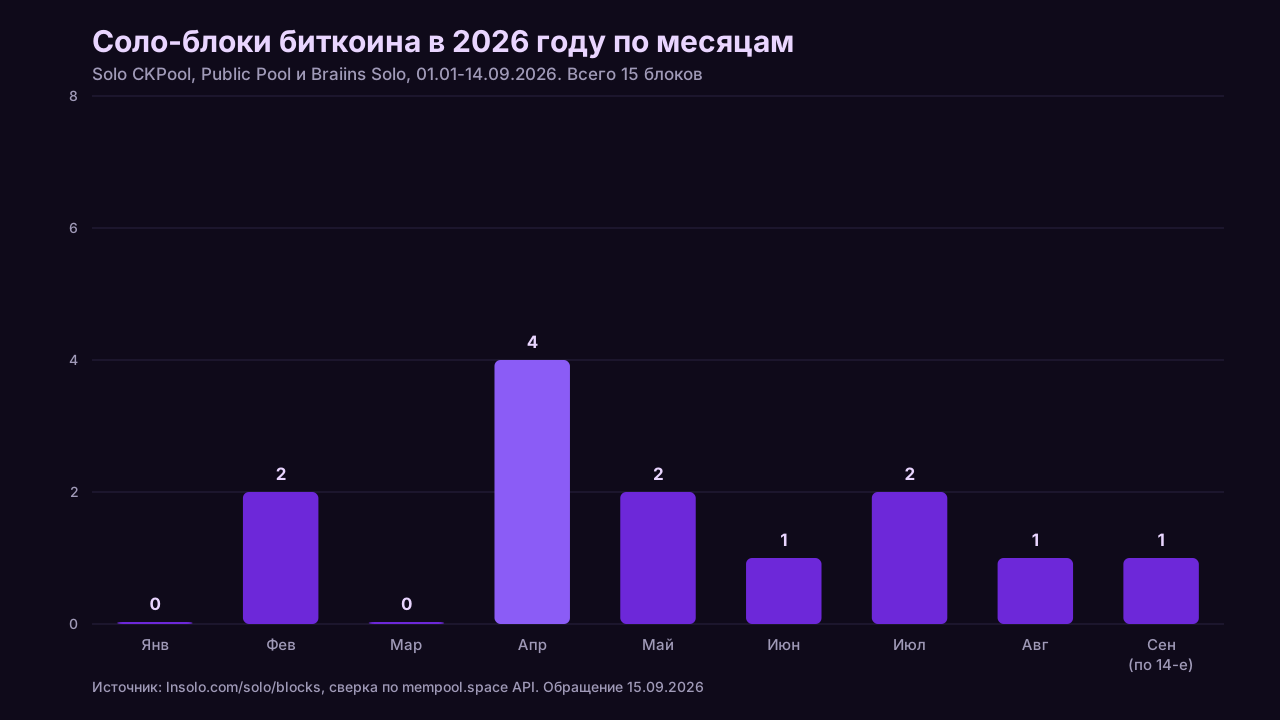
By month: January 0, February 2, March 0, April 4, May 2, June 1, July 2, August 1, September (through the 14th) 1. Source: the LN Solo tracker, cross-checked against the mempool.space API, accessed 15.09.2026. Block rewards are as reported by mempool.space: subsidy plus transaction fees, before the service fee.
The three blocks covered by major outlets:
| Block | Date, UTC | Service | Reward to miner | Hardware | Source |
|---|---|---|---|---|---|
| 957,382 | 09.07.2026 (reported as 10.07) | Public Pool | 3.1382 BTC (about $200,000 at the time) | Bitaxe Gamma | crypto.news, 14.07.2026; CoinDesk, 14.07.2026; our news write-up of the Bitaxe win |
| 960,804 | 03.08.2026 | Solo CKPool | 3.1569 BTC | according to ckpool developer Con Kolivas, rented hashrate peaking at about 100 PH/s; the specific equipment was not disclosed | cryptobriefing.com, 03.08.2026 |
| 966,351 | 10.09.2026 (news published 11-12.09) | Braiins Solo | 3.1473 BTC (about $245,000) | not disclosed in any source | cryptonewsorg.com, 12.09.2026; techflowpost.com, 12.09.2026 |
A few things stand out from the reporting:
- The September block ended a gap of almost 40 days: 38 days passed between 03.08 and 10.09 with no solo win.
- CoinDesk called block 957,382 the twelfth solo block of the year on 14.07.2026. That matches the tracker count.
- According to news.bitcoin.com, as cited by HOGE Wire, block 960,804 was the 317th solo block in Solo CKPool's history.
- September coverage of block 966,351 noted that the five largest pools (Foundry, AntPool, F2Pool, ViaBTC and SpiderPool) together held 78.31% of network hashrate.
What are the real odds of finding a block with one S21 or a Bitaxe?
One Antminer S21 at 200 TH/s has a 1.08-1.10% chance of finding at least one block in a year, assuming network hashrate stays near 950-970 EH/s. On average that works out to one block every 90-92 years. A Bitaxe Gamma at 1.0-1.2 TH/s scales down in proportion: 0.0054-0.0066% a year.
The formula is short. Your chance per block equals your share of network hashrate:
`p = your hashrate / network hashrate`
Bitcoin targets 144 blocks a day, or 52,560 a year. Multiply `p` by the number of blocks to get the expected number of wins. For low expectations, the chance of at least one win is `1 - e^(-expected wins)`.
Inputs from mempool.space on 15 September 2026: difficulty 127.45T, realtime network hashrate 967 EH/s, 7-day average about 950 EH/s (daily values ranged from 836 to 1,025 EH/s). We use 950-970 EH/s and a block subsidy of 3.125 BTC. Bitaxe Gamma hashrate: about 1.2 TH/s per the official repository, 1-1.3 TH/s per CoinDesk on 14.07.2026.
| Hardware | Hashrate | Chance per block | Expected blocks per year | Chance of at least one block in a year | Average wait |
|---|---|---|---|---|---|
| Antminer S21 | 200 TH/s | 2.06-2.11 in 10 million | 0.0108-0.0111 | 1.08-1.10% | 90-92 years |
| Per 1 TH/s (scale for any device) | 1 TH/s | about 1.03-1.05 in a billion | 0.000054-0.000055 | 0.0054-0.0055% | 18,080-18,460 years |
| Bitaxe Gamma | 1.0-1.2 TH/s | 1.03-1.26 in a billion | 0.000054-0.000066 | 0.0054-0.0066% | 15,060-18,460 years |
Two caveats. Network hashrate keeps moving, so these figures go stale within weeks. And the model assumes exactly 144 blocks a day, which the network only averages over time. Plug your own device and current hashrate into the POOL BTC mining calculator to see the pool side of the same hardware.
Why don't these wins prove solo mining is worth it?
Solo mining and pool mining have roughly the same expected value, but the likely outcome is completely different. An S21 in a pool earns a small, steady payout. The same S21 mining solo earns nothing in about 99 years out of 100. The news covers the one miner who won and never mentions the thousands who didn't.
Three points the headlines skip:
- Survivorship. Every solo win is public. Every miner who ran a Bitaxe for two years and found nothing stays invisible. The 15 blocks of 2026 don't tell you how many devices were running.
- Luck doesn't accumulate. Each hash is an independent attempt, so a miner who has waited a year has the same odds tomorrow as on day one. We cover this in more detail in how to read pool luck and orphan stats.
- Averages look similar on paper. For one S21, 0.0108-0.0111 expected blocks times 3.125 BTC comes to about 0.034-0.035 BTC a year, or about $2,610-2,680 at a BTC price of about $77,300. A pool paying hashprice at $38.96-40 per PH/day gives the same machine $2,844-2,920 a year gross. Close averages, wildly different distributions.
That distribution matters because electricity bills arrive every month. A solo miner with no block has to cover them from somewhere else. Our solo vs pool breakdown goes through the hashrate level where solo stops being a lottery.
Which solo services exist, and what do they charge?
Solo CKPool charges 2% and Braiins Solo 0.5%, both only from a block you find. Public Pool charges no fee, and OCEAN charges DATUM miners 1% instead of its base 2%. The official kano.is and ViaBTC SOLO pages don't publish a percentage. We checked Solo CKPool and Braiins Solo on 20 August, the rest on 15 September 2026.
| Service | Fee | Setup | Status of our check |
|---|---|---|---|
| Solo CKPool (solo.ckpool.org) | 2%, only from a found block | BTC address as username, any password | verified 20.08.2026 |
| Braiins Solo (solo.stratum.braiins.com) | 0.5%, which goes to the ckpool developers whose code the service uses | BTC address as username, no Braiins Pool account | verified 20.08.2026 |
| KanoPool solo (kano.is) | the official page doesn't publish a percentage | account, switch to solo mode in settings | not confirmed |
| ViaBTC SOLO mode | the official page doesn't publish a percentage; third-party tracker miningpoolstats lists 1% | ViaBTC account, change payout method to SOLO | mode confirmed, fee not |
| OCEAN DATUM Gateway | 1% for DATUM, base fee 2% (ocean.xyz) | your own full node plus DATUM Gateway, not a simple address login | verified 15.09.2026 |
| Public Pool | 0% (web.public-pool.io) | address-based | verified 15.09.2026 |
On a 3.125 BTC subsidy, the gap between 0.5% and 2% is about 0.047 BTC. That's real money if you win, and zero if you don't. Service reliability and uptime matter more than the fee for a lottery you will most likely never collect on.
When does lottery mining actually make sense?
Solo mining makes sense when you'd run the hardware anyway and don't need the income. Think a Bitaxe drawing little power as a hobby, a miner heating a room in winter, or someone who wants to support decentralized block production. It doesn't make sense for machines you bought on credit or a farm budgeted around payback.
Cases where the lottery is reasonable:
- Hobby and learning. A small device costs little to run and teaches you how stratum, block templates and coinbase transactions work. Power draw of a Bitaxe Gamma: 15-21 W (CoinDesk 14.07.2026, bitaxeorg repository).
- Heat you'd pay for anyway. If a miner replaces an electric heater, part of the power bill is covered by the heat. Canaan's heat projects in the Nordics show the idea at scale in our hash-to-heat article.
- Spare hashrate. Some miners keep most of their fleet on a pool and point one machine at a solo service.
- Very large hashrate. At 1 EH/s and above, solo stops being a lottery and turns into ordinary variance.
Cases where it isn't: equipment financed with debt, hosting contracts with fixed monthly fees, and any plan where the question "how long until payback" has to have an answer. For those, compare the pool side in our ROI analysis for small farms.
How can you check that a solo win story is real?
Every block is public, so the block height is enough to check most of a story in a few minutes. Open the block in any explorer, read its coinbase transaction, and check who received the reward. The one detail you can't confirm on-chain is the hardware, because a block doesn't record which device found it.
- Take the block height from the article (for example, 966,351) and open it in a public block explorer such as mempool.space.
- Check the timestamp against the date in the story. News often lags by a day or two: block 966,351 was found on 10.09, and coverage started on 11-12.09.
- Open the coinbase transaction, which is the first transaction in the block.
- Read the coinbase tag. Explorers use this text to label which pool or service mined the block.
- Look at the outputs. A ckpool-based solo service pays the reward straight to the miner's address and sends its fee to a separate output. A regular pool block pays the pool's own address.
- Add up the outputs and compare them with the reward in the article (subsidy plus transaction fees, minus the service fee).
- Treat hardware claims as unverified unless the miner or the service confirms them publicly. Nothing on-chain can prove "it was a Bitaxe".
If the block height is missing from a story, be skeptical. Every case in the tables above names its block.
Pool vs solo over one year: what to expect with one S21?
Over a year, one S21 in a pool gets a gross revenue of about $2,844-2,920 at September 2026 hashprice, paid in small daily amounts. The same machine mining solo has a 1.08-1.10% chance of a block worth about 3.1 BTC after the fee, and about a 98.9% chance of earning nothing. The electricity bill is the same in both cases.
| One Antminer S21 (200 TH/s, 17.5 J/TH), 12 months | Pool, FPPS | Solo via Braiins Solo |
|---|---|---|
| Gross revenue | $2,844-2,920 at $38.96-40 per PH/day | 0 BTC in about 98.9% of years; 3.125 BTC subsidy plus fees in 1.08-1.10% |
| Service fee | depends on the pool; AntPool is 2.5% per the miningpoolstats tracker, its official page doesn't publish the figure | 0.5% of a found block |
| Revenue in the likely case | steady daily payouts | $0 |
| Revenue if a block is found | not applicable | about 3.109 BTC from the subsidy after fee, about $240,000 at $77,300 per BTC, plus fees |
| Electricity | 30,660 kWh a year × your electricity price per kWh | the same |
| Payout rhythm | daily, above the pool's minimum | once, or never |
These are snapshot figures. Hashprice and BTC price move every day, so the table shows the shape of the two outcomes, not a forecast. Run live numbers for your own hardware and power price in the calculator, and read FPPS vs PPLNS if you're still choosing the pool-side payout scheme.
How are lottery mining wins taxed?
Taxation depends on your country. In many jurisdictions mining rewards count as income when you receive them, so a single solo block can show up as one very large income event in one tax year. We can't give tax advice. Talk to a local tax adviser before you point hardware at a solo service.
Things worth keeping on file from the first day, whichever system you fall under:
- Block height, timestamp and the coinbase transaction ID.
- The BTC price at the moment of receipt, from a source you can cite later.
- The service fee withheld in the coinbase.
- Hardware purchase receipts and electricity bills.
One official example: in the US, under IRS Notice 2014-21 (question Q8), mined cryptocurrency is included in income at its fair market value on the date of receipt. For other countries, check with your national tax authority.
What we didn't cover
- Completeness of the 2026 solo block list. The LN Solo tracker doesn't cover kano.is, ViaBTC SOLO or OCEAN DATUM, so the count may be low, although we found no 2026 news of solo wins on those services.
- Hardware for two of the three headline blocks. For 960,804 we only know it was rented hashrate peaking at about 100 PH/s; for 966,351 the equipment wasn't disclosed at all.
- Hashrate volatility. In the week before 15.09.2026 daily values swung between 836 and 1,025 EH/s, so the odds above use a 950-970 EH/s range and will go stale quickly.
- The service fee share in each block. Rewards in the main table are full block rewards from mempool.space; how much went to the service needs a look at the coinbase outputs in an explorer.
This week, the one useful step is small: if you already run a home miner, look up block 966,351 in an explorer and read its coinbase. Ten minutes of that teaches you more about solo mining than any headline.