

Hash-to-Heat: Canaan's Bitcoin Miners Now Warming 2,800 Nordic Homes
In May 2026, Canaan Inc. (NASDAQ: CAN), the bitcoin mining equipment manufacturer, announced a contract to supply heat-recovery computing infrastructure to a district heating network in the Nordic region. The first phase is already operational: 228 hydro-cooled Avalon A1566HA miners are delivering hot water to residential buildings. At full deployment, the system will serve approximately 2,800 homes. Calculate your mining profitability on POOL BTC.
How Hash-to-Heat Works
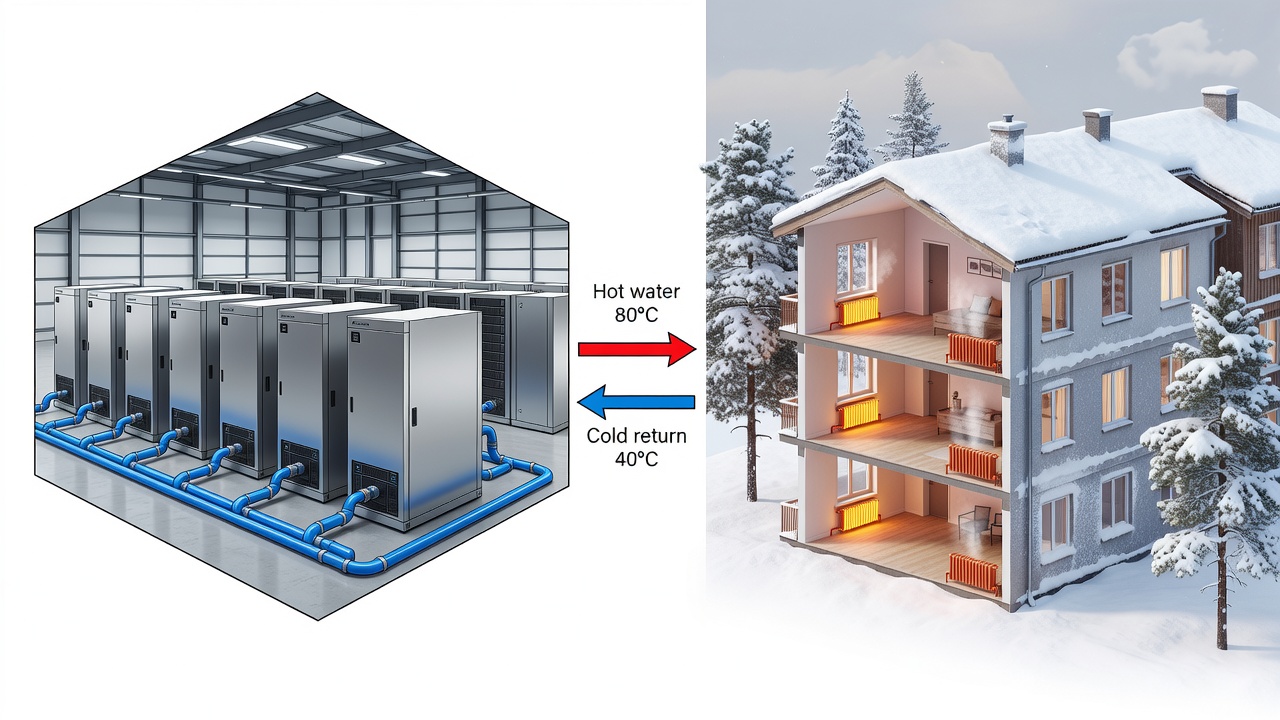
Traditional air-cooled ASICs dump heat into the atmosphere via fans -- that energy is simply lost. Canaan's Avalon A1566HA hydro-cooled miners work differently: instead of air, the chips are cooled by water, which heats up to approximately 80 degrees Celsius.
That temperature range is directly compatible with existing district heating infrastructure. The hot water feeds straight into residential heating networks -- just like output from a conventional boiler, except the heat source is bitcoin mining instead of gas or coal.
Project Parameters
| Phase | Units | Heating Capacity | Status |
|---|---|---|---|
| Phase 1 | 228 Avalon A1566HA | 2 MW | Operational, hot water delivered |
| Phase 2 | +692 Avalon A1566HA | +6 MW (8 MW total) | Ordered March 2026 |
At full deployment (8 MW), the system is designed to serve approximately 2,800 homes. The Nordic heating provider has not been named publicly.
A key technical advantage: the parallel architecture of many individual miners lets operators dynamically overclock or underclock each unit in real time, matching thermal output to shifting heating demand -- something centralized boilers cannot do as flexibly. The parallel design also reduces single-point failure risk.
Canaan's Vision: Heat as a Product, Not a Byproduct
"Heat reuse is no longer an ancillary byproduct of compute. It is central to building a more efficient, sustainable energy future, and a core part of how we think about system design at Canaan." -- CEO Nangeng Zhang.
For Canaan, the contract represents a strategic push beyond mining equipment into what the company calls 'energy-integrated compute infrastructure.' The hash-to-heat concept has circulated in the mining industry for years, but generating high-grade heat at commercial scale has been the barrier. The Nordic deployment marks documented proof that the barrier has been crossed.
What This Means for Miners
Hash-to-heat has three practical implications:
- New revenue stream: beyond block rewards, miners can sell heat to district heating operators, improving overall economics especially in cold climates.
- Energy efficiency: instead of 100% of input power becoming waste heat, up to 95% of that heat becomes useful output -- dramatically improving the energy utilization ratio.
- Grid relationships: municipalities that benefit from mining heat become stakeholders in mining operations, reducing regulatory friction.
While you explore new revenue streams, maximize your mining income with a low-fee pool: pool-btc.com -- 1% fee, daily payouts, profitability calculator.
FAQ
What temperature does the water reach?
Approximately 80 degrees Celsius with the Avalon A1566HA -- sufficient for standard district heating infrastructure.
Does hash-to-heat reduce mining profitability?
No. Mining runs normally. Heat sales to the district operator are an additional revenue stream on top of block rewards.
Can regular air-cooled ASICs do this?
Not directly: air-cooled ASICs cannot produce water at the required temperature. Hydro-cooled or immersion-cooled units designed for liquid output are needed, such as the Avalon A1566HA.
Is this possible at small scale?
Home-scale versions exist (Braiins covered 'hashrate heated houses'). Industrial hash-to-heat requires scale -- dozens of miners minimum plus an agreement with a district heating operator.