
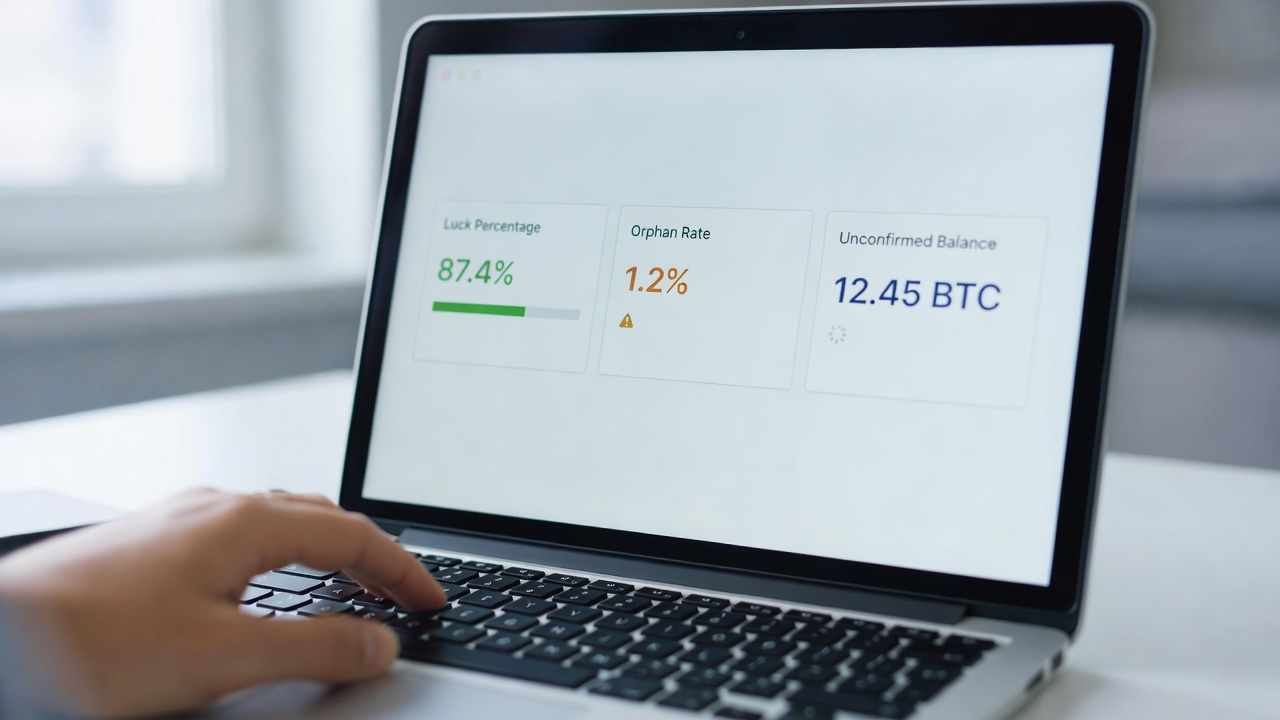
How to Read Mining Pool Stats: Luck, Orphan Rate, Unconfirmed
Opening a mining pool dashboard for the first time, it's easy to get lost among metrics with confusing names. We break down three indicators that most often scare beginners without reason, luck, orphan rate, and unconfirmed balance, and explain when you should actually worry.
Luck (Pool Luck)
Luck shows how fast or slow a pool finds blocks relative to the theoretical expectation at the current network difficulty. A value of 100% means the pool finds blocks exactly on schedule. A value of 150% means the pool is lucky, blocks are found faster than expected. A value of 70% means bad luck, blocks are found more slowly.
When to worry: short-term luck fluctuations (hourly, daily) are statistical noise, not a signal of pool trouble. If luck stays below 80% for several weeks straight on a large pool, it's worth a closer look, but it's still more often coincidence than a real problem.
Important: on PPS+ and FPPS schemes, pool luck doesn't affect your income, the risk of bad luck sits with the pool. On PPLNS, pool luck directly affects your daily income.

Orphan Rate
Orphan rate is the percentage of blocks found by the pool that didn't make it into the main blockchain (rejected by the network in favor of a competing block found around the same time). This happens due to delays in block propagation across the network.
Normal range: large pools with good infrastructure typically keep orphan rate below 1-2%. Values consistently above 3-5% may indicate issues with the pool's network infrastructure.
What it means for miners: on PPS+/FPPS schemes, orphan blocks don't affect your payout, the pool absorbs that risk. On PPLNS, a high pool orphan rate can theoretically slightly reduce miners' overall income.
Unconfirmed Balance
This is income earned but not yet paid out, it appears in your stats immediately after being credited, but becomes withdrawable only after reaching the payout threshold and usually a short delay for blockchain transaction confirmation (typically 1 to several dozen confirmations depending on pool policy).
When to worry: if unconfirmed balance keeps growing but never moves to confirmed/paid for several days after hitting the payout threshold, that's a reason to contact pool support. Otherwise, a delay of a few hours is normal blockchain behavior.
Other Metrics Worth Watching
- Hashrate (5min / 1h / 24h) - short-term spikes are normal, the 24-hour average's stability matters more
- Workers online - if the number of active workers drops unexpectedly, check your hardware connection, not the pool's stats
- Difficulty (share difficulty) - not to be confused with network difficulty; this is an internal pool parameter controlling how often shares are submitted
If you're still choosing between pools and payout schemes, see our FPPS vs PPLNS vs PPS+ breakdown and full pool selection guide.
To check whether your actual income matches expectations at current network difficulty and your hardware, use our mining profitability calculator.
Frequently Asked Questions
Why does pool luck change every day?
Finding a block is inherently a random process (Bitcoin uses proof-of-work). Short-term luck swings in both directions are statistical normal, not a sign of trouble.
Does orphan rate affect my payout directly?
On PPS+ and FPPS, no, the risk sits entirely with the pool. On PPLNS, potentially yes, but the effect is usually minimal below a 2% orphan rate.
How long should I wait for unconfirmed balance to pay out?
Depends on pool policy, usually a few hours to a day after reaching the payout threshold. If the delay exceeds several days, contact support.