

When a mining pool shuts down or goes bankrupt: what happens to your balance
Within three weeks last summer the industry produced two very different scenarios. On 2 July 2026 SBI Crypto announced it was closing its pool. On 22 July 2026 Poolin filed for bankruptcy. Both hit miner money, but the mechanics differ so much that treating them as one story will mislead you.
POOL BTC is not a pool. It is an independent comparison site. What follows is what open sources actually say, and what they honestly do not.
What happens to your balance when a pool closes?
In an orderly shutdown the balance normally gets paid out. The pool sets a date, stops accepting shares, runs a final settlement and sends coins to the addresses on file. Bankruptcy works differently. Your balance becomes a claim against the company, you join the creditor queue, and you receive a fraction of whatever the court manages to distribute.
The difference has nothing to do with pool size or reputation. It comes down to whether the operator still has money when the exit begins. SBI Crypto closed a working service by owner decision. Poolin stopped withdrawals because the money was not there, and that has been running since September 2022.
Shutdown versus bankruptcy
| Parameter | Planned shutdown | Bankruptcy |
|---|---|---|
| Who decides | The pool operator | The court, on a filing by the company or its creditors |
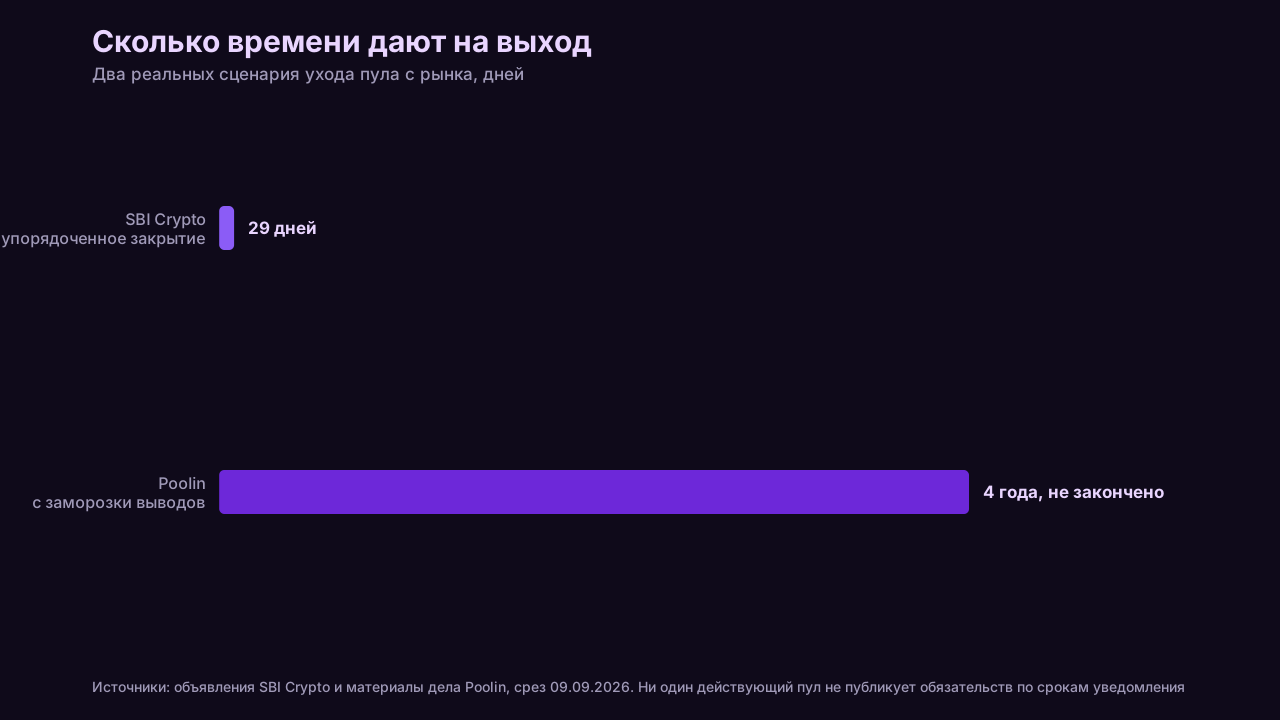
| How much time | Whatever the pool announces. SBI Crypto left roughly four weeks between the 2 July 2026 notice and closure on 31 July 2026 | No timeline. Poolin went from frozen withdrawals in September 2022 to a Chapter 11 filing on 22 July 2026, and the case is still open |
| Your balance | Final settlement, paid to your address | A creditor claim in the general pool, partial recovery |
| Where to go | Pool support, before the deadline | The bankruptcy process, through the court and appointed representatives |
| Odds of full recovery | High, though no public post-closure report on SBI could be found | Low. Poolin's proposed 52 million dollar Texas asset sale works out to roughly 32 cents on the dollar, before administrative costs |
The SBI Crypto case: what a clean exit looks like
SBI Crypto announced closure on 2 July 2026, with 31 July as the shutdown date. At the time of the announcement the pool held 2.2% of the network, or 20.9 EH/s. Share submission stopped at 22:00 UTC on 30 July, and anything sent after that missed the final settlement. The pool named three migration targets outright: Luxor, Braiins and NeoPool.
One caveat keeps this from being a tidy success story. No public confirmation exists that every client actually received their balance in full. There is guidance to keep mining until the deadline, and there is no follow-up report on how settlement ended for customers.
The four weeks SBI gave often get retold as an industry norm. They are not. They are a single observed precedent. None of the active pools checked (F2Pool, ViaBTC, AntPool, Braiins, Luxor, Foundry, Binance Pool) publishes a term promising notice of N days before shutting down a service. Nobody commits to that.
The Poolin timeline: why this can run for years
September 2022. Poolin suspends withdrawals from its wallet service, citing liquidity problems, and issues IOUs. Obligations total 163.7 million dollars across roughly 11,700 customers.
22 July 2026. The company and two of its US affiliates file for Chapter 11 in New Jersey.
Summer 2026. A stalking horse sale of two West Texas sites is proposed for a combined 52 million dollars. Against the IOU total that comes to roughly 32 cents on the dollar, before administrative costs and priority claims are taken out.
10 and 18 September 2026. An auction and a sale hearing are scheduled. Neither had taken place when this piece was written, the final recovery percentage is unknown, and the 52 million figure is an opening bid rather than a settled number.
Four years between the freeze and the filing. That is the lesson of the case: money sitting on a pool balance is not frozen for a week, it can stay out of reach longer than an ASIC generation stays profitable.
Two similar sounding events deserve separating. Slush Pool became Braiins Pool: rebrand announced in 2019, name change effective in 2022. Old URLs kept working and operations never stopped. That is a new sign over the door, not a closure, and it does not belong in the same category as SBI or Poolin.
As for BTC.com, no direct confirmation of a full pool shutdown during 2024 to 2026 could be found either way. Saying so plainly beats guessing on behalf of the sources.
What pool terms actually say about forfeited balances
Very little. Of twelve pools checked, exactly one publishes an explicit legal rule. F2Pool's terms state that if a valid payout address is not provided within six months of written notice, the user loses rights to accrued rewards and the pool may treat them as Forfeited Rewards. A softer rule sits alongside it: if no payout address is set for 90 days or more, rewards may be treated as a donation.
The other eleven pools have no comparable published rule. That does not mean no rule exists. It means none is published, and at the moment of closure the operator interprets the situation, not you.
Why a low payout threshold works as insurance
The arithmetic is blunt. Whatever sits on the pool's balance is what you lose fully or partly in a bad scenario. Whatever already reached your wallet is not at risk at all. The payout threshold decides how much money is exposed on average.
Thresholds vary wildly between pools. In our pool comparison the spread runs roughly a hundredfold, from 0.0001 BTC at some venues to 0.01 BTC at others. The same hashrate under a high threshold leaves two orders of magnitude more money on someone else's books and simply waits longer for release. To see how much accumulates between your own payouts, run the numbers in the mining calculator; typical crediting times are collected in the payout time section.
The full cost of switching is not just the fee percentage. There is a separate breakdown of what a migration itself costs you: the real price of changing pools.
Warning signs you can spot early
No open source offers a list of "signs of coming bankruptcy" verified after the fact. So what follows is limited to things observable from your side, and each one calls for a check rather than panic.
- Payouts arrive later than the usual schedule, with no explanation.
- Withdrawal terms shift: the threshold rises, a new fee appears, manual approvals show up.
- Worker or revenue statistics vanish, pages return errors.
- Support stops answering, or answers with templates and no specifics.
A single glitch is ordinary service life. Two or more of these overlapping for weeks is reason enough to cut your pool balance to a minimum and confirm the backup slot actually works.

Preparation checklist
- Configure a backup pool in advance, in the second and third ASIC slots. How failover works and how to verify switching is covered in backup pools and failover ``.
- Do not let the balance accumulate. Set the payout threshold to the lowest your pool offers.
- Verify the payout address: valid, yours, keys in your hands. The F2Pool six month rule exists precisely for this failure mode.
- Keep screenshots of accruals and payout history. A creditor claim in bankruptcy needs something to stand on.
- Test the second pool with real hashrate, even a few hours of it. A config slot that has never accepted a share is a line of text, not a backup.
The first 24 hours after a closure announcement
- Find the official notice on the pool site rather than a news retelling. Record two dates: the share submission deadline and the service closure date. At SBI these were different moments, and the gap decided whether a miner made the final settlement.
- Check your current balance and payout address in the dashboard. If the address is empty or stale, fix that before anything else.
- Lower the payout threshold to the minimum available, if the pool allows it.
- Request a withdrawal of the available amount instead of waiting for the automatic cycle.
- Do not power down before the share deadline if the pool promises a final settlement. Shares sent after the cutoff do not count toward it.
- Prepare and test the destination pool before the deadline: stratum address, workers, threshold, payout address.
- Save screenshots of the balance, the accruals and the notice text as of the announcement date.
- Move hashrate after the cutoff rather than in the middle of a panic, and confirm shares are landing at the new venue.
In short
A planned shutdown is a logistics problem measured in weeks. A bankruptcy is a creditor queue measured in years, with partial recovery at the end. You cannot know in advance which one you will get. You can, at any moment, reduce how much of your money sits on someone else's balance. That part of the picture is the one a miner controls.
This article contains referral links to mining pools (marked as sponsored). We may receive a reward if you register through them. This does not change the figures or the order of rows in the tables: the terms are taken from the pools' official pages.