

Bitcoin mining difficulty: what it is and how it hits your mining profit
On 5 September 2026 Bitcoin difficulty rose 1.31% to 127.45 T at block 965,664, the eighth increase of the year (Luxor, Hashrate Index, KuCoin; figures unchanged in our news digests from 06.09 to 13.09.2026). CoinWarz expected the next retarget around 19 September at about 130.53 T, or +2.42%. Your ASIC will hash exactly as before. It will simply earn less BTC for it.
This piece is about what that means for your money: how much a given percent of difficulty takes from daily income, how to build difficulty growth into a payback plan, why a halving is a different kind of hit, and why switching pools does not help. The mechanics of forecasting the next adjustment from block times are already covered in our difficulty and hashprice guide. Here we only use them as the starting point.
Summary for the impatient
- Income in BTC is inversely proportional to difficulty. A rise of X takes X / (1 + X) of revenue: +2.42% takes 2.36%, +10% takes 9.09%.
- Your power bill does not retarget, so the whole hit lands on margin. Near breakeven one retarget can wipe out most of your profit.
- A payback plan built on today's difficulty is optimistic by construction. Apply a growth multiplier to the output of the profitability calculator.
- A halving is equivalent to difficulty doubling overnight. Retargets are small, but they add up.
- The pool does not change the expected effect of difficulty. It changes only the variance of payouts and the fee.
What is Bitcoin mining difficulty and why does it retarget every 2016 blocks?
Difficulty is the number that sets how many hashes, on average, the network needs to find one block. Every 2016 blocks, roughly two weeks, nodes compare how long that window actually took against the 20,160 minute target and rescale difficulty so blocks keep arriving about every ten minutes, whatever the total hashrate is.
Without the retarget, every new batch of machines would speed up block production and issuance. With it, issuance stays on schedule and the extra hashrate only raises the bar for everyone. One retarget cannot move difficulty more than a factor of four in either direction, and it lands on a block height, not on a calendar date.
The full procedure for estimating the next adjustment yourself, with the formula based on the average block interval, is in the difficulty and hashprice guide.
How is difficulty connected to hashrate and hashprice?
Difficulty follows network hashrate with a lag of up to two weeks. Hashrate grows, blocks come faster, the next retarget raises difficulty. Hashprice, the daily revenue per PH/s, sits on the other side: difficulty is in its denominator, so at a fixed BTC price and block reward, higher difficulty means proportionally lower hashprice.
The three figures do not move in lockstep, and September 2026 shows why. According to AInvest (12.09.2026), network hashrate fell to 853 EH/s on 7 September and recovered to 915 EH/s the next day, around 20% below the October 2025 peak of 1.15 ZH/s. Difficulty stayed at 127.45 T through all of it, because it only reacts at the retarget.
Hashprice moved on its own axis, driven by the BTC price. Luxor put the August 2026 average at $34.63 per PH/s per day, 32% below the 2025 average of $50.68, and the reading on 09.09.2026 at $38.96 (both via our news digests of 11.09 and 13.09.2026). What hashprice is and how to use it for a profit estimate is covered in the hashprice explainer.
| Metric | What it measures | When it changes | What moves it |
|---|---|---|---|
| Network hashrate | Total computing power of all miners | Continuously, estimated from block times | Machines switching on and off, curtailment, new hardware |
| Difficulty | How hard it is to find a block | Once every 2016 blocks | Hashrate over the previous window |
| Hashprice | Revenue per PH/s per day in USD or BTC | Continuously | Difficulty, BTC price, block reward, fees |
How much BTC per day do you lose when difficulty rises X percent?
At the same hashrate, BTC income changes by exactly minus X / (1 + X) when difficulty rises by X. A 2.42% retarget takes 2.36% of BTC per day, a 5% one takes 4.76%, a 10% one takes 9.09%. The loss is always slightly smaller than the rise, but net profit falls much further.
The expected number of blocks a machine finds per day is its hashrate in hashes per second times 86,400, divided by difficulty times 2 to the power of 32. Multiply by the block subsidy of 3.125 BTC and you get gross income before the pool fee and without transaction fees.
Worked example for 100 TH/s:
- At 127.45 T (after the 05.09.2026 retarget): 100 × 10^12 × 86,400 / (127.45 × 10^12 × 2^32) = 0.0000158 blocks a day.
- Times 3.125 BTC gives about 4,932 sats a day of gross subsidy.
- At the forecast 130.53 T: about 4,816 sats a day, 116 sats less, or minus 2.36%.
| Difficulty change | BTC income change at the same hashrate |
|---|---|
| -5% | +5.26% |
| +1% | -0.99% |
| +1.31% (retarget of 05.09.2026) | -1.29% |
| +2.42% (CoinWarz forecast for ~19.09.2026) | -2.36% |
| +5% | -4.76% |
| +10% | -9.09% |
This is pure protocol arithmetic. It does not include the pool fee, transaction fees or the BTC price, which scales the dollar value of the whole column. Forecasts also move: on 14.09.2026, with 64.68% of the epoch mined, mempool.space already estimated the next retarget at +4.20% at block 967,680 around 19.09.2026, which means minus 4.03% of BTC per day. The actual value will only be known after that block.
How do you build difficulty growth into an ASIC payback calculation?
Replace today's income with a declining series. Pick an assumed average difficulty growth per retarget g, divide each next epoch's revenue by (1 + g), subtract the fixed power bill for each epoch, and add the epochs up until the sum covers the hardware price. If net income reaches zero first, the machine never pays back.
The profitability calculator takes network difficulty from mempool.space at its current value and does not project growth. That is honest for today's income and optimistic for a year-long plan. A sequence that works with any calculator:
- Get today's daily revenue for your machine and pool from the calculator, before electricity.
- Choose several growth scenarios g per retarget. Do not take one "most likely" value, take a range.
- Revenue in epoch n equals today's revenue divided by (1 + g) to the power of n. Electricity stays the same in every epoch.
- For each epoch, multiply daily net income by 14 days and add it to a running total.
- Payback is the epoch where the running total passes the hardware price plus delivery and setup. If daily net income turns negative earlier, write down "does not pay back at this g".
- Run the same table at a lower BTC price. Price and difficulty compound each other.
What the growth assumption does to revenue, in pure arithmetic (the g values are hypothetical inputs, not a forecast):
| Assumed growth per retarget, g | Revenue after 13 retargets (~6 months) | Revenue after 26 retargets (~1 year) | Average revenue over the year, % of today |
|---|---|---|---|
| 0% | 100% | 100% | 100% |
| 1% | 87.9% | 77.2% | 88.6% |
| 2% | 77.3% | 59.8% | 78.9% |
| 3% | 68.1% | 46.4% | 70.8% |
The last column is the useful one. Multiply your annual revenue from the calculator by it before you subtract electricity. At g = 2% the machine books about a fifth less revenue in its first year than a flat projection promises, and all of that comes out of the margin.
What g to use is not a question arithmetic answers. In 2026 difficulty has moved both ways: of the 18 retargets between 1 January and 8 September, 8 went up and 10 went down, from +14.73% on 19 February to -11.16% on 7 February (mempool.space, retrieved 08.09.2026). Over those 18 retargets difficulty went from about 148.25 T to 127.45 T, a compound average of roughly -0.84% per retarget. So a flat or even slightly negative g is a real 2026 scenario, not wishful thinking. It is still only one scenario: that same stretch was a hashprice slump, and a recovery brings idle machines back. The general payback method is in the ASIC payback period guide.

What hits income harder: a halving or a difficulty retarget?
A halving. It cuts the block subsidy from 3.125 to 1.5625 BTC in one block, which for a miner equals difficulty doubling overnight: minus 50% of subsidy income. A typical retarget moves income by a few percent. Retargets win only through accumulation, since there are about 26 of them a year.
The next halving is expected in April 2028 at block 1,050,000. Countdown sites disagree on the exact day by about ten days within April, because they project from the current average block interval (CoinGecko, NiceHash, CoinWarz, Blockchair, retrieved 02.09.2026).
| Difficulty retarget | Halving | |
|---|---|---|
| How often | Every 2016 blocks, about 26 times a year | Every 210,000 blocks, about once every four years |
| Size of the effect | Usually a few percent, capped at a factor of 4 | Exactly minus 50% of the subsidy |
| Direction | Up or down | Down only |
| Predictability | Estimated from block times inside the epoch | Block height known years ahead |
| What follows | Nothing, until the next retarget | Loss-making hardware goes offline, and later retargets can come down |
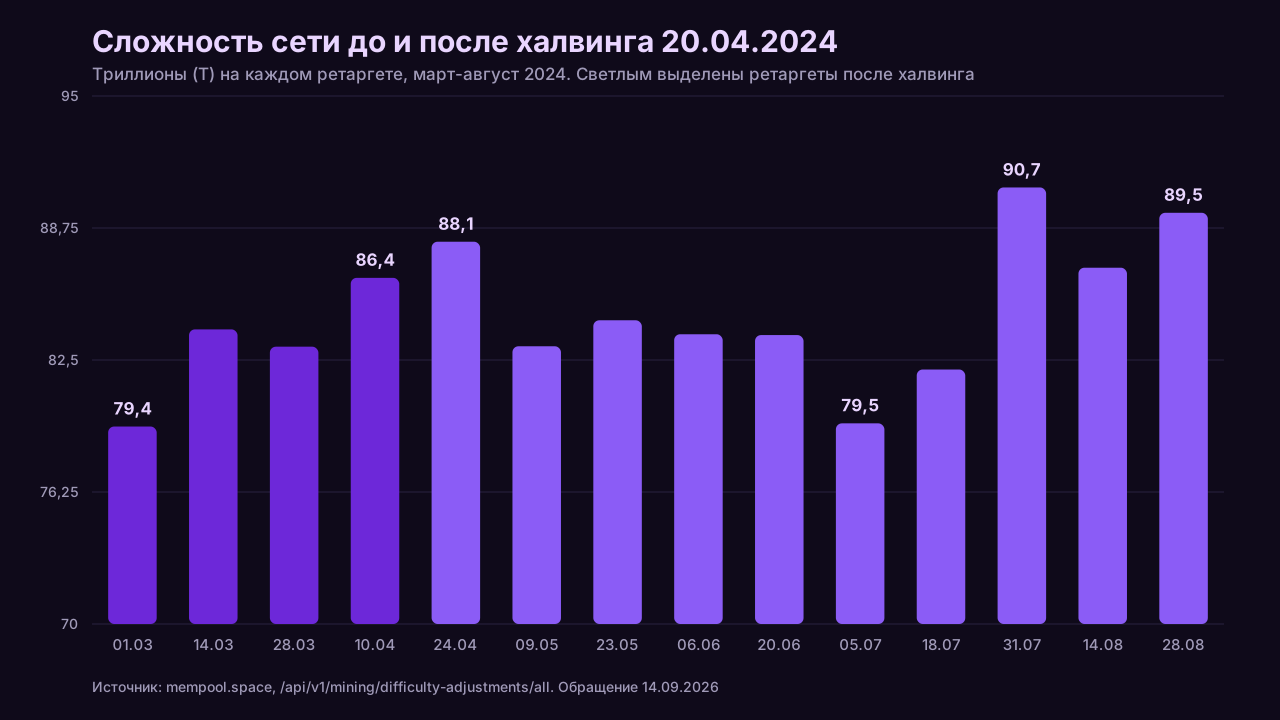
The two interact. After a halving, machines whose shutdown price falls below the operator's tariff switch off, hashrate drops, and subsequent retargets move difficulty down, partly offsetting the halving for those who stay. After the halving of 20.04.2024 that is what happened, but modestly: from 88.10 T at the first retarget after it (24.04.2024) difficulty fell to 79.50 T by 05.07.2024, minus 9.8%, while monthly average network hashrate went from 623.71 EH/s in April to 584.12 EH/s in June, minus 6.3%. By 31.07.2024 difficulty was already 90.67 T, above its pre-halving level (mempool.space, retrieved 14.09.2026). A 10% offset against a 50% cut in subsidy. How much it offsets cannot be known in advance, so a plan that crosses April 2028 should carry a separate post-halving scenario.
Why can difficulty fall, and is a drop good news for a miner?
Difficulty falls when the previous 2016 blocks took longer than 20,160 minutes, meaning part of the hashrate went offline. For a miner who stayed on, a drop raises BTC per day: a 5% decline adds 5.26%. But the reason for the drop is usually low hashprice, and that same reason squeezes everyone's margin.
The typical triggers are machines switched off as unprofitable, seasonal curtailment and large sites going offline. Luxor's report of 08.09.2026 estimated idle ASIC capacity at about 235 EH/s (unprofitable, deliberately curtailed, in transit or under repair) against about 1,150 EH/s of total installed capacity (via our digest of 10.09.2026). The same report named the end of the summer curtailment window in Texas as a reason some capacity could come back.
That is the other side of a drop. Idle machines are a reserve that returns once hashprice recovers, and its return raises difficulty again. So a favourable retarget is a window, not a new baseline, and a payback plan should not be rebuilt around it. How the 2026 drops played out is in our piece on the June 2026 difficulty drop.
Where can you see the forecast for the next retarget?
The fastest route is the difficulty page: current difficulty, the forecast for the next adjustment and a 12-month chart in one place. For cross-checking, mempool.space shows the epoch progress and estimated change, and CoinWarz publishes the expected date and value of the next retarget.
Forecasts early in an epoch are noisy, because block discovery is random and a short run of fast blocks says little about the trend. By the middle of the epoch the estimate is far more stable. It is worth knowing that sources differ: on 12.09.2026 CoinWarz gave +2.42% for ~19.09, while mempool.space on 08.09.2026, with 20.63% of the same epoch mined, estimated +6.58%. The difference comes from how much of the epoch was already mined.
A sensible routine: look once mid-epoch, once a day before the retarget, and after the retarget update the growth assumption in your own payback table.
Does your choice of pool change how difficulty affects income?
No. Your expected income is your share of network hashrate times the block reward, and a pool cannot change that share. Difficulty cuts expected BTC per day equally at every pool. A pool changes only two things: how evenly the income arrives (variance) and how much of it it keeps (fee and payout scheme).
It helps to separate expectation from variance. Expectation is the average income over a long period. Variance is how far a particular day's income deviates from that average. A solo miner with 100 TH/s has the same expectation as a pool member with the same 100 TH/s, about 4,932 sats a day of gross subsidy at 127.45 T, but in practice gets either nothing or a whole block. A pool smooths that out and charges a fee for it.
Which is why "my income dropped, time to switch pools" is usually the wrong conclusion. First check whether a retarget happened. If income fell by about the same percentage as difficulty rose, the pool is not the cause. What a pool does control, the fee and the FPPS or PPLNS scheme, is easy to compare side by side in the FPPS vs PPLNS calculator. The gap can be large even inside one pool: according to its official help pages, F2Pool charges 4% on FPPS, 2.5% on PPS+ and 2% on PPLNS, and ViaBTC 4% on PPS+ and 2% on PPLNS (POOL BTC check of 29.08.2026). Some large pools, AntPool and Binance Pool among them, keep no public fee page.

How does rising difficulty push old ASICs to shutdown?
Every retarget lowers a machine's shutdown price, the electricity price at which revenue after the pool fee equals the power bill. The threshold falls by the same factor of 1 / (1 + X) as income. A machine whose threshold sits just above the operator's tariff crosses below it after a few retargets and has to be switched off.
How hashprice turns into profit for a specific machine is covered in the hashprice explainer. Here is what difficulty does to it, on an older-generation machine.
AInvest (13.09.2026) described the S19 Pro as a machine of about 29.5 J/TH that works at breakeven or at a loss. Take hashprice at $38.96 per PH/s per day (Luxor, 09.09.2026) and a 2% pool fee as a parameter, not as any specific pool's rate:
- Shutdown price: 38.96 × 0.98 / 24 / 29.5 = $0.0539 per kWh.
- After the forecast +2.42% retarget at the same BTC price: 0.0539 / 1.0242 = $0.0527 per kWh.
- How many retargets until the threshold falls to a $0.05 tariff: ln(0.0539 / 0.05) / ln(1 + g). At g = 1% that is about 7.6 retargets, at g = 2% about 3.8.
In calendar terms, with a hypothetical 2% per retarget, that is under two months for a machine running on five-cent power, assuming BTC holds its price. That is how a generation leaves the network: each retarget takes a little, not one bad day. It is also why a used machine that looks cheap in a payback table needs a separate check against the difficulty growth scenario.
| Tariff compared with the machine's shutdown price | What to do |
|---|---|
| Tariff well below the threshold | Keep running, but recompute the threshold after every retarget |
| Tariff within a few retargets of the threshold | Plan the shutdown date and resale in advance |
| Tariff above the threshold | Switch off: every hour adds to the loss |
Common questions about Bitcoin mining difficulty and profit
How often does Bitcoin difficulty change?
Once every 2016 blocks. At a ten-minute average interval that is about every two weeks, but the actual date shifts: when hashrate grows, blocks come faster and the retarget arrives earlier, when hashrate falls it arrives later. Between retargets difficulty does not change at all, even if hashrate swings hard.
Why does my income fall when my hashrate is stable?
Because income depends on your share of network hashrate, not on your hashrate alone. After an upward retarget the same hashrate earns fewer blocks, and BTC per day falls by X / (1 + X). In dollars the BTC price layers on top. Check the retarget date before suspecting the pool or the hardware.
Should a payback calculation assume difficulty growth?
Yes, as several scenarios. A calculation at today's difficulty shows the best case for the first two weeks, not a year. Apply an average revenue multiplier for the assumed growth per retarget, keep electricity fixed, and check that the machine pays back in a conservative scenario as well.
Can a pool reduce the effect of rising difficulty?
No. Expected income is set by your share of the network, and it is the same at every pool. A pool affects only payout smoothness and its fee. A lower fee or a different payout scheme raises net income, but that effect is separate from difficulty.
Where do I check the next retarget forecast?
On the difficulty page, with cross-checks on mempool.space and CoinWarz. Treat early-epoch forecasts as a direction, not a number. The procedure for estimating it yourself from the average block interval is in the difficulty and hashprice guide.
What this article leaves out
The BTC price is held constant in all the tables, and in practice it moves harder than difficulty. Transaction fees, pool deductions, cooling, rent, repairs and resale value are not in the calculations. The difficulty growth scenarios are hypothetical inputs, not a forecast of the network.
---
POOL BTC is not a mining pool and does not accept hashrate. We compare other pools and services and turn their published terms into daily figures. The calculations here are approximate and are not financial advice.