
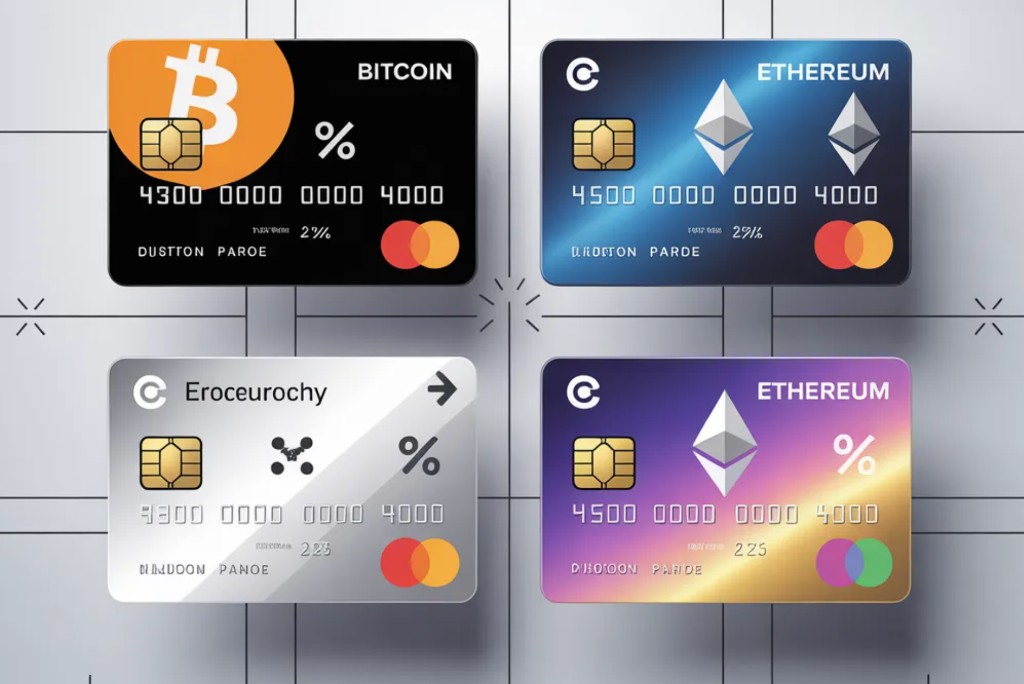
Best Crypto Cards 2026: Comparison of Binance Card, Crypto.com and Bybit
Crypto cards allow you to spend Bitcoin and other cryptocurrencies in physical stores and online through the Visa/Mastercard network. Conversion occurs automatically at the time of payment. Key players in 2026: Binance Card, Crypto.com Visa, Bybit Card and Nexo Card. The choice depends on the cashback, fees, limits and availability in your country.
Short:Crypto.com Visa gives up to 5% cashback in CRO with a stake of $4,000+. Binance Card - up to 8% cashback in BNB when staking 100+ BNB. Bybit Card - no stake, 1-3% cashback. For most users, the optimal option is without a mandatory stake with a 1-2% cashback.
Comparison of top crypto cards 2026
| Map | Cashback | Min. steak | Withdrawal limit/day | Availability |
|---|---|---|---|---|
| Binance Card (Visa) | 0.1-8% in BNB | 100 BNB (~$60K) | $2,000 | 50+ countries (no Russian Federation) |
| Crypto.com Visa | 0-5% in CRO | from $400 (Ruby) | $10,000 | 30+ countries |
| Bybit Card (Visa) | 1-3% in USDT | No | $2,000 | 40+ countries |
| Nexo Card | up to 2% in NEXO/BTC | No | $5,000 | 30+ countries |
| Wirex Visa | up to 2% in WXT | No | $3,000 | 60+ countries |
How does a crypto card work when paying?
The process is transparent to the seller:
- You pay by card in store or online
- The payment system (Visa/Mastercard) requests an amount in local currency
- The card provider converts the required cryptocurrency into fiat at the market rate
- The seller receives fiat, you spend crypto
Important: conversion occurs instantly, at the rate at the time of the transaction. In a volatile market, this can be either a plus or a minus.
What is staking for maximum cashback?
To receive increased cashback on Binance Card and Crypto.com Visa, you need to “freeze” platform tokens for a certain period:
- Binance Card: 8% cashback requires >100 BNB (~$60,000 at May 2026 exchange rate)
- Crypto.com Visa Jade: 3% cashback requires a stake of 10,000 CRO (~$600)
- Crypto.com Visa Obsidian: 5% cashback - stake 350,000 CRO (~$21,000)
For most users, a realistic cashback is 1-2% without large investments. More information about Binance Card - inoverview of cashback and limits.
How to choose a crypto card to suit your needs?
Scenario guidelines:
- Everyday Shopping Without Steak:Bybit Card or Nexo Card
- Maximum cashback with BNB:Binance Card (if you have 20+ BNB)
- Travel (multi-currency):Wirex or Crypto.com
- Russia and CIS:most maps are not available; current list - for each provider
Frequently asked questions about crypto cards
Is KYC required for a crypto card?
Yes, all legal providers require identity verification (passport + proof of address). Cards without KYC usually have very low limits (up to $200/day) or are fraudulent.
Is it safe to store money on a crypto card?
Keep only the current amount for expenses. Funds on the card are funds on the exchange, without state insurance. More details - inarticle about the security of crypto cards.
Is it possible to pay with a crypto card wherever Visa is accepted?
Yes, Visa cards are accepted in 200+ countries. The only limitation is the availability of funds on the card balance in supported cryptocurrencies. Read more aboutpayment at airports- in a separate guide.
How does a crypto card affect taxes in different countries?
Using a crypto card creates tax events that many users don't think about. In most jurisdictions, every card payment = sale of cryptocurrency:
| Country | Tax on crypto payments | Reporting threshold |
|---|---|---|
| Germany | 0% with retention 1+ year | Any amount |
| Portugal | 28% (short-term) | Any amount |
| UAE | 0% | No |
| Kazakhstan | 10% of growth | Any amount |
| Russia | 13-15% (cards not available) | - |
Practical advice: if you use a crypto card frequently, keep a transaction log (date, amount in crypto, exchange rate at the time of payment, amount in fiat). Most exchanges provide export of transaction history to CSV. In Germany, holding BTC for longer than a year is more profitable than spending “fresh” coins - there is zero tax on the gain. For miners who receive BTC regularly, it is recommended to consult a tax advisor on the FIFO/LIFO method when determining the basis. Current commissions for withdrawing BTC from pools (important for tax accounting) - onPOOL BTC.
Bottom line: crypto card as part of the mining ecosystem
The crypto card in 2026 is a mature product with real infrastructure. For the miner, it solves the problem of “how to spend BTC on regular purchases” without additional steps. The choice of card depends on your country of residence, preferred cashback currency (BNB, CRO, USDC) and the amount of daily spending. When spending $500+/month, the difference in cashback between cards can exceed $30-50/month - this is a real addition to profitability. To calculate total income (mining + cashback):POOL BTC.