
Mining Profitability in 2026: Real Numbers, Forecasts, and Strategies for Maximum Returns
Key takeaways
- The electricity breakeven threshold for Bitcoin mining in 2026 is no higher than $0.07/kWh when BTC trades from $100,000.
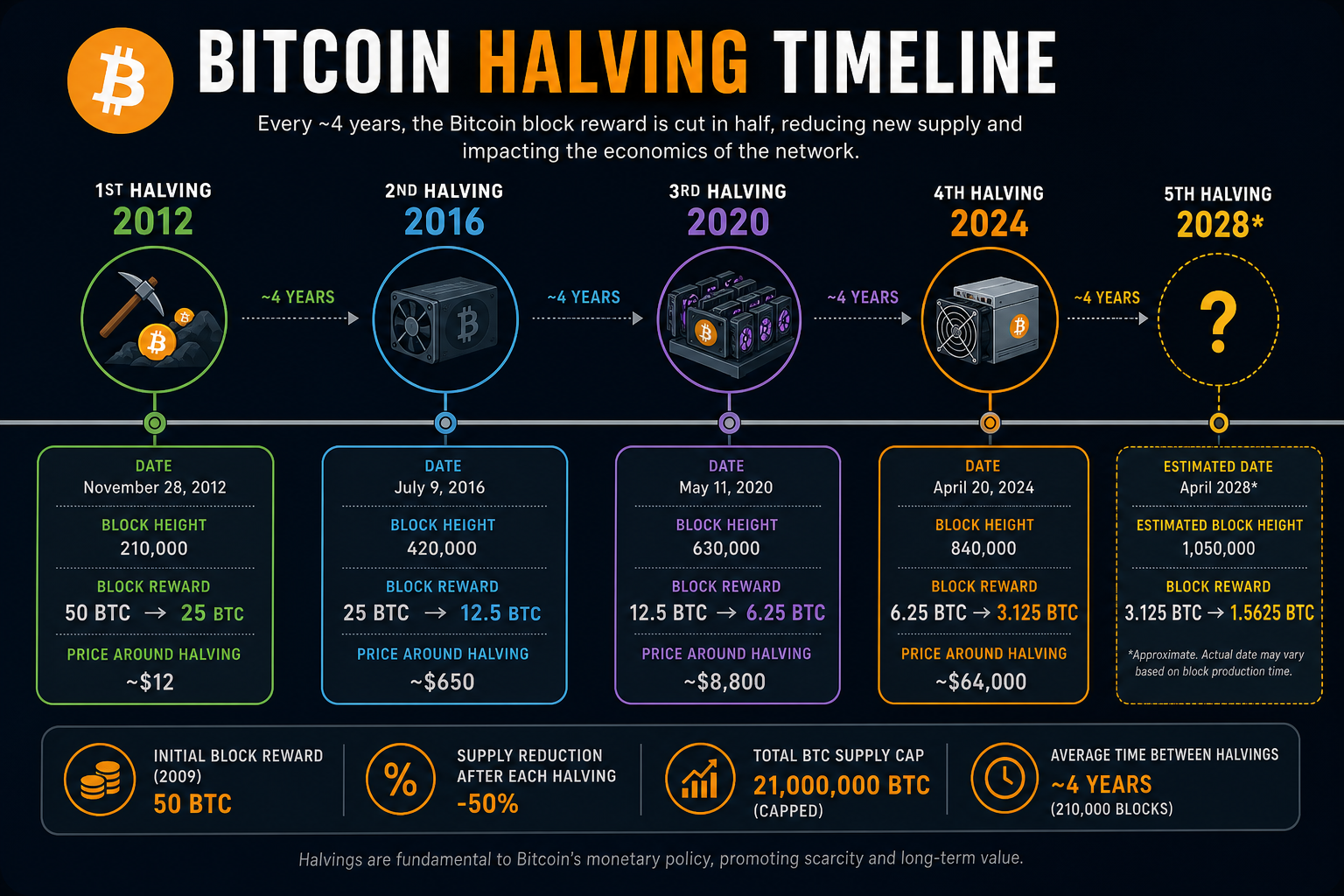
- The April 2024 halving cut the block reward from 6.25 to 3.125 BTC - structurally reshaping mining economics for every market participant.
- 2024-2026 ASIC generations at 15-17.5 J/TH are the only hardware class competitive at current network difficulty.
- Altcoins (Kaspa, Alephium) offer higher modeled ROI but carry elevated delisting and low-liquidity risk.
- Cloud mining: most platforms on the market are fraudulent schemes with no real hardware. Verify the provider against 7 red flags before signing a contract.
- Profit formula: net profit = mining revenue minus electricity, depreciation, taxes, pool fee, and logistics. Gross revenue differs from net profit by 40-60%.
- 2026 is a window to enter with electricity below $0.06/kWh and capital from $15,000 for professional-grade equipment. For everyone else, the competitive bar is high.
Why 2026 is a turning point for mining: context after the halving
The Bitcoin halving in April 2024 fundamentally rebuilt mining economics: the block reward was cut in half, forcing the industry through a harsh filter of participants. By 2026, network difficulty reached levels where the results of that restructuring are measurable - this is when you can objectively assess who remained, on what hardware, and at what cost base.
How the 2024 halving redistributed miner revenue
The block reward dropped from 6.25 to 3.125 BTC - the starting point for understanding everything that followed. At a Bitcoin price of $100,000 and ASIC consumption of 3,500 W, the electricity breakeven looks like this: $0.05/kWh - solid profit, $0.07/kWh - minimum viability, $0.10/kWh - operating loss for most models. After the halving, operators with tariffs above $0.09/kWh exited the market in large numbers - Hashrate Index data recorded an 18-22% decline in the share of small miners within three months after April 2024. Large data centers with industrial rates and new ASICs absorbed the freed market share. For them, BTC price growth in 2024-2025 fully offset the lower reward - payback on new equipment stayed within 10-16 months.
What changed in mining by 2026: key market shifts
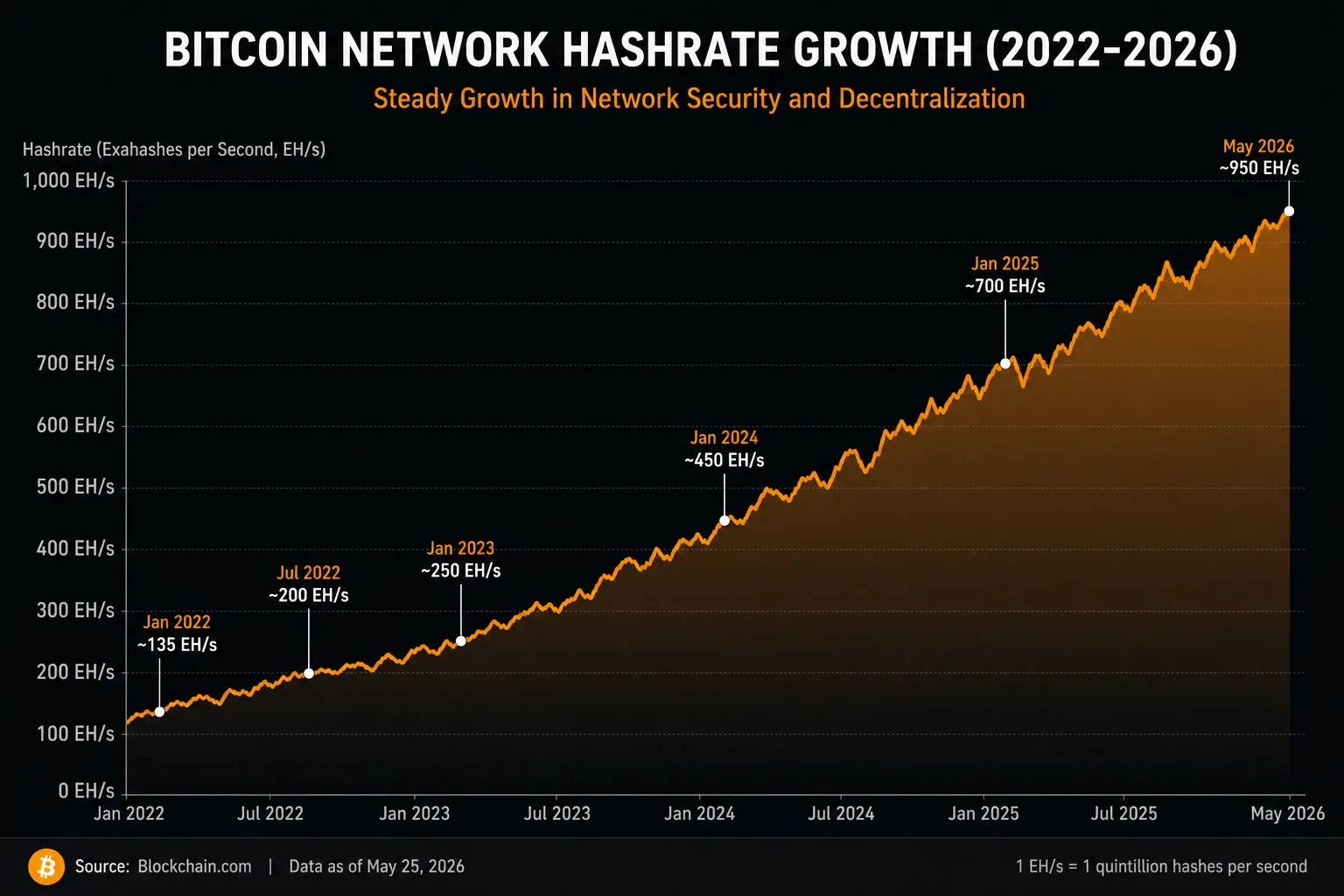
- Bitcoin network hashrate exceeded 600 EH/s - competition grew so much that revenue per 1 TH/s fell roughly 35% versus 2023.
- Institutional players - Bitdeer, HIVE Blockchain, Marathon Digital Holdings - now control more than 30% of network hashrate, which was unthinkable a few years ago.
- Industrial mining became the norm: the average size of a new farm launched in 2025-2026 is 50 ASICs or more.
- Bitmain and MicroBT hold more than 85% of the new-equipment market, and each new generation ships with a 15-20% efficiency gain.
- Infrastructure requirements rose sharply: without a stable internet link, backup power, and industrial-grade cooling, competing is practically impossible.
Bitcoin network difficulty dynamics by 2026: what the data show
Bitcoin network difficulty recalculates automatically every 2,016 blocks - roughly every two weeks. If hashrate rises, difficulty rises; if hashrate falls (for example after a sharp price drop or mass farm shutdowns), difficulty falls. This is a built-in self-balancing mechanism. By 2026 the difficulty growth trend is steady but predictable - Braiins and Mempool.space publish real-time data and support financial models with a projected difficulty adjustment. CoinWarz further translates that into profitability for specific hardware. Difficulty growth is a manageable variable, not a random risk. Cross-check assumptions with the POOL BTC calculator on the main page.
Factors that determine mining profitability in 2026
Mining profitability is driven by four variables: cryptocurrency price, electricity cost, equipment efficiency in joules per terahash (J/TH), and network difficulty. Understanding each is mandatory for a correct ROI calculation.
Cryptocurrency price in 2026: forecasts and scenarios
Standard Chartered analysts in 2024 cited BTC in the $150,000-$200,000 range by end-2025; JPMorgan’s base case pointed to $120,000-$150,000. These are analytical anchors, not guarantees - the distinction matters. For practical modeling, three scenarios work well. Conservative ($80,000): at $0.06/kWh and Antminer S21 (200 TH/s), monthly net profit is about $180-220. Base ($150,000): the same ASIC yields $500-650/month net. Optimistic ($200,000+): potential net profit exceeds $900/month per unit. Bitcoin remains the key pricing asset for mining, and the BTC rate directly drives payback - no optimization on other factors fully offsets a 50% price drop. This material is not financial advice; scenarios are for analytical modeling only.
Electricity: why it is the main cost line
Electricity is the only operating parameter a miner can deliberately control. At BTC $100,000 and an ASIC drawing 3,500 W, the picture by tariff looks like this.
| Rate ($/kWh) | ASIC power (W) | Cost/mo | Revenue/mo | Net profit/loss |
|---|---|---|---|---|
| 0.04 | 3500 | ~$100 | ~$420-504 | +$250-380 |
| 0.06 | 3500 | ~$151 | ~$504 | +$80-130 |
| 0.07 | 3500 | ~$176 | ~$504 | breakeven / thin margin |
| 0.10 | 3500 | ~$252 | ~$504 | loss after OPEX |
| 0.15 | 3500 | ~$378 | ~$504 | deep loss |
At $0.04/kWh (Kazakhstan, select Russian regions) monthly power spend is about $100, and net profit stays positive even at BTC $80,000. At $0.07/kWh you are in the balance zone with minimal margin. At $0.10/kWh the operation goes loss-making. At $0.15/kWh - deep negative territory. Among Russia’s most cost-effective regions by tariff: Krasnoyarsk Krai, Karelia, and the Far East. Internationally, Kazakhstan ($0.03-0.05/kWh), Iceland (~$0.04/kWh), and Texas during load-valley hours stand out.
Mining hardware 2025-2026: performance and efficiency
Efficiency gaps between ASIC generations critically affect payback. Antminer S19 runs at 29.5 J/TH - at current difficulty that hardware is unprofitable above roughly $0.05/kWh. Antminer S21 is 17.5 J/TH - materially better, viable up to about $0.07/kWh. 2025-2026 models from Bitmain and MicroBT reach ~15 J/TH and below, setting a new industry baseline. The key takeaway: J/TH, not absolute hashrate, defines unit economics. Older high-power gear is displaced by the market not by manufacturer choice but by economics.
Network difficulty and hashrate: how to forecast competition
The link is direct and unavoidable: higher network hashrate means higher difficulty and lower revenue per unit of compute. At 600+ EH/s and continued growth, revenue per terahash per second is down about 35% versus 2022. That is why solo mining in 2026 is economically non-viable: one Antminer S21 at 200 TH/s statistically expects a block on the order of centuries. A mining pool solves this by pooling hashrate. For live difficulty and forecasting use Braiins Pool, Mempool.space, and CoinWarz - all three are free and real-time. For your own farm inputs, also run scenarios in the POOL BTC calculator.
Which cryptocurrencies are most profitable to mine in 2026
The best coin to mine depends on three variables: available hardware, budget, and risk tolerance. Bitcoin is the liquidity benchmark; every other asset is judged relative to it.
Bitcoin in 2026: the flagship with a high entry bar
A concrete example: Antminer S21 (200 TH/s, 3,500 W), BTC $120,000, tariff $0.06/kWh. Expected monthly production - about 0.0042 BTC, or roughly $504 gross. Electricity - $151. Net profit before depreciation and tax - about $353/month. Payback on a $4,500 unit - about 13 months. BTC’s main edge over altcoins is liquidity: daily volume exceeds $20 billion, so mined coins can be converted without meaningful slippage. Bitcoin mining in 2026 is economically justified mainly for pool participants with access to industrial electricity rates. Model your case in the profitability calculator before buying hardware.
Litecoin and Dogecoin: a stable option via merged mining
Merged mining lets you mine two coins at once without extra computational work. A Scrypt ASIC (for example Antminer L9) mines Litecoin and Dogecoin in parallel: the same work counts in both networks. That shortens equipment payback via two revenue streams. Risk remains: LTC and DOGE market cap is far below BTC, so price volatility is higher. Combining revenue streams reduces dependence on a single asset - a fair argument for Scrypt hardware owners.
High-ROI altcoins: Kaspa, Alephium, Zephyr, and others
Kaspa (kHeavyHash algorithm) is the most discussed GPU- and ASIC-compatible altcoin of 2024-2026. Dedicated KAS ASICs (for example IceRiver KS3) earn roughly $8-15/day at $0.06/kWh, though the figure is highly coin-price dependent. Alephium (Blake3) is GPU-friendly with an active developer community; a 6×RTX 4070 farm earns on the order of $4-8/day. Zephyr uses RandomX+ and targets CPU/GPU mining. All three can show higher ROI than BTC for similar capital - but carry higher risk. Monero was delisted from Kraken in EEA countries in 2024 - a documented regulatory precedent for privacy-focused coins that must be weighed when choosing an asset.
Zcash and Monero: niche options with elevated risk
Monero uses RandomX, resistant to ASIC mining - production is on CPU and GPU. Yet delisting from Kraken and other exchanges in the European Economic Area severely limits exit routes for mined coins. Zcash suffers from high hashrate concentration in the Foundry pool - a centralization risk historically tied to payout instability. Both coins need a written exit strategy before mining starts and are not suitable for beginners.
Coin profitability comparison: summary table
Below is a comparison of key assets on parameters that matter to miners.
| Coin | Algorithm | Hardware | Profit ($/day) | Risk | Recommendation |
|---|---|---|---|---|---|
| Bitcoin | SHA-256 | ASIC | ~$15-22 net* | Low | Industrial rate, pool |
| LTC+DOGE | Scrypt | Scrypt ASIC | ~$8-14 | Medium | Merged mining |
| Kaspa | kHeavyHash | ASIC/GPU | ~$8-15 | High | Experienced miners |
| Alephium | Blake3 | GPU | ~$4-8 | High | GPU farms |
| Monero | RandomX | CPU/GPU | ~$2-6 | Regulatory | Exit strategy needed |
*Per one Antminer S21; figures depend on price and network difficulty.
For the Russian market with tariffs of 3-7 RUB/kWh and the current regulatory context, the best risk-return balance remains Bitcoin (with an industrial tariff) and the LTC+DOGE pair via merged mining. Kaspa suits those ready for altcoin volatility and with access to specialized ASICs.
How to calculate mining profitability: step-by-step methodology
The most common mistake is treating gross revenue as net profit. The gap is 40-60% depending on infrastructure - where most newcomers get disappointing results instead of expected ones.
Net profit formula for a miner: every cost line
Example: Antminer S21 (200 TH/s, 3,500 W), $0.06/kWh, BTC $120,000. Gross revenue - ~$504/month. Now subtract real costs.
- Electricity: $151/month (main cost).
- Pool fee: 1-2% of revenue, about $7-10/month.
- ASIC depreciation: at $4,500 and a 3-year useful life - $125/month.
- Tax (personal income or corporate): 13-20% of income depending on legal form - $65-100/month.
- Logistics and customs (buying ASIC from China): one-time $300-600, ~$8-17/month amortized.
- Ventilation and filtration: $10-30/month depending on scale.
- Internet: $5-15/month.
- Maintenance and unplanned downtime: 3-5% of revenue, ~$15-25/month.
- Spare-parts reserve: plan 5% of equipment cost per year.
Net profit after all lines - about $80-130/month per ASIC at these inputs. Tax authorities treat mining income as taxable, so tax is mandatory in the model, not optional. Use the POOL BTC calculator to sanity-check gross revenue against current difficulty and BTC price.
Best online mining calculators and how to use them
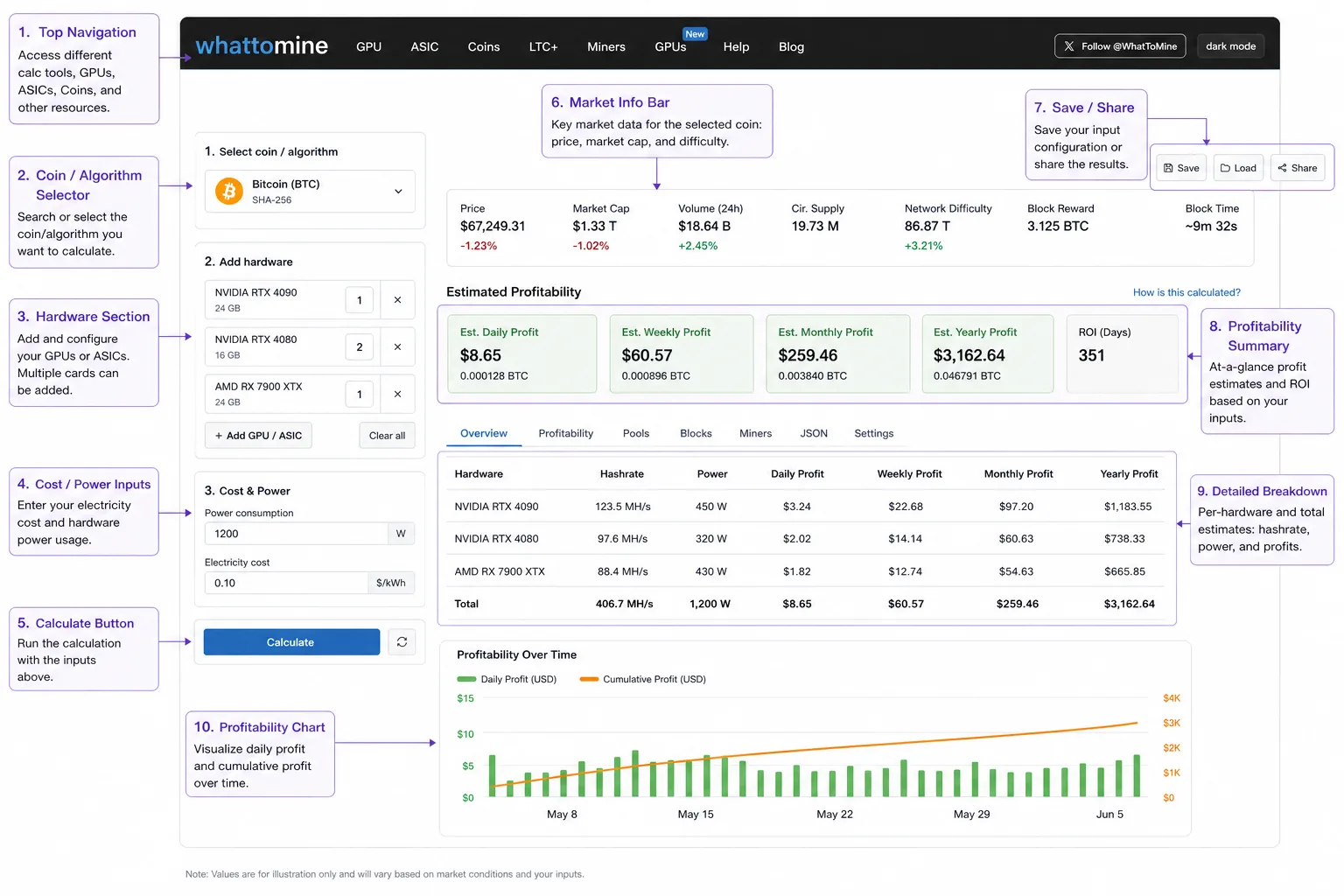
Important warning before any calculator: real hardware output is 3-7% below theoretical estimates due to stale shares, latency, and planned downtime. Build that discount into every model. Four key tools: WhatToMine - best for comparing many coins; AsicMinerValue - best for specific ASIC models; NiceHash Calculator - useful when selling hashrate on NiceHash; CoinWarz - good for quick live profitability checks. For BTC pool mining with your tariff and hashrate, the site’s POOL BTC calculator is the primary reference.
- Pick a specific ASIC model in the tool’s database.
- Enter your actual regional electricity rate.
- Set the target coin or run auto-select by profitability.
- Reduce stated hashrate by 5% for real-world output.
- Add tax, depreciation, and pool fee to costs - you get realistic net profit.
Typical mistakes when estimating mining returns
- Using today’s BTC price as a fixed constant → the model is too optimistic on any price drop or difficulty rise.
- Ignoring projected difficulty growth → after 6 months real returns are often 15-25% below entry-day estimates.
- Excluding ASIC depreciation → understates real costs by $100-150/month per device.
- Omitting tax → unaccounted payments cut net profit by 13-20%.
- Not counting pool or equipment downtime → overstates expected revenue by 3-7%.
Mining equipment in 2026: selection and payback
Energy efficiency in J/TH directly sets payback: the lower the number, the less you pay per satoshi mined at a fixed electricity rate.
Top ASIC miners 2025-2026: market overview
The ASIC market splits into three clear performance tiers.
- Entry tier (100-180 TH/s): Antminer S21 (200 TH/s / 17.5 J/TH / ~$4,500) - optimal entry choice, widely available, efficient enough up to ~$0.07/kWh.
- Mid tier (200-300 TH/s): Whatsminer M66S from MicroBT (~280 TH/s / 18.5 J/TH / ~$6,000-7,000) - solid for semi-pro farms of 5-20 units.
- Flagship tier (350-450 TH/s): Antminer S21 Pro (~350 TH/s / 15 J/TH / ~$8,000-9,500) and Avalon A1566HA (~185 TH/s) - for industrial operators on industrial tariffs.
Refurbished gear costs 30-50% less than new but carries shorter remaining life and often no manufacturer warranty. If buying used ASICs - demand runtime logs and run diagnostics before payment.
GPU mining in 2026: relevance and outlook
A straight comparison: a farm of 6×RTX 4070 at ~360 MH/s on Ethash draws about 1,200 W and costs ~$3,600. One Antminer S21 at 200 TH/s on SHA-256 draws 3,500 W and costs $4,500. On Bitcoin a GPU farm cannot compete with an ASIC - the performance gap is orders of magnitude. GPU mining’s niche in 2026 is kHeavyHash (Kaspa), Blake3 (Alephium), and decentralized compute networks like Iron Fish and Render Network. The latter open alternative monetization for GPUs beyond classic coin mining. GPUs remain a flexibility tool, not the core strategy for serious mining.
Economies of scale: how farm size affects profit
Profit per ASIC in large operations is 15-35% higher than home use - a documented market pattern, not marketing copy.
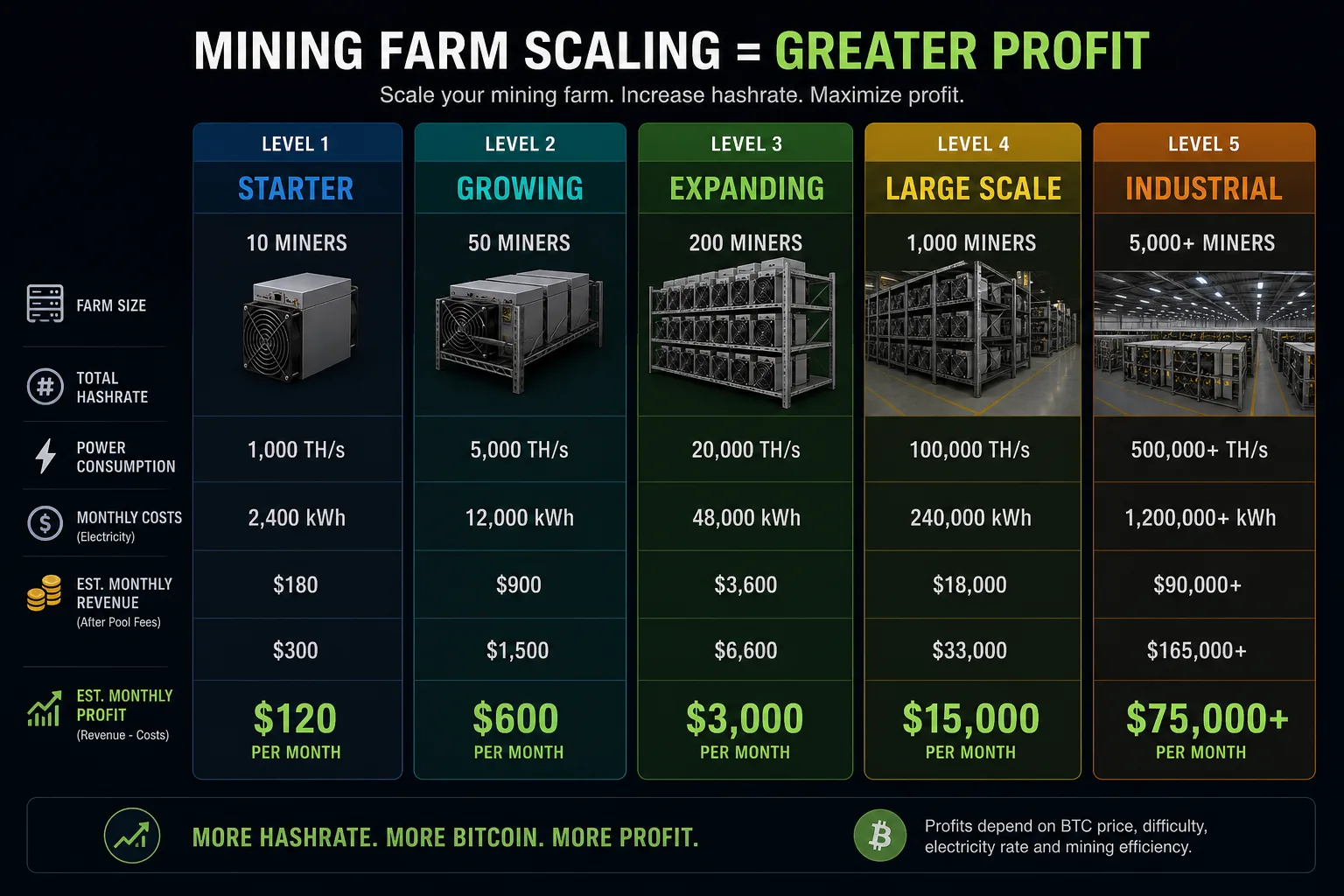
1-3 ASICs (home): tariff 7-9 RUB/kWh, margin per unit minimal or zero, high infrastructure loss from thermal throttling. 5-20 ASICs (semi-pro): dedicated feed possible at 4-6 RUB/kWh, margin rises to $80-150/unit/month at BTC $120,000. 50-100+ ASICs (industrial data center): negotiated tariff 3-4.5 RUB/kWh, 24/7 service, thermal optimization - margin $150-250/unit. Electricity is the lever through which scale becomes profit: each RUB of tariff difference on 100 ASICs at 3,500 W saves about 252,000 RUB/month.
Mining equipment payback period: scenario analysis
- BTC $80,000, $0.07/kWh: Antminer S21 pays back in 22-28 months - marginal viability.
- BTC $120,000, $0.06/kWh: payback 12-15 months - base case for most professional operators.
- BTC $180,000, $0.05/kWh: payback accelerates to 6-8 months, though parallel difficulty growth partly offsets the price upside.
Important nuance: if BTC price doubles, payback does not halve - parallel hashrate and difficulty growth reduce revenue per TH/s. That is often underestimated in optimistic scenarios.
Home mining vs professional data center: comparison in 2026
By 2026 the profitability gap between home mining and colocation in a professional data center is large enough that format choice directly determines whether the operation survives - especially from 5 devices upward.
Why home mining loses competitiveness in 2026
Technical barriers: unstable residential voltage cuts ASIC hashrate by 3-8%; insufficient cooling adds another 5-10% from thermal throttling; accelerated wear shortens useful life from 3-4 years to 2-2.5. Financial barriers: residential tariff in Russia is 7-9 RUB/kWh versus industrial 3-5.5 RUB/kWh. For one Antminer S21 that is about 3,500-4,200 RUB/month more in power - critical when margin is $100-150. Net effect: home mining in 2026 is competitive only with a dedicated line and a preferential tariff - the exception, not the rule.
Advantages of a professional data center: numbers and reality
The tariff gap between a data center (5.5 RUB/kWh) and the residential grid (8 RUB/kWh) on 100 ASICs at 3,500 W each is about 630,000 RUB/month in savings - the price basis of the data-center effect. For one device the gap is ~6,300 RUB/month, which at current margins of $80-150 can flip the sign from negative to positive.
| Parameter | Home mining | Professional DC |
|---|---|---|
| Тариф | $0.10-0.13/kWh (residential) | $0.04-0.07/kWh (industrial) |
| Охлаждение / Cooling | Limited, overheating risk | 6-19°C, industrial |
| Hashrate stability | -5-15% | Maximum 24/7 |
| Maintenance | Self-service | 24/7 monitoring |
| ASIC lifespan | 2-2.5 years | 3-4+ years |
| Profitability | Often zero or loss | +15-35% per unit |
Professional data-center rooms hold 6-19°C - eliminating thermal throttling and supporting stable 24/7 hashrate. Additional benefits: round-the-clock monitoring, component replacement in hours not days, and 20-30% longer ASIC life from optimal temperature.
Immersion cooling: +5-20% to revenue
Three cooling types exist for ASICs. Air - standard for most farms, no special gear. Hydro - liquid heat exchanger, compatible with Antminer S21 Hydro and Whatsminer M53/M56s. Immersion - full board submersion in dielectric fluid, maximum efficiency. Immersion can overclock ASIC chips by 5-20% without heat degradation - a documented range, not a guarantee. Immersion infrastructure only pays back from ~50 ASICs upward: below that, capex exceeds the efficiency gain.
When a data center pays for itself
Example: the same ASIC at home throttles to 195 TH/s; in a data center with optimal cooling it delivers 210 TH/s. The extra 15 TH/s plus tariff savings (~$30-40/month) minus colocation (~$50-80/month). Math favors moving to a data center from 5+ ASICs: combined power savings and hashrate gain cover hosting and add 15-30% to net profit.
Strategies to increase mining profitability in 2026
Optimizing mining returns requires work on three fronts at once: lower electricity cost, higher equipment performance, and management of mined coins.
Where to find cheap electricity: jurisdictions and approaches
Tariff benchmarks: Kazakhstan - $0.03-0.05/kWh (industrial zones in northern Kazakhstan), Texas - off-peak night rates down to $0.02-0.04/kWh in demand valleys, Iceland - stable ~$0.04/kWh on geothermal. Russia: Krasnoyarsk Krai and Karelia offer 3-4 RUB/kWh for industrial consumers; the Far East - preferential rates in some special economic zones. Practically: from ~500 kW consumption there is a real chance to negotiate an individual tariff with local grid companies - standard industry practice, not an exception. Renewables (hydro, wind) cut tariffs and open access to “green” certificates that large institutional BTC buyers increasingly require from miners.
Firmware optimization and ASIC overclocking
ASIC firmware falls into three classes: stock - manufacturer default; optimized third-party (for example Braiins OS+) - fine frequency and voltage control; immersion - firmware for extreme low-temperature operation. Safe overclocking yields 3-8% more hashrate if you follow three rules: raise frequency gradually in steps of no more than 5%, maintain adequate cooling across the load range, use only verified firmware from official sources. Undervolting is an alternative: cut power draw 8-12% with minimal hashrate loss, improving J/TH without crystal degradation risk. Warning: unauthorized overclock voids warranty and accelerates chip wear - documented risk, not theory.
HODL vs immediate sale: managing mined coins
Miners who held mined BTC from early 2020 through end-2021 saw returns above 800% from the mining point. Miners who sold everything immediately had stable cash flow but missed much of the upside. Full HODL creates an operational problem: power, rent, and payroll must be paid regardless of price. Practical rule: sell 40-60% of production to cover current costs, hold the rest. In a prolonged bear market (BTC below $60,000 for more than 6 months), full HODL without reserves is equivalent to borrowing against losses - fundamental risk, not hypothetical.
Diversification: mining multiple coins
- Less dependence on one asset’s volatility - when BTC falls, altcoin mining may stay profitable.
- ASIC portfolio: majority of hashrate on BTC/LTC via SHA-256 and Scrypt, smaller share on new algorithms where compatible hardware exists.
- GPU portfolio: flexible switching among Kaspa, Alephium, and decentralized compute via NiceHash.
- NiceHash - automatic profit-switching: the platform routes hashrate to the most profitable coin in real time.
- Diversification reduces single-asset risk but does not guarantee higher total returns.
Cloud mining in 2026: an objective review
Cloud mining is a legitimate product category that has existed for more than a decade. It is also the segment with the highest concentration of fraud among all ways to participate in Bitcoin mining - documented fact, not editorial opinion.
How cloud mining works and who it suits
Legitimate cloud mining rents real compute from physical hardware in the operator’s data center. You pay for hashrate; the operator runs equipment and pays you a proportional reward minus margin. Fraud platforms work differently: no real hardware, payouts funded from new participants in a Ponzi structure until inflows stop. Net returns on legitimate cloud contracts are typically lower than owning hardware: operator margin (often 20-35%) absorbs much of the income. It suits investors who want mining exposure without managing physical infrastructure. Industry-known platforms for reference: NiceHash, Genesis Mining, Bitdeer.
How to avoid scams: 7 warning signs
- The platform does not publish a verifiable data-center address or proof of real hardware.
- Promises of fixed returns above market levels (for example “10% per month guaranteed”) - real mining cannot guarantee income.
- No transparent fee breakdown: no split for maintenance, power, and platform margin.
- Withdrawals require extra deposits or rising thresholds that never stabilize.
- Registration in a jurisdiction without oversight combined with no identifiable team.
- Aggressive referral payouts are the core business model - a pyramid signal.
- Platform age under 2 years with no auditable reporting or independent reviews.
Important: several platforms that once looked legitimate shut down and froze payouts - documented cases, not hypotheticals. Long track record does not guarantee a cloud provider will stay solvent.
Legal regulation of mining in Russia in 2026
From 2025, mining in Russia is a regulated activity: mandatory registration in the Federal Tax Service (FNS) registry, tax requirements, and territorial restrictions in 13 regions. Non-compliance directly hits the financial model through fines and equipment seizure risk - not an abstract legal issue but a payback input.
Main requirements under Russian mining law
Legal entities and individual entrepreneurs must register in the FNS miner registry and file monthly reports via the taxpayer portal. Individuals may mine without registering as an IE if electricity consumption stays within the limit set by the Russian government (under 2024-2025 rules the household threshold is 6,000 kWh per month). Cryptocurrency is legally defined as property, which sets taxation rules. Some Russian mining pools offer automated FNS reporting - a practical selection criterion, not marketing fluff.
Territorial restrictions: where mining is banned or limited
13 Russian regions have active mining restrictions. Buryatia and Zabaykalsky Krai have year-round bans linked to power-capacity shortages. Other regions impose seasonal limits during peak grid load. Before launching an operation, check current restriction status for your region on the official FNS site or the miner registry. Operating in a banned zone leads to equipment confiscation and administrative fines - documented enforcement, not theory.
Taxation of mining income: practical guide
Individuals pay personal income tax at 13% (income up to 5 million RUB/year) or 15% above that. Legal entities pay corporate tax at the standard 20% rate. A common misunderstanding: when tax arises. Under current FNS interpretation, income arises when cryptocurrency is received (at mining), not when it is sold. That means even a HODL strategy creates a tax obligation at mining time at market price on that date. Working with a tax advisor who specializes in crypto is practical advice. Include tax in the payback model from day one - it cuts net profit by 13-20%.
Mining risks in 2026: objective analysis
Any investment activity carries risk - this section’s value is specificity and completeness, not generic warnings.
Price volatility: how a BTC drop affects profitability
Pessimistic example: BTC $60,000, $0.08/kWh, Antminer S21 (200 TH/s). Gross revenue - ~$252/month. Electricity - $202/month. Result before depreciation and tax - ~$50/month, which does not cover full costs. There is an offset: when unprofitable miners exit en masse, network difficulty falls via difficulty adjustment - partially restoring returns for survivors. In December 2022, with BTC near $16,000, difficulty fell 7.3% in two weeks - a concrete historical example. Volatility is a manageable risk with reserves, not an uncontrollable catastrophe. Stress-test tariffs and BTC price in the POOL BTC calculator.
Equipment obsolescence: when an ASIC becomes unprofitable
ASIC efficiency versus the market average erodes about 5-10% per year - not in absolute specs but versus new Bitmain and MicroBT generations. Practical replacement rule: when your J/TH is 30%+ worse than current flagships, replacement economics turn positive. Example: Antminer S19 at 29.5 J/TH versus a 15 J/TH flagship - a 96% gap, long past replacement threshold. Antminer S21 at 17.5 J/TH versus 15 J/TH flagship - 17% gap, still competitive. Plan replacement cycles in the financial model from day one.
Regulatory and cybersecurity risks
China’s 2021 mining ban is the most studied regulatory precedent. Counterintuitive outcome: after Chinese miners left, network difficulty fell 28% and remaining operators temporarily earned ~40% more on the same hardware. Regulatory risk does not always mean loss - it means redistribution. Russia’s 13-region restrictions are current reality, not forecast. On security: two-factor authentication on all pool accounts, separate wallets for payouts, unique credentials per platform - baseline, not extra caution. Stratum v1 is vulnerable to job-substitution attacks; pools with Stratum v2 offer stronger protection.
- BTC price volatility → hold a reserve for 3-6 months of operating expenses.
- Network difficulty growth → upgrade when you hit the -30% J/TH threshold versus flagships.
- Regulatory change → monitor the FNS registry and regional restrictions quarterly.
- Pool account cyberattacks → 2FA, dedicated wallets, Stratum v2.
- Equipment obsolescence → planned replacement every 2-3 years.
- Cloud provider risk → verify against 7 signs before signing.
Should you start mining in 2026: forecast and recommendations
The answer depends entirely on your operation’s parameters - not general market mood or editorial opinion.
Three profitability scenarios for mining in 2026
- Optimistic (BTC above $180,000): below $0.06/kWh, Antminer S21 payback in 4-8 months. Recommended response: maximize hashrate, reinvest part of profit in new gear, partial HODL (40-60% of production).
- Base (BTC $100,000-$150,000): at $0.05-0.06/kWh, payback 10-18 months. Recommended response: cut cost via data center, diversify coins, sell 50-60% of mined BTC for opex.
- Pessimistic (BTC below $70,000): above $0.07/kWh the operation is loss-making. Recommended response: switch ASICs to alternate algorithms or pause until conditions recover. The 2024 halving historically preceded price upcycles 12-24 months later - a pattern from three cycles, not a forecast of a fourth.
Who mining suits in 2026: criteria and recommendations
Mining in 2026 is a fit for:
- Electricity below $0.06/kWh (or below 5 RUB/kWh in Russia).
- Starting capital from $15,000 for 3-5 current ASICs plus an opex reserve.
- Investment horizon of at least 18 months without critical liquidity needs.
- Ability to host in a professional data center or install a dedicated industrial power line.
- Understanding and compliance with FNS tax obligations.
Consider alternatives if:
- Available tariff is above $0.08/kWh (or above 7 RUB/kWh) - home mining in most Russian regions.
- Capital under $5,000 with no path to scale - weak economies of scale in a competitive market.
- Expecting payback in 3-6 months - unrealistic in the base scenario.
- No technical ability to maintain gear or access professional ASIC hosting.
- Your region is among the 13 with mining restrictions.
Frequently asked questions about mining profitability in 2026
- Is it worth starting to mine in 2026? With a tariff below $0.06/kWh, capital from $15,000, and a horizon of at least 18 months - yes, economics work in the base BTC scenario of $100,000-$150,000. With a home tariff above $0.08/kWh and no data-center access - breakeven is practically unreachable.
- How did the 2024 Bitcoin halving affect mining profitability in 2026? The block reward fell from 6.25 to 3.125 BTC. Inefficient operators left the market, hashrate dipped temporarily, and surviving miners with modern ASICs were compensated by BTC price growth in 2024-2025.
- How does electricity cost affect mining viability? It is the decisive parameter: a $0.04/kWh difference on one Antminer S21 changes monthly results by $100-150. Above ~$0.09/kWh most current-generation ASICs run at a loss even at BTC $120,000.
- What is average mining payback in 2026? In the base case (BTC $120,000, $0.06/kWh, Antminer S21) - 12-15 months. In the optimistic case (BTC $180,000+, $0.05/kWh) - 6-8 months. In a pessimistic price and high-tariff scenario, payback can exceed 30 months.
- What is the ROI forecast for Bitcoin mining in 2026? In the base scenario ($120,000 BTC, $0.06/kWh) first-year ROI is about 60-90% before tax. This is an analytical estimate, not financial advice. Standard Chartered and JPMorgan published BTC forecasts in the $120,000-$200,000 range for 2025-2026.
- What drives mining returns in 2026? Four factors in order of impact: BTC price, electricity tariff, ASIC efficiency (J/TH), and network difficulty. A 20% move in either of the first two changes net profit by 40-60%.
- Is profit realistic for a mining beginner in 2026? Yes if conditions are met: tariff below $0.06/kWh, a modern ASIC, hosting in a data center or dedicated space. Home mining on residential tariffs is almost always unprofitable in 2026.
- Is mining legal in 2026? In Russia - yes, with FNS registry registration, tax compliance, and operation outside the 13 restricted regions. Mining in banned zones leads to equipment confiscation.
- How do you calculate Bitcoin mining ROI? Formula: (monthly BTC revenue × BTC price) minus (electricity + depreciation + tax + pool fee + logistics) = net profit. ROI = net profit over the period / equipment cost × 100%. Use WhatToMine or AsicMinerValue for a base case, then adjust hashrate down 5%. Cross-check BTC scenarios on the POOL BTC calculator.
- Why is home mining profitability falling in 2026? Two reasons: residential tariff (7-9 RUB/kWh) versus industrial (3-5.5 RUB/kWh) and ASIC thermal throttling with inadequate cooling. Combined, net profit is 40-60% lower than in a data center on the same hardware.
- What is the minimum budget for profitable mining in 2026? Minimum viable threshold - from $8,000-10,000 for one modern ASIC including logistics, customs, and initial opex. For scale and data-center access - from $15,000-20,000 for 3-5 units.
- How does pool choice affect returns in 2026? Pool fee is 1-3% of revenue. More important than fee: payout stability, automated FNS reporting support, and Stratum v2 protection. Large pools (Antpool, F2Pool, Braiins) tend to deliver more predictable income than small ones.
- What tax obligations do miners face in Russia in 2026? Individuals pay 13-15% personal income tax at the moment coins are mined at market rate. IEs and legal entities pay 20% profit tax or simplified regime. Keep a log of each coin mined with date and rate - an FNS requirement.
- Which Russian regions are most profitable for mining in 2026? Krasnoyarsk Krai, Karelia, and Far East regions offer industrial tariffs from 3 to 4.5 RUB/kWh - 2-3× below average residential rates, which fundamentally changes operation economics.
- What investment risks exist in mining in 2026? Six categories: BTC price volatility, network difficulty growth, ASIC obsolescence, regulatory change, pool-account cyberattacks, and cloud-provider risk. Each is manageable with reserves and an action plan.
- How can you increase mining profit? Three levers: lower electricity (move to a data center or negotiate industrial tariff), raise equipment efficiency (upgrade to models below 17 J/TH), optimize coin management (partial HODL + NiceHash profit-switching).
- What is most profitable to mine in 2026? BTC - for operators with industrial tariffs and modern ASICs. LTC+DOGE via merged mining - for Scrypt hardware owners. Kaspa (kHeavyHash) - for GPU miners accepting altcoin volatility. Detailed comparison - in Table 2.
- Which ASIC models are most profitable in 2026? Flagships: Antminer S21 Pro (~350 TH/s, 15 J/TH) and Whatsminer M66S (~280 TH/s, 18.5 J/TH). Best price-efficiency balance: Antminer S21 (200 TH/s, 17.5 J/TH, ~$4,500). Any ASIC older than the S19 generation is barely viable at 2026 difficulty.
- How much does a mining farm earn per month in 2026? A farm of 10 Antminer S21 units at BTC $120,000 and $0.06/kWh: gross ~$5,040/month, net after all costs - $800-1,300/month. Figures scale with BTC price and unit count.
- How much does one ASIC earn per month in 2026? Antminer S21 (200 TH/s) at BTC $120,000 and $0.06/kWh: gross ~$504, net after all costs - $80-130/month. At BTC $150,000 net rises to $180-250/month.
- How do network difficulty and the halving affect mining returns? The halving halves revenue in the short term but historically correlates with BTC price rises over 12-24 months. Difficulty growth lowers revenue per TH/s. Both belong in the model as dynamic variables.
- Why are many miners moving to professional data centers? The tariff gap (5.5 vs 8 RUB/kWh) adds 40-60% to net profit per ASIC. Plus stable 6-19°C removes throttling, and professional maintenance extends hardware life 20-30%.
- Which farms stay profitable at a low BTC price? Farms below $0.05/kWh with 15-17.5 J/TH equipment keep positive margin even at BTC $70,000-80,000. Electricity is the primary factor; hardware is second.
- How does BTC price affect ASIC payback time? At BTC $80,000 - 22-28 months. At $120,000 - 12-15 months. At $180,000 - 6-8 months. Important: doubling price does not halve payback because difficulty rises in parallel.
- Is it better to sell mined Bitcoin immediately or hold for price growth? Optimal approach - partial: sell 40-60% to cover operating costs, hold the rest. Full HODL without reserves creates a cash gap in a long bear market. 2020-2021 cycle data support partial holding.
- How does difficulty growth affect long-term mining forecasts? With annual hashrate growth of 50-70%, revenue per 1 TH/s falls 30-40% per year. Static forecasts without a difficulty adjustment overstate expected returns over 12+ months.
- What matters more when choosing an ASIC: hashrate or power draw? Energy efficiency (J/TH) matters more than absolute hashrate. At a fixed tariff, 17.5 J/TH costs ~40% less per BTC mined than 29.5 J/TH. Hashrate matters for scale; efficiency matters for viability.
- How does cloud mining differ from physical mining, and which is better in 2026? Physical mining: higher ROI but needs capital, infrastructure, and management. Cloud: lower entry but operator margin (20-35%) reduces net returns. With capital from $10,000, physical mining in a data center is usually more economical.
- What is Russia’s mining law and how does it regulate the activity? From 2025 mining is governed by dedicated legislation: mandatory FNS registry registration, monthly reporting, taxation of mined crypto as property, and bans in 13 regions. Violations lead to fines and equipment seizure.
- What is the best scenario for a mining beginner in 2026? Start with 1-3 Antminer S21 units via hosting in a professional data center in Krasnoyarsk Krai or Karelia, tariff 3.5-4 RUB/kWh, register as an IE for tax clarity, sell 50% of production for expenses. Horizon - at least 18 months.
- What is the best scenario for a mining investor in 2026? Build a fleet of 20-50 flagship ASICs in a data center below $0.05/kWh, partial HODL of BTC (30-40%), diversify with merged LTC+DOGE on part of the fleet. ROI at BTC $150,000+ can reach 80-120% in year one before tax.
- How does the scaling effect work in mining? Each scale tier unlocks lower tariffs: 1-3 ASICs - residential, 5-20 - dedicated feed possible, 50+ - negotiation with the grid operator. Profit per device at industrial scale is 15-35% higher than at home.
- Can small private miners compete with institutional players in 2026? Yes, but only with low tariffs and modern hardware. Direct competition with Marathon Digital or Bitdeer on scale is impossible, but a small miner at $0.03-0.04/kWh has viable economics.
- How much do industrial mining farms earn in Russia? A 100-ASIC S21 farm at 3.5 RUB/kWh and BTC $120,000: gross ~$50,000/month, net after all costs - $12,000-18,000/month. Figures scale with device count and BTC price.
- How does equipment diversification reduce risk and stabilize returns? Combining SHA-256 ASIC (BTC) and Scrypt ASIC (LTC+DOGE) lowers dependence on one asset. If BTC falls 30%, merged LTC/DOGE can partly offset losses. NiceHash enables automatic coin switching.
- What should you look for when choosing an ASIC? Priority order: J/TH (key), hashrate (for scale), purchase price including logistics and customs, manufacturer warranty, compatibility with available cooling. Avoid gear more than two generations old.
- What are the main cost lines for running a mining farm? Nine items: electricity (50-60% of costs), ASIC depreciation, tax, pool fee, logistics and customs, ventilation, internet, maintenance, reserve fund. Power and depreciation together are 70-80% of total spend.
- How do you calculate mining returns, costs, and risks? Step 1 - gross revenue in WhatToMine. Step 2 - subtract all 9 cost lines. Step 3 - reduce forecast hashrate by 5%. Step 4 - build three BTC price scenarios. Step 5 - calculate breakeven by tariff and price. Validate on the POOL BTC calculator.
- Why can the same ASIC produce different profit? Four reasons: different electricity tariffs, different cooling (throttling cuts hashrate 5-10%), different pools with different fees and reward schemes, different tax regimes.
- How does temperature affect ASIC profitability? Above ~40°C most ASICs throttle: hashrate falls 5-15%, directly cutting revenue. Optimal range - 15-35°C. A professional data center at 6-19°C delivers stable maximum hashrate.
- When does a data center pay off versus home mining? From 5+ ASICs: tariff savings plus hashrate gain (195 vs 210 TH/s) cover colocation and add net profit. With 1-2 devices the math is individual; data center often still wins even at small scale.
- What is mining’s potential in 2026? In the base BTC scenario of $120,000-$150,000 and industrial tariff below $0.06/kWh, mining remains one of the few assets with measurable, manageable ROI in the 60-120% annual range. Potential is realized when entry conditions are met - not automatically.
- How does electricity determine mining viability in Russia? Russia has a unique regional tariff spread: from 3 RUB/kWh in Krasnoyarsk Krai to 9+ RUB/kWh in Moscow and Saint Petersburg. Choosing the right region matters more than choosing between ASIC models of the same generation.