
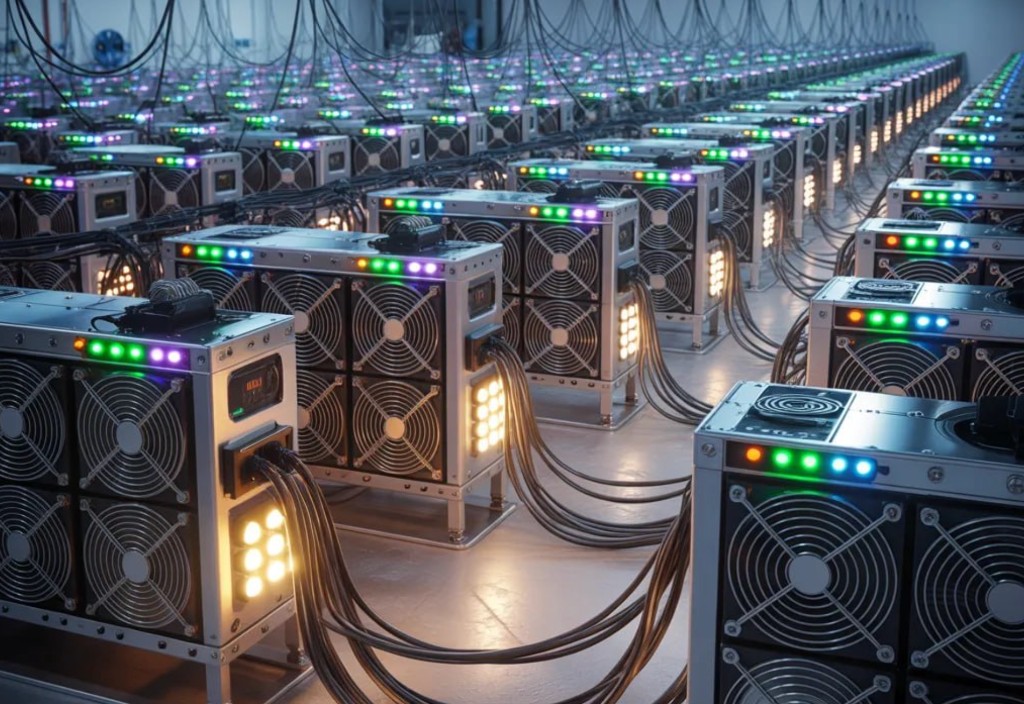
BTC Miners Rating: the best ASIC devices of 2025-2026
Short:The best ASIC 2026 in terms of efficiency are Antminer S21 XP (14.2 J/TH) and WhatsMiner M66S (16.0 J/TH). At a tariff of $0.06/kWh, the break-even threshold for S21 Pro is ~$0.079/kWh. Old models (S19, M30) with 29+ J/TH are unprofitable at a tariff above $0.04. Calculate your option:POOL BTC calculator.
Current situation in the Bitcoin mining market
The Bitcoin mining industry in 2025 is undergoing significant changes following the 2024 halving, which reduced the block reward from 6.25 BTC to 3.125 BTC. This event led to a major overhaul of the economic model of mining and highlighted equipment energy efficiency as a key factor in profitability.
The complexity of the network continues to grow: over the past 24 months it has increased by 87%, which requires miners to constantly update their fleet of ASIC devices. Major hardware manufacturers - Bitmain, MicroBT and Canaan - are competing intensely, releasing increasingly energy-efficient models that can make a profit even in the face of declining rewards.
Against the backdrop of these changes, the market was divided into two segments: institutional miners operating large-scale farms and having access to cheap electricity, and small miners, for whom the energy efficiency of their devices has become critical.
- Network complexity: +87% over 2 years
- Block reward: 3,125 BTC
- Average hashrate: 778 EH/s
- Minimum energy efficiency for profitable operation: <30 J/TH
Market factors shaping the demand for ASIC miners
The cost of electricity has become a decisive factor in the economics of Bitcoin mining. With an average electricity tariff of $0.10 per kilowatt-hour, miners with energy efficiency above 30 J/TH are practically unable to generate profit. This has created unprecedented demand for devices below 25 J/TH.
The situation is aggravated by global competition for energy resources between mining companies and data centers for AI computing. In some regions, this led to an increase in electricity tariffs by 15-20%, which made the return on investment in mining critically dependent on the energy efficiency of the equipment.
Institutional miners are actively purchasing the latest batches of equipment straight from the assembly line, which creates a shortage in the retail market and pushes up prices for the most efficient models. Many miners are now choosing to locate their equipment in regions with tariffs below $0.05 per kilowatt-hour in order to maintain profitability.
There is also a trend to modernize existing installations, replacing outdated models with new ones to maintain competitiveness in an increasingly complex network.
Key factors when choosing an ASIC miner
When choosing an ASIC miner for Bitcoin mining in 2025, there are several critical parameters to consider that directly affect your return on investment.
Hashrate- measured in TH/s (terahashes per second), shows the computing speed of the device. Modern top models, such as Antminer S19 XP, reach 140 TH/s and higher. However, it is important to understand that a high hashrate in itself does not guarantee high profits.
Energy consumption- the number of watts consumed by the device. For example, the same Antminer S19 XP consumes about 3010 W at full load. This parameter directly affects operating costs.
Energy efficiency- measured in joules per terahash (J/TH) and is perhaps the most important indicator. The lower this value, the more efficiently the device converts energy into processing power. For market leaders this figure is 21-25 J/TH.
To calculate the real payback of an ASIC miner, you should:
- Determine daily energy consumption: power (W) × 24 hours / 1000 = kWh per day
- Calculate daily electricity costs: kWh per day × tariff per kWh
- Calculate expected income taking into account the current network hashrate and your share
- Subtract energy costs from expected income
- Divide the cost of the device by the net daily profit to get the number of days until full payback
Using a specific example - Antminer S19 XP with a hashrate of 140 TH/s, power consumption of 3010 W and energy efficiency of 21.5 J/TH - and a tariff of $0.05 per kWh, the payback period can be about 14-18 months under current network conditions.
Energy efficiency: the main factor when choosing a miner
After the 2024 halving, energy efficiency has become a decisive criterion when choosing an ASIC miner. Cutting the reward in half significantly reduced potential income, making electricity costs a major cost in the mining economy.
The J/TH (joules per terahash) indicator is now critical. The difference between devices with an energy efficiency of 25 J/TH and 35 J/TH can determine whether mining will be profitable or unprofitable. At a tariff of $0.10 per kWh, this difference translates into an additional $24 in costs for every 100 TH/s of power daily, or more than $8,700 per year.
A specific example: the Antminer S19 XP miner with an energy efficiency of 21.5 J/TH with a hashrate of 140 TH/s consumes 72.24 kWh per day. A similar hashrate but less efficient miner with 35 J/TH will consume 117.6 kWh - a difference of 45.36 kWh daily. At $0.10, that's an additional $4.54 per day or $1,656 per year for just one device.
In practice, this means that older models with efficiencies less than 35 J/TH have become unprofitable in most regions of the world. Mining companies are massively switching to devices with performance levels below 25 J/TH, and models with an efficiency of about 20 J/TH are considered optimal.
| Energy efficiency (J/TH) | Consumption (kWh/day) per 100 TH/s | Cost per day ($0.10/kWh) | Costs per year |
|---|---|---|---|
| 20 | 48 | $4.80 | $1,752 |
| 25 | 60 | $6.00 | $2,190 |
| 35 | 84 | $8.40 | $3,066 |
ASIC vs GPU mining: which will bring the best ROI?
When comparing ASIC miners and video cards for Bitcoin mining, it is important to understand the fundamental differences in their performance and intended purpose.
ASIC miners are designed specifically for the SHA-256 algorithm used in Bitcoin. The modern Antminer S19 XP with a hashrate of 140 TH/s outperforms the most powerful GPU farm of the top 100 video cards, which only achieves 1-2 TH/s when mining Bitcoin. The difference in performance reaches 70-140 times, which makes GPU mining of Bitcoin economically impractical.
However, the advantage of video cards is their versatility. If Bitcoin becomes unprofitable for mining, ASIC miners cannot be reconfigured to other cryptocurrencies, while GPUs can be switched to alternative coins with different algorithms.
| Characteristic | ASIC miner (Antminer S19 XP) | Farm of 8 GPUs (NVIDIA RTX 4090) |
|---|---|---|
| Initial costs | $3000-5000 | $12000-16000 |
| Hashrate for Bitcoin | 140 TH/s | ~0.2 TH/s |
| Energy consumption | 3010 W | 2400 W |
| Monthly Income (Bitcoin) | ~$350-450 | ~$0.5-0.7 (unprofitable) |
| Flexibility | Only Bitcoin and forks on SHA-256 | Dozens of different cryptocurrencies |
| Payback period for Bitcoin | 10-16 months | Won't pay off |
In the context of Bitcoin-only mining, ASIC devices provide significantly higher ROI. However, if you view mining as a long-term strategy with the ability to adapt to market changes, combining mostly ASIC miners with a small number of GPUs can be a smart risk diversification strategy.
Top 5 best ASIC miners for Bitcoin mining
In 2025, the ASIC miner market is represented by models with impressive characteristics that determine the efficiency of Bitcoin mining. Based on objective technical parameters, we will highlight five models that demonstrate strong performance in the current network conditions.
1. Antminer S19 XP (Bitmain)
- Hashrate: 140 TH/s
- Power consumption: 3010 W
- Energy efficiency: 21.5 J/TH
- Year of manufacture: 2023
2. Whatsminer M50S (MicroBT)
- Hashrate: 126 TH/s
- Power consumption: 3276 W
- Energy efficiency: 26 J/TH
- Year of manufacture: 2023
3. AvalonMiner 1246 (Canaan)
- Hashrate: 90 TH/s
- Power consumption: 3420 W
- Energy efficiency: 38 J/TH
- Year of release: 2022
4. Antminer S21 (Bitmain)
- Hashrate: 190 TH/s
- Power consumption: 3800 W
- Energy efficiency: 20 J/TH
- Year of manufacture: 2024
5. Whatsminer M53S+ (MicroBT)
- Hashrate: 175 TH/s
- Power consumption: 3850 W
- Energy efficiency: 22 J/TH
- Year of manufacture: 2024
| Model | Hashrate (TH/s) | Power consumption (W) | Energy efficiency (J/TH) | Approximate price (USD) |
|---|---|---|---|---|
| Antminer S21 | 190 | 3800 | 20.0 | 7500-9000 |
| Whatsminer M53S+ | 175 | 3850 | 22.0 | 6500-8000 |
| Antminer S19 XP | 140 | 3010 | 21.5 | 3000-5000 |
| Whatsminer M50S | 126 | 3276 | 26.0 | 2800-4500 |
| Avalon Miner 1246 | 90 | 3420 | 38.0 | 1800-2500 |
Comparison of technical characteristics and efficiency
A detailed comparison of key ASIC miners for Bitcoin shows that not only absolute hashrate values determine the attractiveness of a device. Energy efficiency is becoming a critical factor, especially in regions with medium and high electricity tariffs.
Antminer S21 with 20 J/TH demonstrates the best energy efficiency among the presented models, making it a strong choice for long-term mining. Whatsminer M53S+ is slightly inferior in energy efficiency (22 J/TH), but offers more advanced control and monitoring functions.
Antminer S19 XP, despite having a lower hashrate compared to the latest models, remains competitive thanks to good energy efficiency (21.5 J/TH) and a more affordable price. This makes it a frequent choice for miners on a budget.
Payback analysis of popular models
The actual payback of an ASIC miner depends on many variables: the cost of the equipment, the electricity tariff, the current complexity of the network and the price of Bitcoin. Let's consider payback scenarios for two popular models - Antminer S19 XP and Whatsminer M50S.
For Antminer S19 XP (140 TH/s, 3010 W, 21.5 J/TH) with a device cost of $4000:
- Optimistic scenario($100k per BTC, $0.05 per kWh): net profit ~$13.9/day, payback ~9.5 months
- Basic scenario($60k per BTC, $0.10 per kWh): net profit ~$3.3/day, payback ~40 months
- Pessimistic scenario($40k per BTC, $0.15 per kWh): unprofitable
The analysis shows that energy efficiency directly affects the sustainability of the mining business model under various market development scenarios. When choosing a device, it is also important to consider the potential increase in network complexity (historically 10-15% per quarter), which further reduces profitability over time.
Cost Analysis: Initial Investment and Ongoing Costs
Fully understanding the economics of mining requires considering not only the initial investment in hardware, but also ongoing operating costs.
- Initial investment:device, power supply, connection, cooling
- Current expenses:electricity, maintenance, internet, additional cooling
- Hidden costs:wear, depreciation, repairs, downtime, rent/area
Over a typical 24-month horizon, energy costs can account for 70-80% of the total cost of ownership, so energy efficiency remains a key parameter.
Optimal Bitcoin Mining Strategies in 2025
In a highly competitive environment and the growing complexity of the network, choosing the right Bitcoin mining strategy becomes as important as choosing the equipment.
Mining poolsremain the base option for most individual miners: regular payouts and lower income dispersion.
Solo miningfor small capacities remains extremely risky due to the low probability of regularly finding a block.
Placement in data centersoften gives a lower rate and professional service, but adds a commission and reduces direct control.
Home mining vs. professional data centers
| Characteristic | Home mining | Professional data center |
|---|---|---|
| Initial investment | Above (device + infrastructure) | Medium (mostly device) |
| Electricity tariff | Often higher | Often lower |
| Service | On one's own | Professionally |
| Equipment control | Full | Limited |
How to Maximize BTC Mining Profitability
- Provide stable power and high-quality cooling
- Monitor temperature, dust and fan condition
- Use parameter monitoring and correct frequency settings
- Calculate ROI in multiple BTC price and network complexity scenarios
Forecasts for the development of Bitcoin mining equipment
The key vector of development is further reduction of J/TH, increasing computing density and improving cooling systems. Manufacturer competition will continue to shift the market towards more efficient models and more professional hosting infrastructure.
Conclusion: Choosing the Ideal ASIC Miner
When choosing an ASIC miner for Bitcoin mining in 2025, it is critical to take into account the combination of “energy efficiency + electricity tariff + device price + reliability.” In the current market cycle, it is energy efficiency that most often determines the line between profit and loss.
Even models with strong hashrate require realistic ROI planning, taking into account the growing complexity of the network and operating costs. In practice, it is not the loudest TH/s numbers that win, but balanced solutions with sustainable economics in several market scenarios.