
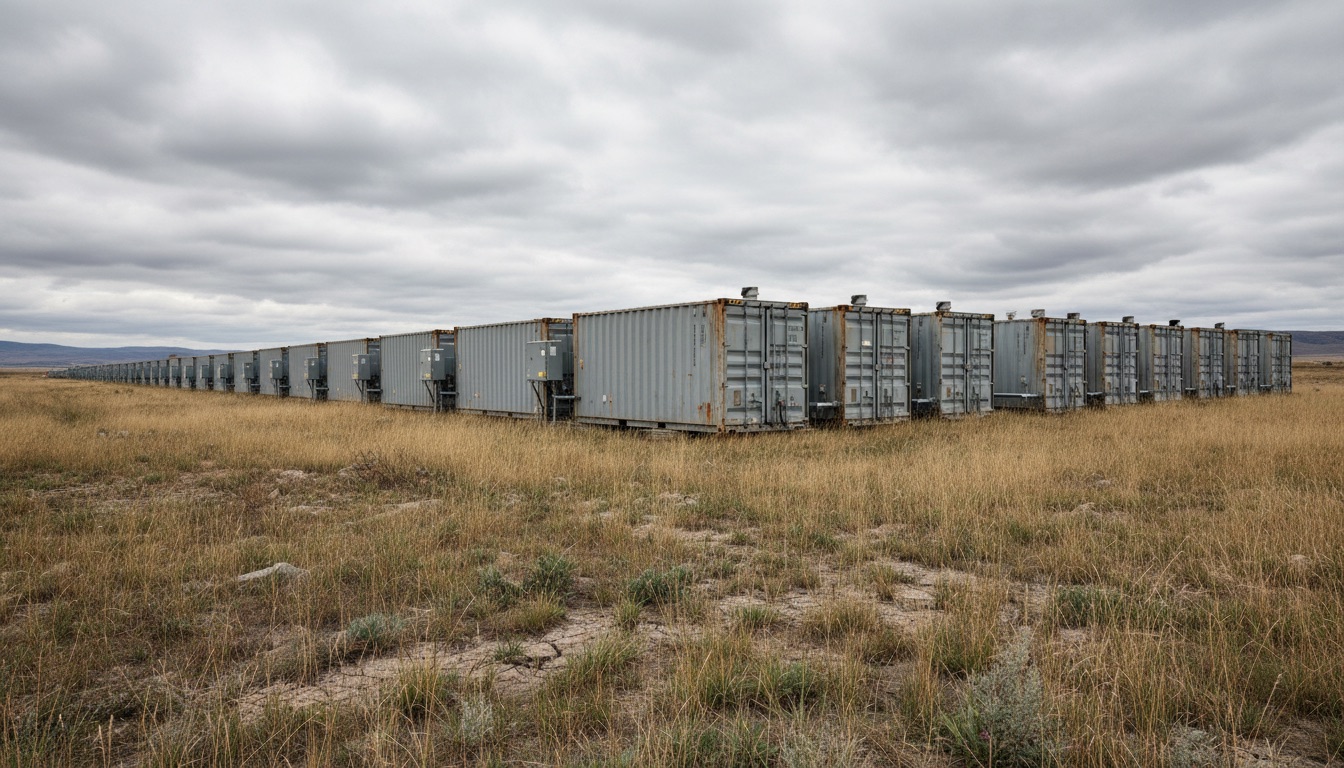
Bitcoin mining hosting: the complete guide to picking a data centre without overpaying
Hosting is sold by the kilowatt-hour and paid for by the invoice. The headline cents go on the landing page. Maintenance, bandwidth, repairs, deposits and downtime live in an annex to the contract, or nowhere at all. This guide covers what the real rate is made of, who pays for what, and which questions to ask before your ASIC is on a truck.
One disclosure first. POOL BTC is not a hosting provider and not a mining pool. It is an independent comparison site for pools, facilities, cards and calculators, so there is no favourite partner being sold here.
[IMAGE: sunny day, modular container data centre in an open field, green grass, wind turbines on the horizon, bright sky]
What mining hosting is and how it differs from cloud mining
Hosting means renting space, power and cooling for hardware you own. You buy the ASIC, ship it, pay for electricity and service, and point the hashrate at your own pool account. Cloud mining works the other way: you buy an abstract contract for hashrate and never receive a machine.
The difference is practical rather than semantic. With hosting you keep a liquid asset. When the contract ends you can collect the machine, sell it or move it somewhere cheaper. With a cloud contract you hold a promise, and when payouts stop there is nothing to collect.
Why you compare the all-in rate, not the headline cents per kWh
The all-in rate is your monthly total divided by the kilowatt-hours you actually consumed. Headline pricing often excludes maintenance, bandwidth, cabling, repairs, insurance, unloading and storage. A site with pricier power and service included frequently beats one with a pretty number on the landing page and a long list of add-ons.
Run the maths this way. Take your machine's rated draw, multiply by 720 hours, add every recurring fee, then divide by those same kilowatt-hours. That number is your real rate, and it is the only figure worth putting side by side across providers.
For scale, public rates in August 2026 ranged from roughly $0.0364/kWh (a seven-year fixed deal, per the provider's own page) up to $0.08 and above in the US. A single cent of difference across ten hydro S21-class units works out to about $409 a month. That is close to five thousand dollars a year hiding in a line item most people skim past.
| Cost line | Often inside the rate | Often billed separately |
|---|---|---|
| Electricity | yes | sometimes with a grid markup |
| Maintenance and dust cleaning | at retail hosts | at industrial sites |
| Bandwidth and monitoring | yes | at budget sites |
| Reboots, PSU and fan swaps | almost never | yes, by price list or hourly |
| Unloading, racking, storage | no | yes, one-off fees |
| Insurance | no | optional |
| Deposit and prepayment | no | yes, separately |
[IMAGE: bright infographic with two cost columns, green and light blue tones, daylight setting]
What the contract covers and what it does not
Read the agreement and its annexes, not the sales page. A decent contract spells out the rate and how it can change, the term, what the site does on its own, what it does on request and for money, who pays for parts, and what happens when the grid goes down.
Clauses worth finding and rereading twice:
- How consumption is measured: nameplate draw or metered at the socket.
- Rate indexation: tied to an exchange, a utility tariff, inflation, or fixed.
- Where scheduled maintenance ends and billable repair begins.
- Incident response times and the consequence when the site misses them.
- The process for removing hardware and the penalty for leaving early.
- Whether the site may relocate your machine to another facility.
The last point surprises people most. A contract with one address at the top sometimes lets the operator move your hardware to wherever power is cheaper, and that new address is not one you will be visiting.
Who pays for reboots and repairs
Scheduled maintenance, dust blowouts and remote reboots are usually on the site. Physical repair is almost always billable: labour by price list or by the hour, parts on the client. A power supply, hashboard or fan swap arrives as a separate invoice, and having those parts in stock is rarely a contractual promise.
Ask separately about the warranty on repair work and who carries the loss if the machine does not come back up afterwards. Retail hosts often run their own bench with spare boards. Larger sites sometimes outsource repair, and then the wait is measured in weeks.
Is the rate fixed, and for how long
Fixed rates exist, and multi-year fixes do show up on public price lists, but they are rarely free. You pay for one through a higher starting price, a larger deposit, or a long term with no exit. Floating rates start cheaper and hand you the full risk of the tariff moving.
The important question is not whether the rate is fixed but what the carve-outs are. Nearly every agreement has a clause on regulated tariffs, taxes or grid charges that lets the operator reprice around the fix. Ask to see that clause before you sign anything.
Deposits and prepayment
The usual structure is a deposit covering one or several months plus payment in advance for the current period. The deposit protects the site if a client stops paying and abandons hardware. Its return is normally tied to removing your machines with no outstanding balance, and the refund timeline is often left vague on purpose.
How many machines do you need before a site will take you?
The spread is wide. Simple Mining and Compass Mining both state publicly that they accept a single machine, with Compass adding the qualifier "where possible". Abundant Mines also starts at one unit, with volume discounts from ten. Blockware sets a hard floor of ten machines, while Core Scientific and CleanSpark have no retail offering at all.
The figures below were taken from the providers' own pages on 01.09.2026.
| Provider | Minimum intake | Note |
|---|---|---|
| Simple Mining | from 1 machine | stated as no minimum quantity |
| Compass Mining | from 1 unit | qualified "where possible"; volume discounts from 10 units |
| Abundant Mines | from 1 machine | wholesale discounts start at 10 units |
| Blockware Solutions | from 10 machines | roughly $40,000 to get started |
| Core Scientific | no retail intake | institutional colocation at tens to hundreds of MW, contracts not public |
| CleanSpark | no retail intake | same picture, no public retail terms found |
The practical takeaway is straightforward. Retail hosts will onboard an individual with one ASIC, and they charge more per kilowatt for it. The industrial sites with the best rates either start the conversation at serious volume or do not deal with private clients at all and publish nothing.
Retail sites in the CIS market
In the Russian-speaking segment the retail floor also varies and has to be confirmed site by site. As of 01.09.2026 the retail end of that market includes Ihmining, Digital North (ЦИФРОВОЙ СЕВЕР), FastMine, EVI Mining, R7miner and New Mining Company.
One habit there is worth borrowing as a comparison tool, because American hosts rarely offer it: at several of these sites the tariff is tied directly to a stated uptime percentage. A cheap kilowatt means a schedule with planned shutdowns, an expensive one means something close to round-the-clock operation. That is more honest than a generic "95%+" banner, though it is still not an SLA: the method for confirming the percentage is usually not described.
[IMAGE: two people in light clothing inspecting a row of miners in a clean hangar with open doors, green landscape and sunshine outside]
What uptime means and how to verify it
Uptime is the share of time your machine was genuinely hashing. You verify it with your own pool statistics, not with a number on a website: a month of hashrate graphs shows every dip. A promised percentage only carries weight when the contract states how it is calculated and what the site owes you when it misses.
Three things turn an uptime figure from marketing into an obligation:
- The calculation base: whether scheduled work and curtailment count as downtime or are excluded.
- The remedy: a recalculated invoice, a credit next month, or nothing at all.
- The source of truth in a dispute: your pool data or the operator's dashboard.
Your side of that verification is easiest to build on pool data. Payout schemes and how different pools report statistics are covered in our piece on solo versus pool ROI, and the underlying revenue maths runs quickly in the mining calculator.
Who carries the risk on outages and curtailment
Curtailment is a planned reduction in consumption, requested by the grid or triggered by energy prices. Most contracts do not count those stops as site downtime, and no compensation follows. In some markets the operator is paid for shedding load while the client simply loses hashing hours.
Ask directly: how many hours of curtailment did this facility see over the last twelve months, and does the site share demand-response revenue with clients. The answer to the second question is usually no, but how the operator reacts to being asked says a lot about transparency.
How many downtime hours are there actually?
The honest answer is that nobody knows publicly. As of 01.09.2026 none of the providers checked here publishes an actual report of downtime or curtailment hours for the past twelve months. What exists instead is target percentages inside contracts, marketing claims with no log behind them, and industry-wide benchmarks that belong to no particular facility.
What you can actually work with:
- Target percentages from the contract text. Mining Syndicate, for example, writes a target uptime of 90-95% into its agreement and translates that itself into roughly 1 to 2.5 hours of downtime per day.
- Marketing claims without evidence. Simple Mining advertises "95%+ uptime" but publishes no monthly downtime log and no third-party monitoring.
- Industry benchmarks not tied to a specific host. An SLA in the 99.0-99.9% band works out to between 8.76 and 87.6 hours of downtime a year. On ERCOT sites in Texas, summer curtailment can reach 8-12% of operating hours.
The absence of a public downtime log is itself information. It does not make a facility bad, but it does mean you cannot verify the promised percentage before signing, and the question about actual hours over the last twelve months stays on your list for the provider.
Where the providers' own numbers disagree
Internal inconsistencies in a host's published figures are part of the check too. Two observations as of 01.09.2026, both worth verifying yourself before you commit.
Blockware lists three different rates across pages of the same official site: $0.07, $0.075 and $0.078 per kWh. There is no single current figure here without written confirmation from support.
Mining Syndicate's product-page price ($0.075) does not match an independent review quoting $0.10 to $0.11. On top of that, Trustpilot carries multiple customer complaints about deposits not being returned. That is not a finding of wrongdoing, but it is a reputational risk worth checking on your own before wiring three months of prepayment.
For Core Scientific, the only public rate found dates from 2022, so it does not belong in a 2026 comparison.
How to vet a site before shipping hardware
Due diligence costs far less than shipping machines back. The minimum before signing:
- Request a video from the floor filmed today, with your name or the date written on paper in frame.
- Verify the legal entity, the facility address and the lease or ownership documents.
- Find current clients in industry chats and ask them directly instead of reading testimonials.
- Confirm who supplies the power and whether the site holds a direct grid contract.
- Ship one machine, run it for a month, then send the rest.
- Check the first invoice against the contract formula line by line.
That single test machine saves the most trouble. A month of real operation reveals connectivity quality, incident response speed and how the site actually bills.
When home mining beats hosting
On a residential tariff, hosting almost always wins. Domestic power costs a multiple of industrial power, and neither skipping service fees nor saving on freight closes that gap. Home only comes out ahead with an industrial tariff, your own generation, or a setup where miner heat replaces heating, and only once the noise problem is genuinely solved.
Noise is the most underestimated variable. A standard air-cooled ASIC is unlivable in a house without a dedicated room or an immersion loop, and that conversion costs money that belongs in the payback calculation. We covered the heating scenario in our article on miners as a heat source, and regional power costs in the piece on electricity for mining.
| Situation | Usually cheaper |
|---|---|
| Residential tariff, flat or house | hosting |
| Industrial tariff, dedicated room | home |
| Own generation or surplus solar | home |
| Miner heat replaces winter heating | home, seasonally |
| One or two machines, no space, low noise tolerance | hosting |
| Ten or more machines, no site of your own | hosting |
The question list to send before signing
- What is my total monthly cost for one machine of my model, and which lines make it up?
- Is consumption billed on nameplate draw or metered?
- Is the rate fixed, for how long, and what are the carve-outs?
- What maintenance is included, what is billable, and at what price list?
- Who pays for parts, and how many spare machines do you hold?
- What uptime do you commit to, how is it calculated, and what do you pay when you miss it?
- How many curtailment hours did the facility have in the last twelve months, and do you publish that log?
- What is the deposit, and under what conditions and timeline is it returned?
- What is the minimum intake, and is there a volume discount?
- Can I remove hardware early, and what is the penalty?
- May you relocate my machines to another facility?
- Who is your power supplier, and do you hold a direct grid contract?
Get the answers by email. A sales rep's verbal promise is worth nothing six months later, when the invoice has grown and the rep has moved on.
Bottom line
Compare hosting on one number: the monthly total divided by the kilowatt-hours you actually burned. Everything else in the negotiation is about who carries risk, on repairs, on tariff increases, on grid outages. A contract that assigns those three explicitly is worth more than the prettiest headline price on a landing page.
Facility selection and cooling types are covered in our article on choosing a miner data centre in 2026, and hardware payback in the piece on ASIC payback periods.
[IMAGE: bright closing illustration, solar panel and a container data centre on a green hill, clear sky]