
Hashprice risk: how to find your shutdown price and whether hedging hashrate is worth it
On 07.09.2026 hashprice sat at 0.0391 USD per TH/s per day, about 39.14 USD per PH/s per day. In a little over a week the network retargets and that number changes. Your power bill does not retarget with it.
That mismatch is the whole economic problem in mining. Costs are fixed in fiat, revenue per unit of hashrate floats with the network. Which raises a question most mining content skips: can you lock the revenue in advance, the way a farmer sells the harvest before it is grown. The instruments exist, they are called hashrate forwards and futures, and they suit far fewer miners than the marketing suggests.
What follows is the risk side: how to compute your own margin of safety, how a hashrate hedge is built, who should stay away from it, and what to do when derivatives are out of reach. The mechanics of the metric itself and how to forecast the next retarget are covered in our piece on network difficulty and hashprice; here they are only the starting point.
Hashprice in three paragraphs
Hashprice is the expected daily revenue per unit of hashrate at the current difficulty, block reward and BTC price. It is quoted in dollars per PH/s per day or in BTC per PH/s per day. The dollar version moves with both the network and the exchange rate; the BTC version ignores price entirely. Quotes in TH/s are the same figure divided by 1000.
Four inputs feed it, and they differ wildly in how predictable they are. The block subsidy has been 3.125 BTC since the April 2024 halving and holds until the next one. Transaction fees currently contribute very little: per Blockchain.com Charts, between 03.09.2026 and 07.09.2026 the fee share of daily miner revenue ranged from 0.39 to 0.72 percent, and on 07.09.2026 it came to 0.58 percent, with 202,835 USD in fees against 35,267,307 USD of total revenue. That leaves difficulty in the denominator and BTC price as the multiplier, and those two produce all the variance.
Hashprice is not the number your profitability calculator shows. Hashprice describes the network and is identical for everyone. The calculator shows what is left after your power rate, pool fee, deductions and depreciation, and it usually extends today's difficulty forward, which makes income look steadier than it is. We went through that gap in the piece on real mining profitability numbers for 2026; the metric itself is explained in the hashprice guide.
How much the thing you want to hedge actually moves
Before talking about instruments, size the risk. Difficulty retargets every 2016 blocks, roughly every two weeks, and between 1 January and 8 September 2026 the network went through 18 of them. Hashprice responds inversely: difficulty up, revenue per terahash down.
| 2026 to date, 1 Jan through 8 Sep | Value |
|---|---|
| Retargets | 18 |
| Highest difficulty | 146.4726 T, retarget 08.01.2026 |
| Lowest difficulty | 124.9329 T, retarget 14.06.2026 |
| Sharpest increase | +14.73%, retarget 19.02.2026 |
| Sharpest drop | -11.16%, retarget 07.02.2026 |
| Difficulty as of 08.09.2026 | 127.4508 T from block 965,664 |
Source for every row: mempool.space, difficulty-adjustments/all endpoint, retrieved 08.09.2026.
Read the two February rows together. The 11.16 percent drop on 7 February and the 14.73 percent jump on 19 February are twelve days apart. A miner who built a plan on the revenue right after the first one was running completely different economics a week and a half later, and no pool had anything to do with it. The spread between the January high and the June low is roughly 17 percent, and since March difficulty has drifted between about 125 and 139 T with no clear trend.
The next retarget lands at height 967,680. On 17.09.2026 at 13:17 UTC the epoch was 86.90 percent complete, mempool.space estimated the difficulty change at plus 4.07 percent and expected the retarget around 07:35 UTC on 19.09.2026. Nine days earlier, on 08.09.2026, the same estimate read plus 6.58 percent. The forecast drifts with block times, and only block 967,680 will settle the final number. Live values sit on the difficulty page.
One caveat on hashrate that trips up even industry write-ups. The seven-day average from mempool.space over 02.09.2026 to 08.09.2026 was about 927.5 EH/s, while CoinWarz showed roughly 970 EH/s on the same day. Both are correct: the second is a short-term estimate from recent block times, not a weekly average. The gap is close to 5 percent, which is enough to distort a revenue plan. What each metric means is covered in our network hashrate explainer.
Finding your shutdown price from hashprice and efficiency
Your maximum viable power rate depends on only two things: hashprice and machine efficiency in joules per terahash. Hashrate cancels out, because revenue and consumption both scale with it. The formula: max rate in USD per kWh equals hashprice in USD per PH/s per day divided by 24 times efficiency in J/TH.
Run it on September 2026 numbers. Hashprice 39.14 USD/PH/s/day, a machine at 20 J/TH:
- Denominator: 24 × 20 = 480.
- Max rate before pool fee: 39.14 / 480 = 0.0815 USD per kWh.
- With a 2 percent pool fee: 0.0815 × 0.98 = 0.0799 USD per kWh.
Here is the same calculation across hardware generations, at that hashprice and that fee.
| Machine efficiency | Max rate, USD per kWh | What it means in practice |
|---|---|---|
| 15 J/TH | 0.1065 | Headroom even on a retail tariff, though not a peak one |
| 20 J/TH | 0.0799 | An industrial site works, a home tariff is already marginal |
| 25 J/TH | 0.0639 | Needs a cheap energy contract |
| 30 J/TH | 0.0533 | Only viable on very cheap power |
| 35 J/TH | 0.0457 | Living on the edge; one upward retarget switches it off |
Calculated at 39.14 USD/PH/s/day as of 07.09.2026 with a 2 percent pool fee. Depreciation, rent and cooling are excluded, and each of them pushes the ceiling lower.
Now the part that matters. Compute the ceiling not from today's hashprice but from the lowest hashprice of the past six months, then compare it to your real tariff. The distance between those two numbers is your margin of safety. Under a cent, and you are not managing risk, you are waiting for a favourable retarget. Model your own setup in the profitability calculator; the tariff side is covered in electricity for mining.
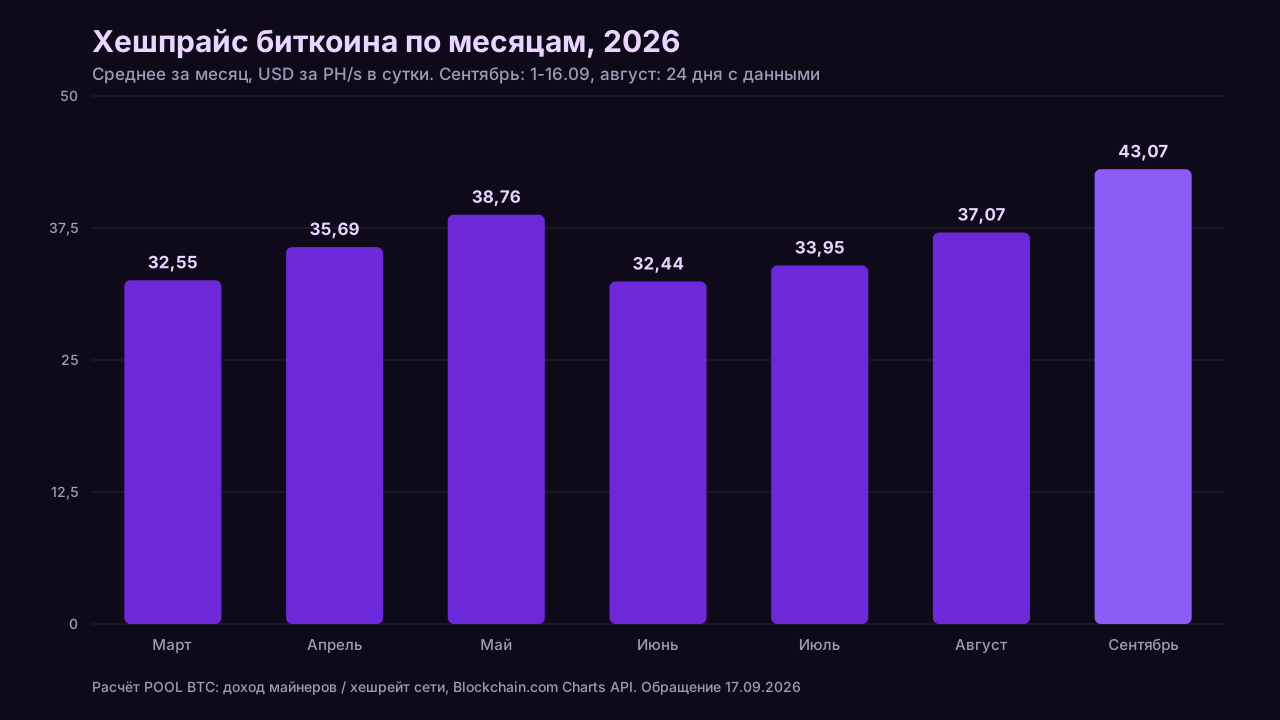
Here is a ready range for that calculation. We divided daily miner revenue in dollars by network hashrate using Blockchain.com Charts data (accessed 17.09.2026). Between 18.03.2026 and 16.09.2026 the low came to 28.13 USD/PH/s per day on 10.06.2026 and the high to 46.31 USD/PH/s on 06.09.2026. Daily points are noisy because the number of blocks found per day swings, and every source has its own method: our figure for 07.09.2026 is 40.05 against 39.14 at bitcoin-data.com. Monthly averages are calmer, from 32.44 in June to 43.07 for 1-16 September.
At the 28.13 low, a 20 J/TH machine paying a 2 percent pool fee can carry a tariff of no more than 0.0574 USD per kWh, not the 0.0799 it can carry at September hashprice. That gap is over two cents, and it is the cushion a farm needs so a summer drawdown does not switch it off.
What hedging hashrate means and which instruments do it
Hedging hashrate means locking future revenue per unit of capacity in advance. The miner sells a contract on future hashprice and receives a known amount regardless of where difficulty and price go. A fall in hashprice is offset by the contract payout; a rise means profit left on the table. Guessing direction is not the point and not required.
Structurally there are three families.
| Type | How it works | What it fixes | Who can access it |
|---|---|---|---|
| Hashprice forward | Over the counter, cash settled against a hashprice index on the settlement date | Revenue per PH/s over a period | Industrial sites and funds, institutional sizes |
| Exchange-listed hashrate or difficulty futures | Standardised contract with a central counterparty, collateral and margin calls | The same, with exchange liquidity | Entities with exchange access |
| Hashrate sold in kind | Buyer prepays for future capacity, miner delivers the mined output | Revenue in BTC, often bundled with hosting | Mid-size farms and hosting providers |
The first question to ask about any of these is not the price, it is the index. Settlement runs off a published hashprice figure, and different services publish it: Hashrate Index from Luxor, open aggregators such as bitcoin-data.com. Their methodologies are not obliged to agree to the third decimal, and that discrepancy is where settlement disputes come from.
Who actually sells these contracts as of September 2026, based on the venues' official pages (accessed 17.09.2026):
| Venue | Instrument | Settlement index | Size and tenor | Margin and access |
|---|---|---|---|---|
| Luxor | OTC forwards, deliverable and non-deliverable | Luxor Bitcoin Hashprice Index | 1 PH/s per day, monthly, up to 12 months out | The seller posts margin of 18 percent of hashprice, the buyer prepays in full. Sellers go through Luxor credit scoring. Trading fees are not published |
| Bitnomial | Exchange-listed hashprice futures | Luxor Bitcoin Hashprice Index | 1 PH, monthly contracts | CFTC-regulated exchange, access through an account with a futures commission merchant (FCM). Fees and margin are not published on the pages we checked |
| Blockstream BMN2 | Not a derivative but a token representing a share of mining on Liquid | Its own computed revenue | Runs to 04.09.2028 | Minimum size and regulatory status are not disclosed on the page |
We found no hashrate or hashprice product at CME, Deribit or Nodal Exchange, either on their official pages or in press releases. The picture is narrow: both the OTC forwards and the listed future settle on the same Luxor index. For anyone buying a hedge that is a concentration risk in its own right, and it rarely gets mentioned.
Who benefits from a hedge and who does not
A hedge pays for itself where fiat obligations run on a fixed schedule: equipment debt, data centre rent, an energy contract with a committed volume. If payments arrive by calendar while revenue floats with difficulty, locking revenue closes exactly that gap. A two-machine home setup has no gap to close and does have an off switch.
| Profile | Worth it | Why |
|---|---|---|
| One or two machines at home | No | One contract is 1 PH/s, or 1,000 TH/s, several times the capacity of a couple of machines, and access requires credit scoring or a broker account |
| Small farm with no debt or rent | Usually not | Curtailing on weak hashprice is cheaper than hedging, and flexibility costs nothing |
| Farm with equipment financing | Partly, yes | The loan payment is fixed while revenue is not, and the hedge covers that specific hole |
| Hosting provider with client commitments | Yes | Yield promised to a client is a fixed obligation too |
| Industrial site with contracted power | Yes | Size gives venue access, and the energy side is already locked |
How much to hedge is derived from costs, not from capacity. The rule: cover the share of revenue that is already promised to somebody else. If fixed payments are 60 percent of monthly costs, hedging more than 60 percent of capacity serves no purpose. Let the rest run at market.
The failure mode that gets discussed more often than the wins: hedging the whole fleet ahead of a rising hashprice turns a miner into someone who sold the harvest at last year's price. No loss on paper, and by year end the site trails neighbours who did nothing at all.
The risks that come with the hedge
None of the four main risks has anything to do with whether you called the direction right.
- Counterparty. An OTC forward is one company's promise to pay. If it does not survive a drawdown, your hedge becomes a claim in a creditor queue. An exchange contract moves that risk to a clearing house and adds the fourth item on this list.
- Basis. The contract settles against an index while you earn through your pool, with your payout scheme, your deductions, your rejected share rate and your uptime. The gap between index and realised revenue always exists and is under no obligation to be zero on settlement day. Under FPPS it is narrower and more predictable; under PPLNS it widens, because block luck variance is added on top. The mechanics are in our FPPS versus PPLNS comparison.
- Liquidity. The hashrate derivatives market is thin next to commodity markets. Exiting a position early is not always possible, and rarely at the price you wanted.
- Margin. Exchange contracts require collateral and top-ups. A move against your position demands cash exactly when cash is scarcest, because current revenue is under pressure at the same moment.
A fifth risk is operational and unglamorous. The hedge is sized on planned capacity, and meanwhile the site is down for repairs, a network outage or a curtailment order. Hedged terahashes that are not hashing leave you with the obligation and no revenue behind it. Uptime becomes a financial parameter rather than a technical one.
On tax and accounting: derivative results and mining income are treated under different rules in most jurisdictions. Settle that with your accountant before the trade, not after. We do not cover specific regimes here and give no tax advice.

What to do without derivatives
Most miners cannot access a hedge and do not need one. The goal stays the same: survive a low-revenue stretch without shutting the site down permanently. Four ordinary tools do the work.
- A BTC buffer. Hold two or three months of expenses in mined coin instead of selling everything on receipt. It does not fix a price, it buys time, and in a hashprice drawdown time decides more than the rate does.
- Fleet efficiency. The table above prices this out: moving from 30 to 20 J/TH lifts the ceiling from 0.0533 to 0.0799 USD per kWh at the same hashprice. No contract shifts a shutdown price that far. Compare machines in the miner rankings.
- Tariff and load schedule. Off-peak rates, curtailment during peak hours, volume agreements. One cent per kWh moves the economics harder than two percentage points of pool fee.
- Pool and payout scheme. FPPS smooths fee variance and gives predictable accruals; PPLNS adds variance and sometimes a higher average. Compare net revenue over 14 days rather than the headline fee. How we compare pools and what goes into the numbers is set out in our methodology, and you can run your own case in the calculator.
The fifth item is obvious and skipped the most: recompute the economics after every retarget instead of once a quarter. Eighteen adjustments in eight months are eighteen occasions to check whether the site has crossed its shutdown price.
Common questions about hashprice risk and hedging
Can a home miner hedge hashprice?
Effectively no. The minimum contract at Luxor and Bitnomial is 1 PH/s, which is 1,000 TH/s, and getting in means credit scoring at Luxor or an account with a futures broker for Bitnomial. On one or two machines that overhead never pays back. The home equivalent is a BTC buffer for expenses, a cheap tariff, and a willingness to power down during a drawdown.
Does a hedge protect against a falling BTC price?
Only if the contract is denominated in dollars and settles against a dollar hashprice index. That covers both drivers at once, difficulty and price, because both already sit inside the index. A BTC-denominated contract fixes revenue in coin and offers no price protection, which is a deliberate choice in favour of accumulation.
What is basis risk in plain terms?
It is the difference between what the contract pays you and what you actually earned. The index averages the whole network, while your revenue depends on your pool, payout scheme, rejected shares and downtime. Those two numbers are not obliged to match, so a basis loss is possible even on a perfectly executed hedge.
How often should the shutdown price be recomputed?
After every difficulty retarget at minimum, so roughly every two weeks. Other triggers: a change in power tariff, a switch of pool or payout scheme, and any purchase of machines with different efficiency. A ceiling computed from the six-month low in hashprice holds up better than one computed from today's figure.
Where to track hashprice and difficulty
mempool.space publishes difficulty and the pending retarget estimate; hashprice values come from Hashrate Index and open aggregators such as bitcoin-data.com. A consolidated view of the network sits on the difficulty page, and net revenue for your own parameters can be modelled in the calculator.
What this piece leaves out
Three things did not fit. Hardware depreciation is absent from hashprice entirely, yet over a two-year horizon it outweighs the difference between payout schemes. Machine prices follow hashprice with a lag, which is why buying at peak revenue almost always turns out expensive. Regional regulation sets both the tariff and whether you may operate at all, and no contract insures against it.
One step for this week. Take the rated efficiency of your machines in J/TH, plug in the hashprice for your calculation date, and work out the ceiling with the formula above. Compare it to your actual tariff. If the difference is under a cent, meet the next retarget with a curtailment plan rather than a hope about price.
This article is informational and is not investment advice.