
How to mine Litecoin and Dogecoin in 2026: hardware, income math, pools and setup
To mine Litecoin and Dogecoin in 2026 you need a Scrypt ASIC such as the Antminer L9 (16 GH/s, 3,360 W) and a pool that pays both coins through merged mining. One machine earns LTC and DOGE at the same time. On 2026-10-01 an L9 grossed about $10.82 a day before pool fees and power.
POOL BTC is an independent comparison site. We are not a pool, we take no hashrate and sell no hardware. Everything below comes with a source and a date, and the coin prices are a snapshot, not a forecast. This is not financial advice.
What is merged mining of Litecoin and Dogecoin?
Merged mining lets one Scrypt machine work on Litecoin and Dogecoin at once. Dogecoin accepts proof of work done for a Litecoin block through a mechanism called AuxPoW (auxiliary proof of work). The miner hashes once and can claim a block on either chain, so DOGE comes on top of LTC at no extra electricity cost.
Dogecoin switched AuxPoW on at block 371,337 with its 1.8 release. The Dogecoin Core v1.8.0 release notes say AuxPoW blocks are rejected before that height and accepted after it. CoinDesk reported the plan on 2014-08-04: the Dogecoin developers wanted more hashrate to protect the chain from a 51% attack, and Litecoin creator Charlie Lee backed the move.
In practice it works like this. The pool builds a Litecoin block template and puts a commitment to a Dogecoin block inside it. Your ASIC hashes that template. A share good enough for Dogecoin's difficulty becomes a Dogecoin block, and a share good enough for Litecoin's difficulty becomes a Litecoin block. You do not split hashrate between the two coins. Both networks see the same work, which is why their hashrate figures sit so close to each other.
How do Litecoin and Dogecoin differ for a miner?
Litecoin targets a block every 2.5 minutes and pays 6.25 LTC per block until its next halving around July 2027. Dogecoin targets one block a minute and pays a fixed 10,000 DOGE per block with no halving. Both use Scrypt, so the same machine mines both, and on 2026-10-01 Dogecoin paid most of the revenue.
| Parameter | Litecoin (LTC) | Dogecoin (DOGE) |
|---|---|---|
| Algorithm | Scrypt | Scrypt |
| Target block time | 2.5 minutes | 1 minute |
| Blocks per day (target) | 576 | 1,440 |
| Block reward | 6.25 LTC | 10,000 DOGE, fixed |
| Next halving | block 3,360,000, around July 2027 | none |
| Network hashrate, 24h average (2026-10-01) | 2.41 PH/s | 2.35 PH/s |
| Price (2026-10-01) | $66.92 | $0.094108 |
Block times, the 840,000 block halving interval and the fixed Dogecoin reward come from the Litecoin and Dogecoin entries. Hashrate and price come from Blockchair Litecoin and Blockchair Dogecoin stats, read on 2026-10-01. Real block counts drift from the target: in the 24 hours to that reading Blockchair showed 541 Litecoin blocks and 1,356 Dogecoin blocks.
When is the next Litecoin halving?
The next Litecoin halving happens at block 3,360,000 and cuts the reward from 6.25 LTC to 3.125 LTC. On 2026-10-01 the chain was at block 3,187,525, so 172,475 blocks remained. At 2.5 minutes per block that is about 300 days, which points to late July 2027.
The arithmetic is simple: 172,475 x 2.5 minutes = 431,188 minutes, or roughly 299 days. Halvings come every 840,000 blocks. After the cut the LTC part of a miner's income halves, while the DOGE part stays the same, because Dogecoin has no halving. On today's numbers DOGE is about 85% of an L9's gross, so the halving hits a merged miner less hard than it would hit an LTC only miner.
Which hardware mines Litecoin and Dogecoin?
The common choice is a Bitmain Antminer L9 at 16 GH/s and 3,360 W, which works out to 0.21 J/MH. The older Antminer L7 does 9.5 GH/s at 3,420 W, about 0.36 J/MH. Efficiency decides survival: the L7 uses more power for less hashrate and falls into the red sooner when power is expensive.
| Model | Hashrate | Power at the wall | Efficiency | Source |
|---|---|---|---|---|
| Antminer L9 | 16 GH/s | 3,360 W | 0.21 J/MH | Bitmain L9 specifications |
| Antminer L7 (9500M) | 9.5 GH/s | 3,420 W | 0.36 J/MH | Bitmain L7 specifications |
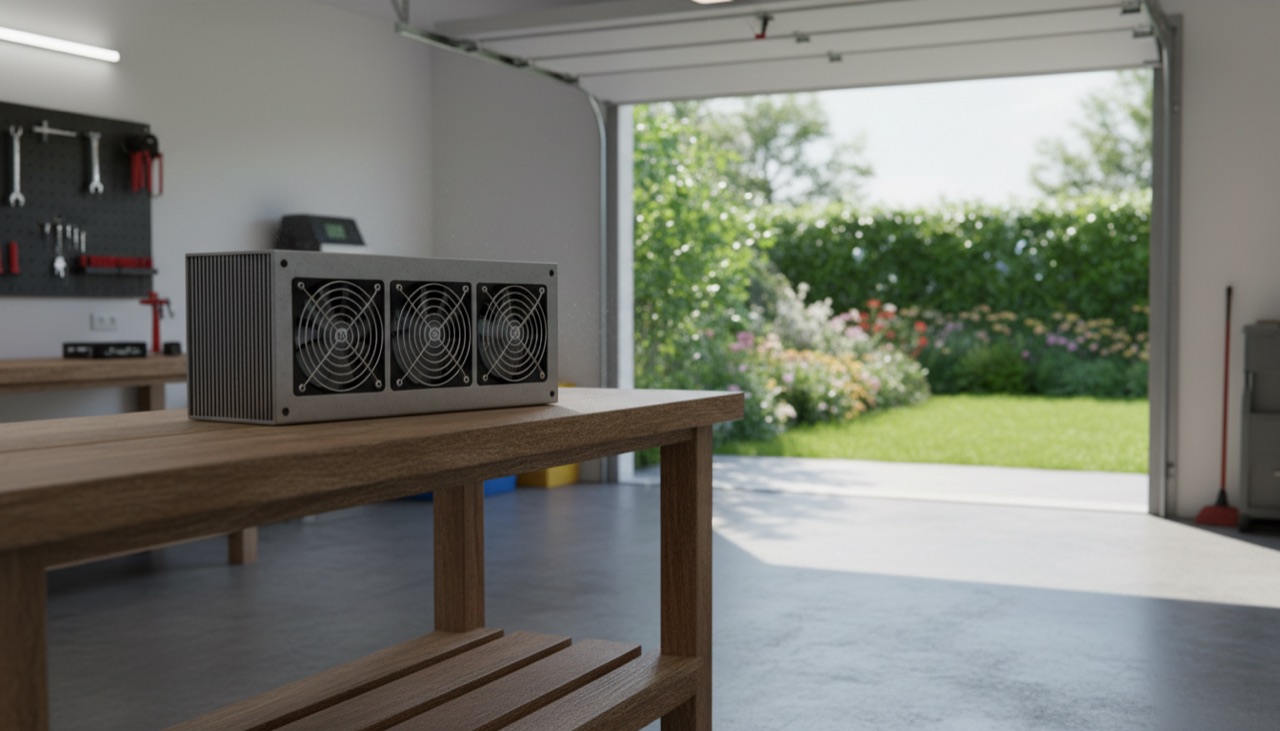
Both are Bitmain's own support pages, checked 2026-10-01. Bitmain lists the L9 for LTC, DOGE and several smaller Scrypt coins, with a 220 to 277 V single phase supply and a noise level of 75 dBA. That noise level matters: an L9 is loud for a flat, so plan for a garage, a basement with ventilation or hosting. The L7 page states power as 3,420 W with a tolerance of plus or minus 10%.
How much does an Antminer L9 earn per day?
On 2026-10-01 an Antminer L9 earned about 0.02389 LTC ($1.60) and 97.94 DOGE ($9.22) a day, $10.82 gross before pool fees. After power it kept $6.78 at $0.05 per kWh, $4.36 at $0.08 and $1.14 at $0.12. An L7 roughly breaks even at $0.08.
The formula for each coin is: your hashrate / network hashrate x blocks per day x block reward x price. For the L9:
- LTC: 16 GH/s / 2,411.4 TH/s x 576 x 6.25 LTC = 0.02389 LTC, times $66.92 = $1.60.
- DOGE: 16 GH/s / 2,352.5 TH/s x 1,440 x 10,000 DOGE = 97.94 DOGE, times $0.094108 = $9.22.
- Power: 3,360 W x 24 h = 80.64 kWh a day.
| Machine | Gross per day | Power per day | Net at $0.05/kWh | Net at $0.08/kWh | Net at $0.12/kWh |
|---|---|---|---|---|---|
| Antminer L9, 16 GH/s, 3,360 W | $10.82 | 80.64 kWh | $6.78 | $4.36 | $1.14 |
| Antminer L7, 9.5 GH/s, 3,420 W | $6.42 | 82.08 kWh | $2.32 | minus $0.14 | minus $3.43 |
The three tariffs are assumptions, not quotes from any supplier. Hashrate and prices are the Blockchair readings for 2026-10-01 and change daily. The table counts target block output and ignores transaction fees, the pool fee and downtime. Take 1% to 3% off for the pool and a few percent more for real uptime. To run your own numbers, open the POOL BTC calculator, pick the coin in the selector and enter your hashrate, power and tariff; calculate LTC and DOGE separately and add them.
Which pools pay both LTC and DOGE?
Among the pools we track, three list both Litecoin and Dogecoin: Tpool, EMCD and Promminer. Their fees run from 0.9% to 3%, and Tpool and Promminer state the payout scheme on their own pages, while only Promminer also states the minimum payout for both coins. Check the dashboard before you connect, because terms change.
| Pool | Fee | Scheme for LTC / DOGE | Minimum payout | Checked |
|---|---|---|---|---|
| Tpool | 0.9%, merged mining 0% | PPS (LTC with merged DOGE, per the pool's coin table) | not stated for LTC or DOGE on the pool site | 2026-10-01 |
| EMCD | from 1.5% | not stated on the LTC page | withdrawals from 0.05 LTC | 2026-10-01 |
| Promminer | 3% | PPS for LTC, PPLNS for DOGE | 0.001 LTC / 1 DOGE | 2026-10-01 |
Tpool's home page says "pool fee 0.9%" and "merged mining 0%", which we read as no extra charge on the DOGE side. EMCD's Litecoin page says the fee starts at 1.5% and is deducted when rewards are credited. Promminer is the only one of the three that spells out a different scheme per coin. PPLNS on DOGE means your DOGE income swings with the pool's luck, while PPS on LTC pays a fixed rate per share. Big Scrypt pools such as ViaBTC, F2Pool, AntPool, Luxor and Binance Pool also list LTC, but our table shows them without DOGE, so check their merged mining terms on their own pages.
How do you set up a Litecoin and Dogecoin miner?
Setup takes about half an hour. You plug the ASIC into power and Ethernet, find its IP address, open the web panel, paste the pool's stratum address and your worker name, and set payout addresses for both LTC and DOGE in the pool account. Then you watch the dashboard until shares show up.
- Check the power line. The L9 needs 220 to 277 V and up to 20 A on one circuit, per Bitmain's spec page. Ask an electrician if you are unsure.
- Register at the pool and create a worker. On merged mining pools the DOGE side is usually tied to the same account.
- Add a Litecoin address and a Dogecoin address for payouts. Without a DOGE address, some pools hold or convert the DOGE part, so read their rules.
- Connect the ASIC by Ethernet, find its IP in your router, and log in to the web panel.
- In Miner Configuration enter the stratum URL from your pool's connection page, then worker name and password. We do not list stratum URLs here because the pools change them; copy the current one from the pool site.
- Save and wait 10 to 15 minutes. The worker should show up online with hashrate near 16 GH/s for an L9.
- Once a day for the first week, compare the pool's reported hashrate with the machine's own number and check both LTC and DOGE balances.

Is mining Litecoin and Dogecoin profitable in 2026?
At the 2026-10-01 snapshot an L9 stays profitable up to roughly $0.13 per kWh before pool fees, while an L7 drops to breakeven near $0.08. Profit depends almost entirely on the DOGE price, which pays about 85% of revenue, and on your tariff. The machine's purchase price is not included.
The L9 breakeven tariff is $10.82 / 80.64 kWh, about $0.134 per kWh. For the L7 it is $6.42 / 82.08 kWh, about $0.078. These are ceilings, not targets: a machine that only breaks even never pays back what you spent on it. A 20% drop in the DOGE price would remove about $1.84 a day from the L9's gross, more than the whole LTC part. Rising network hashrate cuts your share the same way. The July 2027 Litecoin halving would take about $0.80 a day off the L9 at today's prices.
If you mine in Russia, the tariff is only half the story: our guide covers the registry, reporting and taxes for miners.
FAQ
Can I mine Dogecoin without Litecoin?
You can point a Scrypt ASIC at a DOGE only pool, but you would give up the Litecoin side for nothing, because merged mining costs no extra power. Almost all Dogecoin hashrate comes through merged mining with Litecoin, which is why the two networks showed nearly the same hashrate on 2026-10-01.
Does merged mining split my hashrate between two coins?
No. The same hashes count for both chains. Each share is checked against Litecoin's and Dogecoin's difficulty, and whichever target it meets, it pays on that chain. Your L9 does 16 GH/s on Litecoin and 16 GH/s on Dogecoin at the same time.
Can a GPU or a CPU mine Litecoin or Dogecoin?
Not in a useful way. The networks ran at about 2.4 PH/s on 2026-10-01, and the Antminer L9 alone does 16 GH/s. A graphics card does a tiny fraction of that while drawing hundreds of watts, so it would earn cents a month and pay more for power.
What happens to Dogecoin after the Litecoin halving?
Nothing changes on the Dogecoin side. Dogecoin pays a fixed 10,000 DOGE per block with no halving. The Litecoin reward drops from 6.25 to 3.125 LTC at block 3,360,000, expected around July 2027, so only the LTC part of merged mining income shrinks.
How often do pools pay out LTC and DOGE?
It depends on the pool and the scheme. Promminer lists withdrawals from 0.001 LTC and 1 DOGE. EMCD lists withdrawals from 0.05 LTC. Tpool does not state a threshold for these coins on its site (checked 2026-10-01). Check the payout page of your pool before you pick it.
Is the Antminer L7 still worth running?
Only on cheap power. On the 2026-10-01 numbers the L7 nets $2.32 a day at $0.05 per kWh, loses money at $0.08, and loses $3.43 a day at $0.12. Its 0.36 J/MH efficiency is far behind the L9's 0.21 J/MH, so check your tariff before buying one used.
This article contains referral links to mining pools (marked as sponsored). We may receive a reward if you register through them. This does not change the figures or the order of rows in the tables: the terms are taken from the pools' official pages.