
How to mine Ethereum Classic (ETC) in 2026: hardware, income math, pools and setup
To mine Ethereum Classic in 2026 you need an Etchash ASIC such as the Antminer E11, a pool, and power under roughly $0.10 per kWh. On 2026-10-01 the network ran at about 127.7 TH/s, a block paid 1.6384 ETC and ETC traded near $8.87. At those numbers one E11 grossed about $6.46 a day before electricity and pool fees.
POOL BTC is an independent comparison site. We are not a pool, we take no hashrate and we sell no hardware. Every figure below carries a source and a date, and anything we could not confirm is marked as such. Nothing here is investment advice or a price forecast.
What is Ethereum Classic mining and which algorithm does it use?
Ethereum Classic is a proof of work chain that kept mining after Ethereum moved to proof of stake. It uses Etchash, a version of Ethash with a longer epoch, so the DAG file grows more slowly. Miners compete to find blocks, and each winning block pays a fixed reward set by the ECIP-1017 schedule plus transaction fees.
The DAG matters for hardware. The 2Miners ETC node reported a DAG of 4,630,511,488 bytes, about 4.63 GB, at epoch 424 on 2026-10-01 (2Miners API). Any device needs more memory than that to mine at all, and the file keeps growing epoch by epoch.
How big is the ETC block reward and when does it drop?
Under ECIP-1017 each era lasts 5,000,000 blocks and the reward falls by 20% when a new era starts. The first era paid 5 ETC per block. The chain passed block 25,000,000 before October 2026, so the current era pays 1.6384 ETC per block, and the next cut comes at block 30,000,000.
The rule is in the ECIP-1017 text: 5,000,000 blocks per era, a 5 ETC starting reward, minus 20% each era. Working it through gives 5, 4, 3.2, 2.56, 2.048 and then 1.6384 ETC. The 2Miners node showed block height 25,451,378 on 2026-10-01, which puts the chain in the sixth era. At an average block time near 14.5 seconds, the remaining 4.5 million blocks to the next cut take roughly two years.
| Era | Blocks | Reward per block |
|---|---|---|
| 1 | 1 to 5,000,000 | 5 ETC |
| 2 | 5,000,001 to 10,000,000 | 4 ETC |
| 3 | 10,000,001 to 15,000,000 | 3.2 ETC |
| 4 | 15,000,001 to 20,000,000 | 2.56 ETC |
| 5 | 20,000,001 to 25,000,000 | 2.048 ETC |
| 6 (current) | 25,000,001 to 30,000,000 | 1.6384 ETC |
What hardware mines ETC in 2026?
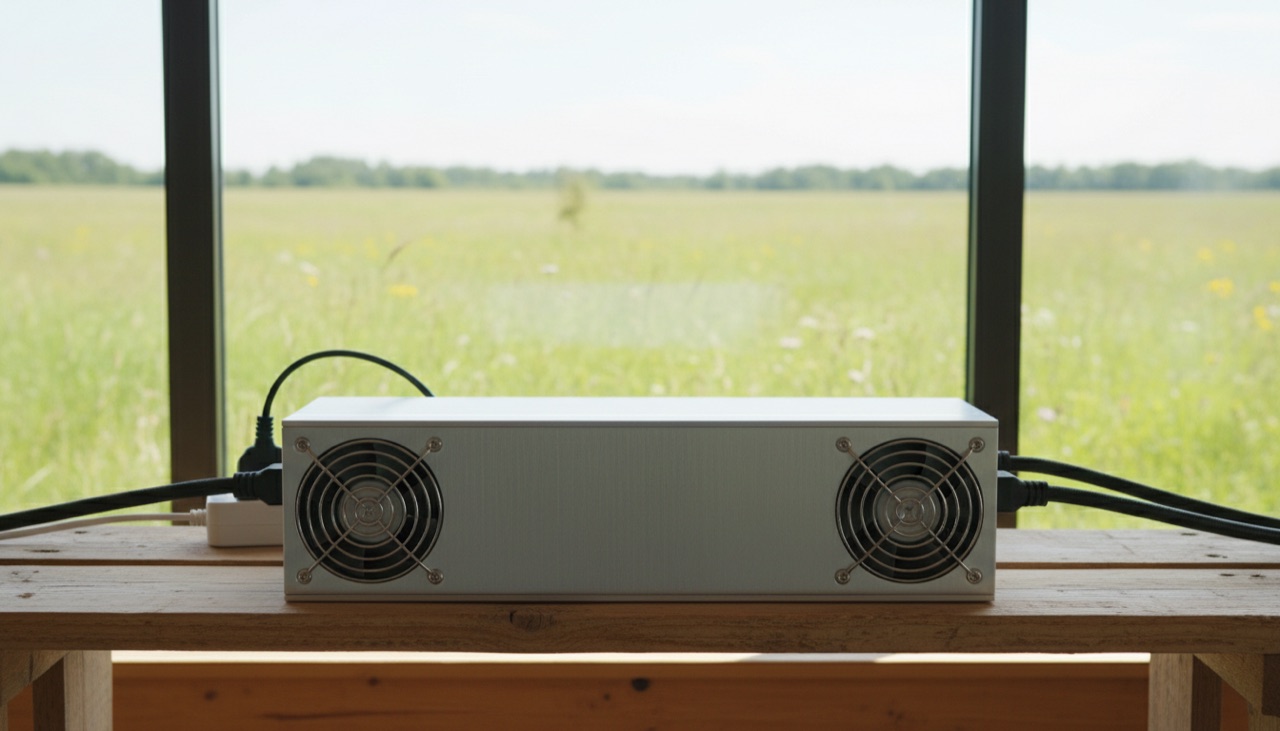
Etchash ASICs from Bitmain dominate. The Antminer E11 is rated at 9.5 GH/s for 2,470 W, and the older E9 Pro at 3.68 GH/s for 2,200 W. The E11 does about 0.26 J/MH, more than twice as efficient as the E9 Pro. GPUs still work if they hold more than 4.63 GB, but they earn far less per watt.
| Model | Hashrate | Power | Efficiency | Released |
|---|---|---|---|---|
| Antminer E11 | 9.5 GH/s | 2,470 W | 0.26 J/MH | January 2025 |
| Antminer E9 Pro | 3.68 GH/s | 2,200 W | 0.598 J/MH | February 2023 |
Specs are from the ASIC Miner Value page for the E11 and for the E9 Pro, checked 2026-10-01. Bitmain's own shop renders these models only through scripts, so we could not read a spec sheet from it on that date. Compare the numbers on the label of the unit you actually buy.
We do not give a GPU income example. We found no manufacturer or pool figure for Etchash hashrate on a specific current graphics card that we could cite, and an invented number would be worse than none.
How do you calculate ETC mining income?
Daily coins equal your hashrate divided by network hashrate, times blocks per day, times the block reward. Multiply by the ETC price for dollars, then subtract power: watts times 24 divided by 1,000, times your tariff. On 2026-10-01 an E11 earned about 0.728 ETC a day before costs.
The inputs, all taken on 2026-10-01:
- Network hashrate 127.69 TH/s, average block time 14.47 s, from the 2Miners ETC node.
- Blocks per day: 86,400 / 14.47 = 5,971.
- Block reward 1.6384 ETC per ECIP-1017.
- Price $8.87 from CoinGecko. This is a snapshot, the price changes every minute.
For the E11: 9.5 GH/s / 127,687 GH/s × 5,971 × 1.6384 = 0.7278 ETC, which is $6.46 at $8.87. It draws 2,470 × 24 / 1,000 = 59.28 kWh a day. The E9 Pro makes 0.2819 ETC, or $2.50, on 52.8 kWh. Uncle rewards and transaction fees are left out, as are pool fees, which usually take about 1%.
How much does an ETC miner earn at different electricity prices?
At $0.05 per kWh an E11 keeps about $3.49 a day, at $0.08 about $1.71, and at $0.12 it loses money. The breakeven tariff for the E11 is about $0.109 per kWh. The E9 Pro breaks even only near $0.047, so on 2026-10-01 numbers it barely pays even with cheap power.
| Machine | Gross per day | Net at $0.05 | Net at $0.08 | Net at $0.12 | Net over 30 days at $0.08 |
|---|---|---|---|---|---|
| Antminer E11 | $6.46 | $3.49 | $1.71 | -$0.66 | $51.4 |
| Antminer E9 Pro | $2.50 | -$0.14 | -$1.72 | -$3.84 | -$51.7 |
The three tariffs are assumptions, not quotes from any utility. The price of the machine is not included, so a positive line is a margin, not a payback. If ETC moves 20% or the network hashrate jumps, every cell moves with it. To plug in your own tariff, open the mining calculator and pick ETC in the coin selector.
Which pools support Ethereum Classic?
Among pools we compare, 2Miners, HeroMiners, Nanopool and WoolyPooly publish their ETC terms openly, with fees between 0.9% and 1% and payout thresholds from 0.01 to 1 ETC. Tpool lists ETC at a 0.9% fee with the FPPS scheme (the pool's coin table, 2026-10-01; minimum payout not stated on the pool site). AntPool, F2Pool, ViaBTC, EMCD and Kryptex Pool also list ETC, but we did not verify their ETC-specific fees.
| Pool | Fee | Scheme | Minimum payout | Source, checked |
|---|---|---|---|---|
| 2Miners | 1% | PPLNS | 0.1 ETC | 2miners.com/terms, 2026-08-18 |
| HeroMiners | 0.9% | PROP, PPS+ | 0.01 ETC | etc.herominers.com, 2026-10-01 |
| Nanopool | 1% | PPLNS | 1 ETC | Nanopool help, 2026-08-18 |
| WoolyPooly | 0.9% | PPLNS | 0.1 ETC | woolypooly.com, 2026-08-18 |
The fees that AntPool, F2Pool, ViaBTC and EMCD publish for bitcoin do not automatically apply to ETC, so read the coin page before you point a machine there. A 0.1 percentage point difference in fee is worth less than a few hours of downtime, so pick the pool with the server closest to you first.
Low thresholds matter for small farms. One E11 at the 2026-10-01 rate reaches 0.1 ETC in roughly three and a half hours and 1 ETC in about a day and a half, so any of these thresholds is fine for an ASIC. A single small GPU would wait much longer on Nanopool.
How do you set up an ETC miner step by step?
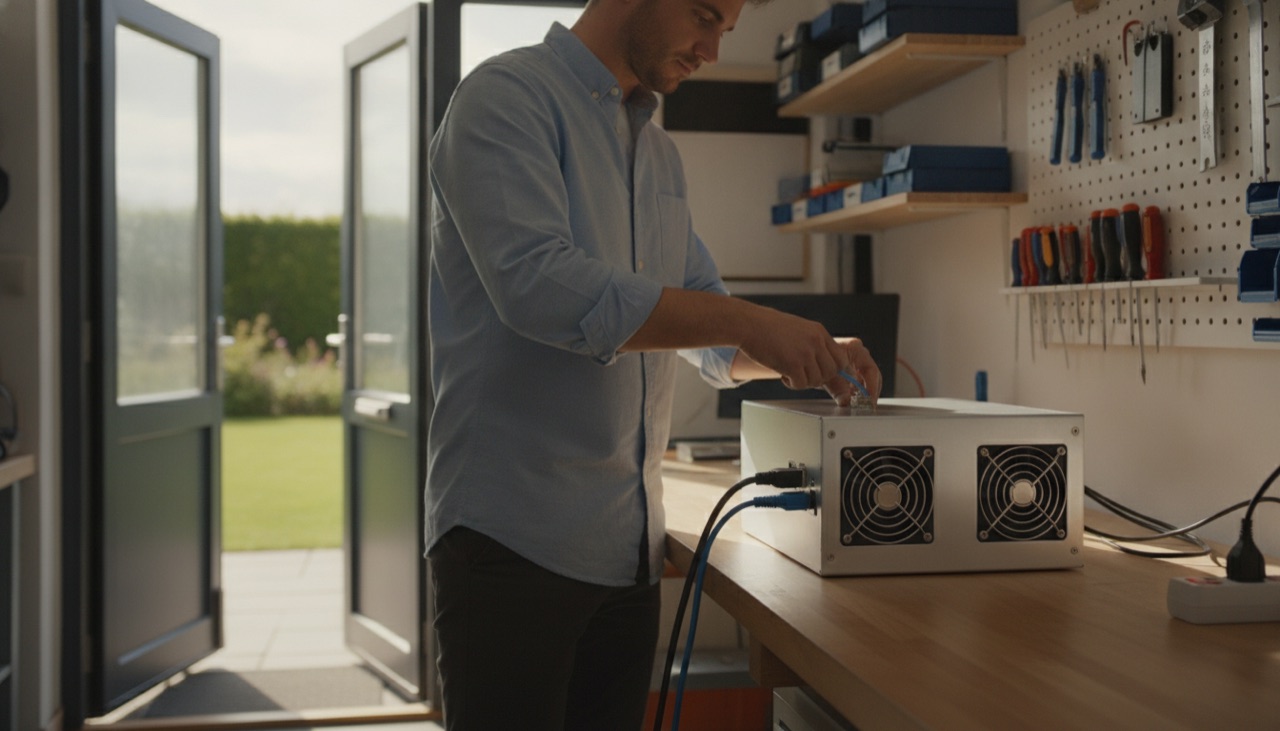
Get an ETC wallet address, pick a pool, connect the ASIC to your network, open its web panel by IP, enter the pool's stratum URL, your address as the worker name and a password, then save. Within about 15 minutes the worker should appear on the pool's stats page under your address.
- Create an ETC address in a wallet that supports Ethereum Classic. Make sure it is an ETC address and not an address on another network.
- Choose a pool from the table above and open its ETC connection page.
- Plug the miner into a 200 to 240 V circuit rated for its draw and connect it to your router by cable.
- Find the miner's IP in the router's client list and open it in a browser.
- In the pool settings enter the stratum address. For 2Miners the help page lists etc.2miners.com:1010, with regional servers such as us-etc.2miners.com:1010 and asia-etc.2miners.com:1010 (checked 2026-10-01).
- As the worker enter your ETC address plus a dot and a rig name, for example ADDRESS.e11.
- Save, wait for the restart, and check accepted shares in the miner panel.
- Open the pool's site, search for your address and confirm the hashrate matches the rating within about 10%.

Is ETC mining legal and what about taxes?
Rules depend on the country, not the coin. In Russia mining is legal under Law 221-FZ but registered, taxed and banned in some regions, and the same rules cover ETC as bitcoin. Check your local law and tax rules before you buy a machine, because a ban zone wipes out any tariff advantage.
For Russia specifically, we covered the registry, the 6,000 kWh home limit and the regional bans in mining in Russia in 2026. Coins received from a pool are usually taxable income on the day you receive them, but the details belong with a local tax adviser.
FAQ
Can I still mine ETC with a graphics card?
Yes, if the card has more than 4.63 GB of memory, which was the DAG size on 2026-10-01 per the 2Miners node. Whether it pays is another matter. A GPU earns far less per watt than an Etchash ASIC, so check your card's hashrate and power in the calculator first.
When is the next ETC reward cut?
At block 30,000,000, when the reward falls from 1.6384 to 1.31072 ETC under ECIP-1017. On 2026-10-01 the chain stood at block 25,451,378, so about 4.55 million blocks remain. At roughly 14.5 seconds per block that is about two years away.
Is the Antminer E9 Pro worth running in 2026?
On 2026-10-01 numbers, only with very cheap power. It grossed about $2.50 a day against 52.8 kWh, so it breaks even near $0.047 per kWh before pool fees. Above that tariff it loses money unless ETC rises or network hashrate falls.
How much does one Antminer E11 make per month?
At the 2026-10-01 numbers it mined about 0.728 ETC a day, so about 21.8 ETC over 30 days, or about $194 gross at $8.87. After power at $0.08 per kWh that leaves about $51. Price and difficulty change daily, so treat this as an example, not a promise.
Which pool has the lowest ETC fee?
Among the pools we checked, HeroMiners and WoolyPooly charge 0.9% and 2Miners and Nanopool 1%. The gap is small. Payout threshold, server location and whether the scheme suits your size usually matter more than a tenth of a percent.
Can I mine ETC solo?
You can, and HeroMiners supports solo mode with a "solo:" prefix per its API on 2026-10-01. With 5,971 blocks a day and 127.7 TH/s of network hashrate, one E11 would find a block on average about once every two and a quarter days, with big swings either way. A pool smooths that out.
This article contains referral links to mining pools (marked as sponsored). We may receive a reward if you register through them. This does not change the figures or the order of rows in the tables: the terms are taken from the pools' official pages.