
SpiderPool review 2026: fees, FPPS rules, payouts, who it fits
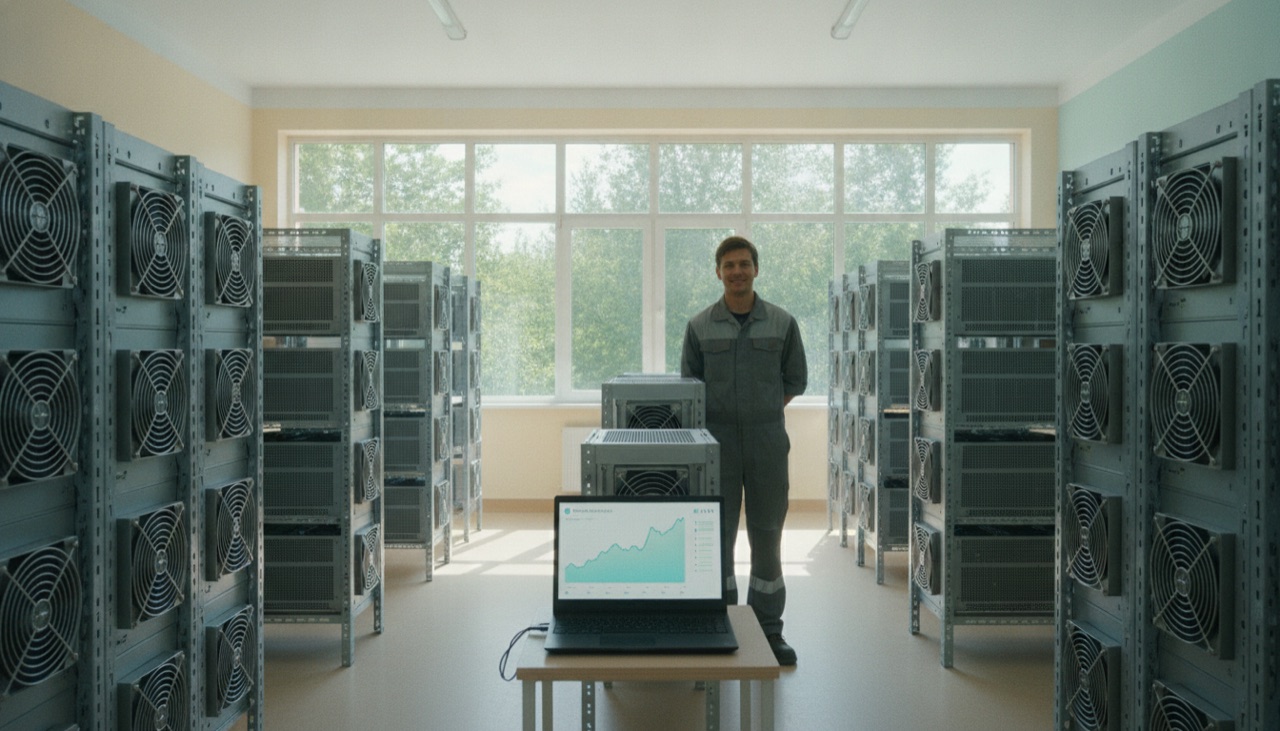
SpiderPool, the fifth-largest bitcoin pool by blocks, is worth a look if you want 4% FPPS, a 0.005 BTC minimum payout and no KYC at signup. It suits mid-size and large farms that earn luck close to the pool average. Small miners should read the FPPS luck rules in its terms first, because the pool can move you to PPLNS.
POOL BTC is an independent comparison site for bitcoin mining pools. We are not SpiderPool and not a mining pool, and nothing here is investment advice. The facts below come from spiderpool.com, its help center and its terms, all checked on 2026-10-21, plus block data from mempool.space and the third-party sources named in the text.
What is SpiderPool and who runs it?
SpiderPool is a bitcoin-focused SHA256 mining pool at spiderpool.com. Its help center says it was founded in 2018. It also mines several smaller coins, and the group around it sells a payment card, firmware, hashrate trading and hosting. The official site does not name the company behind it, and third-party sources disagree on where it sits.
According to LinkedIn and Crunchbase, the operator is Spider Digital Technology Ltd, with a US sister company called SpiderMining Inc. The founder is listed as Jack Chen, who also co-founded xhash.com, and the CEO as Seven Lee. The parent group's site spider.sg calls the pool "an independent mining pool with its own research base."
Where the company is based is unclear. LinkedIn says Singapore, with an office in Beijing. Crunchbase says Beijing, Caplight says Hong Kong, and bitcoinminingstock.io says Singapore. The official site and the terms name neither the legal entity nor the jurisdiction. We found no evidence of a link to Bitmain, the maker behind AntPool.
On certification, the pool's own announcement is titled as SOC 2 Type 1. A "Type 2" appears only in a third-party press release from April 2026, and we could not confirm it on the official site.
How big is SpiderPool's share of the Bitcoin network?
SpiderPool ranks fifth by blocks found over one week, one month and one year. Per mempool.space data pulled on 2026-10-21, it found 65 blocks last week, a 6.11% share. Over one year it found 4,592 blocks, or 8.77%. These shares are our own calculation: the pool's blocks divided by all blocks in the period.
| Pool | 1 week: rank, blocks, share | 1 month | 1 year |
|---|---|---|---|
| SpiderPool | 5 / 65 / 6.11% | 5 / 295 / 6.59% | 5 / 4,592 / 8.77% |
| Foundry USA | 1 / 270 / 25.38% | 1 / 1,149 / 25.66% | 1 / 14,718 / 28.11% |
| AntPool | 2 / 219 / 20.58% | 2 / 943 / 21.06% | 2 / 9,528 / 18.20% |
| F2Pool | 3 / 174 / 16.35% | 3 / 735 / 16.41% | 3 / 6,646 / 12.69% |
| ViaBTC | 4 / 96 / 9.02% | 4 / 421 / 9.40% | 4 / 5,045 / 9.63% |
Hashrate figures disagree depending on who measures. mempool.space estimates about 71.4 EH/s for SpiderPool against a network of about 1,057 EH/s. SpiderPool's homepage shows 61.04 EH/s and 144,120 miners. Hashrate Index lists 98 EH/s and 8.8%, and MiningBoard 63.21 EH/s and 7.66%. The windows and methods differ, so treat all of these as rough.

How much does SpiderPool charge?
For bitcoin, the official homepage and fee page show 4% on FPPS and 1% on PPLNS. The PPLNS number has conflicts: the fee page also shows "0% (Promotion)" next to 1%, and we could not tell whether the promotion is still running. We use 1% as the current official rate.
| Item | Rate | Note | |
|---|---|---|---|
| BTC, FPPS | 4% | Official homepage and fee page | |
| BTC, PPLNS | 1% | Fee page also shows "0% (Promotion)" | |
| BTC, PPLNS, other sources | 2% or 0% | An old undated announcement and MiningBoard say 2%, a third-party directory says 0% | |
| Fractal Bitcoin (FB), merged | 4% on the homepage, 0% on the fee page | Conflict; an announcement titled "FB Mining Pool Shutdown Notice" exists, content not read | |
| DMT-NAT, merged | PPLNS 4% | Homepage | |
| DOGE | PPLNS 4% | Homepage | |
| BELLS | 2% | Homepage | |
| PEP, LKY, JKC, DINGO | 0% | Homepage | |
| ETC | PPS 1% | Labeled "Coming soon"; status unclear | |
| LTC | PPS 4% | Labeled "Coming soon"; status unclear | An announcement titled "Termination of ETC and LTC Mining Pool Services" also exists, so treat ETC and LTC as uncertain. |
The daily revenue formula is (PPS revenue + transaction fee revenue) x (1 - pool fee rate). On FPPS, the PPS part is settled hourly and the transaction fee part daily. The transaction fee rate is computed after excluding the top and bottom 5% of blocks.
The pool offers a VIP discount, but you have to apply and the terms are not stated. A third-party press release dated 2026-04-27 says Compass Mining customers get FPPS at 1% instead of the standard 4%. Fees and thresholds can change at any time, according to sections 12.1 and 13.1 of the terms. Fees are non-refundable.
To see what the gap between 4% and 1% means in coins at your hashrate, use our mining calculator.
What are SpiderPool's payout rules?
The minimum BTC payout is 0.005 BTC, and the pool pays the withdrawal fee at or above that amount. BTC and FB payouts go out daily between 02:00 and 10:00 UTC. The settlement day runs from 00:00 to 00:00 UTC. DMT-NAT pays weekly, on Monday in the same window.
Minimums for other coins: FB 0.1, DMT-NAT 5,000,000, ETC 0.01, LTC 0.002, BELLS 0.1, PEP 100, LKY 0.01, JKC 0.5 and DINGO 100.
If your balance is between 0.001 and just under 0.005 BTC, you can ask for a manual payout. Email support@spiderpool.com from the registered address. Requests are processed on Mondays, and you pay the network fee. Without a bound wallet address, BTC just accumulates in your balance. We found no mention of Lightning payouts on the official site.
How do the FPPS luck rules work?
Once a day at 00:00 UTC, SpiderPool checks each account's lifetime "Lucky" figure. Under section 3.1 of the terms, if it falls below the threshold for your size tier, all your sub-accounts are switched from FPPS to PPLNS without prior notice and without compensation. This is the biggest practical catch of the pool.
Thresholds depend on your share of the network hashrate:
| Account size | Normal (stays on FPPS) | Observation | Suspect |
|---|---|---|---|
| Small: under 0.1% of network hashrate | 80% or more | 50 to 80%: two months of observation, then PPLNS if still under 80% | Under 50% |
| Medium: 0.1% to under 1% | 85% or more | 65 to 85%: one month of observation | Under 65% |
| Large: 1% or more | 93% or more | 80 to 93%: phased observation, PPLNS within about three weeks | Under 80% |
"Suspect" is the harsh category. Under section 3.4, a suspect account is offboarded immediately: shares are rejected, the stratum connection is dropped, and the decision is terminal. Accounts with fewer than one expected block and under 1% of hashrate stay on FPPS (a cold start).
Section 7.1 describes FPPS as "a conditional, value-added credit advance" given at SpiderPool's discretion. The pool is not promising to carry your variance forever.
Our reading, which is an interpretation and not something the terms say: these rules look aimed at block withholding, where a miner submits shares but hides the blocks they find. An honest miner's luck should track the pool's luck over time. But small accounts see noisy luck, and a bad stretch could land you in observation through no fault of your own. If you run a small farm, check your Lucky figure in the dashboard regularly.
Who is SpiderPool a good fit for, and who should skip it?
SpiderPool fits miners who want a large, established pool with FPPS, a fixed 0.005 BTC minimum, daily payouts and no KYC at signup. It fits less well if you run a small account that could drift below the luck thresholds, or if you need to know exactly who your counterparty is.
A good fit:
- Mid-size and large farms, where luck converges on the pool average and the 80%, 85% and 93% thresholds are unlikely to bite.
- Miners who like sub-accounts, roles (Administrator, Engineer, Accountant) and read-only watcher links for hosts and partners.
- Miners who want merged mining rewards from FB and DMT-NAT in the same account.
- Compass Mining customers, if the third-party report of 1% FPPS is accurate for your plan.
A weaker fit:
- Small miners who cannot absorb a switch to PPLNS without notice.
- Anyone who wants the legal entity and jurisdiction in writing before signing up.
Which countries can use SpiderPool?
The official site names no countries. Terms section 11.2 says you must not be located in, incorporated in or a national of a sanctioned jurisdiction, or one restricted by SpiderPool or by law, and the list can change without notice. Russia, CIS countries, the US, China and Argentina are not mentioned anywhere on the official site as of 2026-10-21.
The stratum servers cover North America, South America, Asia, Europe and Africa. That says where servers exist, not who is allowed to register.
Governing law, per section 14.1, is the law of the jurisdiction where the operating entity is registered, and that entity is not named. Disputes go to arbitration in English, with a seat chosen by SpiderPool, and the terms include a class action waiver. If your country is sensitive, email support before moving a farm and keep a backup pool configured.
How safe is SpiderPool, and what happens to my earnings?
The pool holds your earnings until the next payout, so custody risk exists between settlement and withdrawal. The pool offers 2FA through Google Authentication, a read-only watcher link, role-based sub-accounts and a Security Center. It also posts a warning about fake SpiderPool websites, so type the address yourself.
Details from the help center and terms:
- Registration needs a verified email master account. KYC is not required at signup on the pages we read, but section 11.3 lets the pool demand it at any time and suspend the account until you comply.
- Sub-account names are 5 to 20 lowercase letters or digits and cannot be deleted once created.
- The watcher link can be reset, and the sub-account name in its URL can be encrypted.
- The API at api.spiderpool.com uses signed requests with an Access Key set to Read & Write or Read Only.
- The terms allow the pool to claw back erroneous, duplicate or fraudulent payouts (12.2). Liability is capped at one month of fees (7.5), and orphan blocks count as force majeure (7.4).
The official site also carries notices whose content we did not read: payout address risks, a wallet address security upgrade, a settlement irregularity on 2026-02-02 and a temporary suspension of LKY payouts due to a network attack.
What happened at block 966500?
On 2026-09-11, SpiderPool and AntPool each found a valid block at the same height. AntPool's chain was extended by one more block (966501), so SpiderPool's block, worth about 3.1389 BTC, was dropped. Galaxy Research reported it, and Bitcoin.com News, Cryptonews and Odaily covered it. It was the third one-block reorganization in about four weeks, after 962722 on August 16 and 963853 on August 24.
Coverage described this as normal propagation variance, not an attack. We found no official SpiderPool statement. For you as a miner, the effect depends on the scheme (this part is our interpretation). Under FPPS, your pay does not depend on blocks found, so the pool bears the loss. Under PPLNS, a lost block shrinks the round. Our article on the block 966500 reorg explains how such events work.
How do you start mining on SpiderPool?
Register on spiderpool.com, create a BTC sub-account, bind a wallet address and enter a stratum URL and worker name in your ASIC's web interface. The username is the sub-account name, not your wallet or email. The steps below come from the official BTC guide, dated 2026-07-08.
- Register on the website, log in, open Subaccount Management and choose BTC.
- Create a sub-account and bind a wallet address. Without one, BTC stays in your balance.
- Optionally add FB and DMT-NAT addresses to receive merged mining rewards.
- In the ASIC web interface, enter the stratum URL, set the worker to subaccount.worker and click Save.
| Region | Host |
|---|---|
| North America | btc-us.spiderpool.com |
| Asia | btc-as.spiderpool.com |
| Europe | btc-eu.spiderpool.com |
| Africa | btc-af.spiderpool.com |
South America is listed with the btc-as host, which may be a typo, so check your dashboard.
TCP uses port 2309, with backups on 3333, 1800 and 443. SSL/TLS uses 2310, with 2311 as backup. For example: stratum+tcp://btc-us.spiderpool.com:2309 or stratum+ssl://btc-us.spiderpool.com:2310.
Point one machine at the pool first and wait for the first daily payout before you move the rest.
What are the risks of mining with SpiderPool?
The main risks are in the terms, not the technology. The pool can switch you from FPPS to PPLNS without notice, change fees at any time, claw back payouts and demand KYC. It also leaves its legal entity unnamed.
- FPPS can be withdrawn. Falling below your tier's luck threshold moves you to PPLNS with no compensation, and "Suspect" status ends the account.
- Unnamed entity. Governing law and arbitration depend on a company the terms do not identify.
- Changeable terms. Fees and thresholds can change at any time, and fees are non-refundable.
- Conflicting numbers. PPLNS appears as 0%, 1% and 2% in different places, and hashrate figures vary from 61 to 98 EH/s.
- Reorgs. Three one-block reorgs in about four weeks, one of them at block 966500.
How does SpiderPool compare with F2Pool, ViaBTC and AntPool?
F2Pool, ViaBTC and AntPool all rank above SpiderPool by blocks. SpiderPool matches F2Pool on the 4% FPPS fee and the 0.005 BTC minimum. Its PPLNS fee is lower than F2Pool's and ViaBTC's, but the FPPS luck rules are a SpiderPool-specific catch. AntPool shows no verified fee figure.
| Pool | BTC fee | Schemes | Minimum BTC payout | Share, last week |
|---|---|---|---|---|
| SpiderPool | 4% FPPS, 1% PPLNS | FPPS, PPLNS | 0.005 BTC | 6.11% (5th) |
| F2Pool | 4.0% FPPS, 2.0% PPLNS | FPPS, PPLNS | 0.005 BTC | 16.35% (3rd) |
| ViaBTC | 4% PPS+, 2% PPLNS | PPS+, PPLNS | Not shown on the pricing page | 9.02% (4th) |
| AntPool | No verified figure; snippets show 4% PPS+, 0% PPLNS, 1% SOLO | PPS+, PPLNS, SOLO | Pages conflict: 0.001, 0.005 or 0.01 BTC | 20.58% (2nd) |
F2Pool figures come from its homepage and ViaBTC's from its pricing page, where PPS+ is paid hourly by default. AntPool's figures are unverified snippets. Shares are our calculation from mempool.space counts for the last week. Read our AntPool review and F2Pool review for the details on those two.
FAQ
What fee does SpiderPool charge for bitcoin?
The official pages show 4% on FPPS and 1% on PPLNS. The fee page also shows "0% (Promotion)" next to the PPLNS rate, and we could not confirm whether it is active.
What is SpiderPool's minimum payout?
It is 0.005 BTC, and the pool covers the withdrawal fee at that amount. For balances from 0.001 to under 0.005 BTC you can email support for a manual payout, processed on Mondays, with the network fee on you.
Does SpiderPool require KYC?
Not at signup on the pages we read. Registration needs a verified email. Terms section 11.3 lets the pool require KYC at any time and suspend the account until you verify.
Can SpiderPool move me from FPPS to PPLNS?
Yes. Each day it checks your lifetime Lucky figure against a threshold of 80%, 85% or 93%, depending on your size. Below it, your sub-accounts can be switched to PPLNS without notice or compensation.
Which stratum address and port should I use?
Use the host for your region, such as btc-eu.spiderpool.com, with TCP port 2309 or SSL port 2310. Your worker name is subaccount.worker. Copy the exact address from your dashboard.
Who owns SpiderPool?
The official site does not say. Third-party sources name Spider Digital Technology Ltd and give different headquarters: Singapore, Beijing or Hong Kong.
Is SpiderPool worth it in 2026?
For a mid-size or large farm that wants FPPS at 4%, a 0.005 BTC minimum and daily payouts, SpiderPool is worth a test, provided you accept the luck rules and an unnamed legal entity. If you run a small account or want clear paperwork, compare F2Pool and ViaBTC first.
If it fits, register on spiderpool.com, bind your wallet, connect one machine and watch your Lucky figure and first payout before you move the rest.
This article contains referral links to mining pools (marked as sponsored). We may receive a reward if you register through them. This does not change the figures or the order of rows in the tables: the terms are taken from the pools' official pages.