

Bitcoin reorgs in 2026: what the one-block reorg at 966500 means for your pool payout
On September 11, 2026, AntPool and SpiderPool both found a valid block at height 966500. AntPool found the next block on top of its own, its branch won, and SpiderPool's block became stale. Galaxy Research counts this as the third one-block reorg in under a month and found no sign of an attack or a consensus bug. For most miners the loss depends on the payout scheme: on FPPS the pool eats it, on PPLNS the pool's miners share it, on SOLO it is all yours. Below is the incident in a fixed order (what happened, timeline, cause, who was hit), then how pools account for a lost block and what to check on your own dashboard.
POOL BTC is not a mining pool. It is an independent site that compares other people's pools, calculators and services. We did not find, lose or pay out any of the blocks in this article.
Contents
- What is a reorg, and how is a stale or orphan block different?
- What happened at block 966500?
- Timeline
- Why did it happen, and why is this the third case in a month?
- Who loses money in a reorg?
- How many confirmations do pools wait before crediting a block?
- How does a pool show a lost block, and how can you check it yourself?
- Should you switch pools because of reorgs? Checklist
- FAQ
What is a reorg in Bitcoin, and how is a stale or orphan block different?
A reorg (chain reorganization) happens when nodes drop the tip of the chain they had accepted and switch to a competing branch with more total proof of work. The block that gets dropped is called stale, or, in older and pool usage, orphan. The reorg is the event; the stale block is what it leaves behind.
The terms get mixed up, so here they are side by side:
| Term | What it means | Does it pay? |
|---|---|---|
| Reorg | Nodes switch from one chain tip to a branch with more cumulative work | Not a block, an event |
| Stale block | A valid block that ended up outside the main chain | No subsidy, no fees |
| Orphan block | The word most pool dashboards and older guides use for a stale block | No subsidy, no fees |
| Stale share | A share sent to the pool for a job that was already out of date | Not credited, unrelated to reorgs |
A one-block reorg is the mildest kind. Only the very tip changes, and transactions from the dropped block that did not make it into the winning block go back to the mempool and wait for another block. For a miner the practical question is not the chain, it is whose block was dropped and under which payout scheme. The basic terms are also in our Bitcoin mining glossary.
What happened at block 966500?
On September 11, 2026, the Bitcoin network briefly had two valid blocks at height 966500, one from SpiderPool and one from AntPool. AntPool then found block 966501 on its own branch, which gave that branch more total work. Nodes switched to it, and SpiderPool's block became stale.
Galaxy Research described it as the third one-block reorg in less than a month. The earlier two were at heights 962722 on August 16 and 963853 on August 24. According to the same source, there were no signs of an attack or a consensus bug.
Later reposts by aggregators added two details: the time, 11:30:30 UTC, and the size of the two competing rewards, about 3.1389 BTC in the rejected SpiderPool block against about 3.1411 BTC in AntPool's winning block. These figures come from aggregators (Gate News, chaincatcher, mainstreamcryptonews), not from a primary source we checked.
What we do not have. None of the sources we checked names the pools involved in the reorgs at 962722 and 963853. We found no statement from SpiderPool on the lost block, either in the announcements on support.spiderpool.com or on the pool's Medium blog, as of the same date.
Timeline
- August 16, 2026. One-block reorg at height 962722.
- August 24, 2026. One-block reorg at height 963853.
- September 11, 2026, around 11:30 UTC. SpiderPool and AntPool each publish a block at height 966500. Part of the network builds on one, part on the other.
- Shortly after. AntPool finds block 966501 on top of its own 966500. We did not check the exact time of 966501 against a primary source. The timestamp in a block header is set by the miner, so the gap between two blocks read from it is only approximate anyway.
- Nodes switch. AntPool's branch has more work and becomes the main chain. SpiderPool's block becomes stale, and its reward of about 3.1389 BTC never becomes spendable.
- September 12, 2026. Galaxy Research data on the three reorgs appears in coverage.
- September 13, 2026. Aggregators repost the story with the exact time and reward figures. No new facts after that.
Why did it happen, and why is this the third case in a month?
A one-block reorg happens when two pools find a block at the same height within the time it takes a block to spread across the network. Each part of the network mines on the block it saw first. Whichever side finds the next block first wins. Nothing was broken: this is how Bitcoin resolves two honest blocks arriving at once.
Galaxy Research did not call three reorgs in a month an attack. It treated the frequency as a reason to watch two things.
Block propagation delay. The longer a new block takes to reach other pools, the wider the window in which a second pool can find a competing block at the same height. Nobody has published a measured delay for these three incidents. There is one observation from Galaxy Research: its node did not see AntPool's block until the chain had been extended on top of it, so it got SpiderPool's block first. For scale, the 2013 study by Decker and Wattenhofer measured a mean block propagation time of 12.6 seconds and a stale rate of 1.69%. Compact blocks (BIP 152) arrived since then, so those figures describe the past, not 2026.
Pool concentration. When two branches race, the side with more hashrate behind it is more likely to find the next block. A large pool mining on its own block has a head start in that race. Current figures from our news reports:
| Indicator | Value, September 2026 |
|---|---|
| Network hashrate | about 915 EH/s (08.09.2026) |
| AntPool | about 156 EH/s |
| Foundry USA | about 244.6 EH/s (26-27% depending on base) |
| Top five pools combined (Foundry, AntPool, F2Pool, ViaBTC, SpiderPool) | 78.31% |
| Nakamoto coefficient | 3 |
Block shares over the last month are in the chart below: AntPool found 19.25% of 4546 blocks, SpiderPool 8.40%, Foundry USA 25.47%.
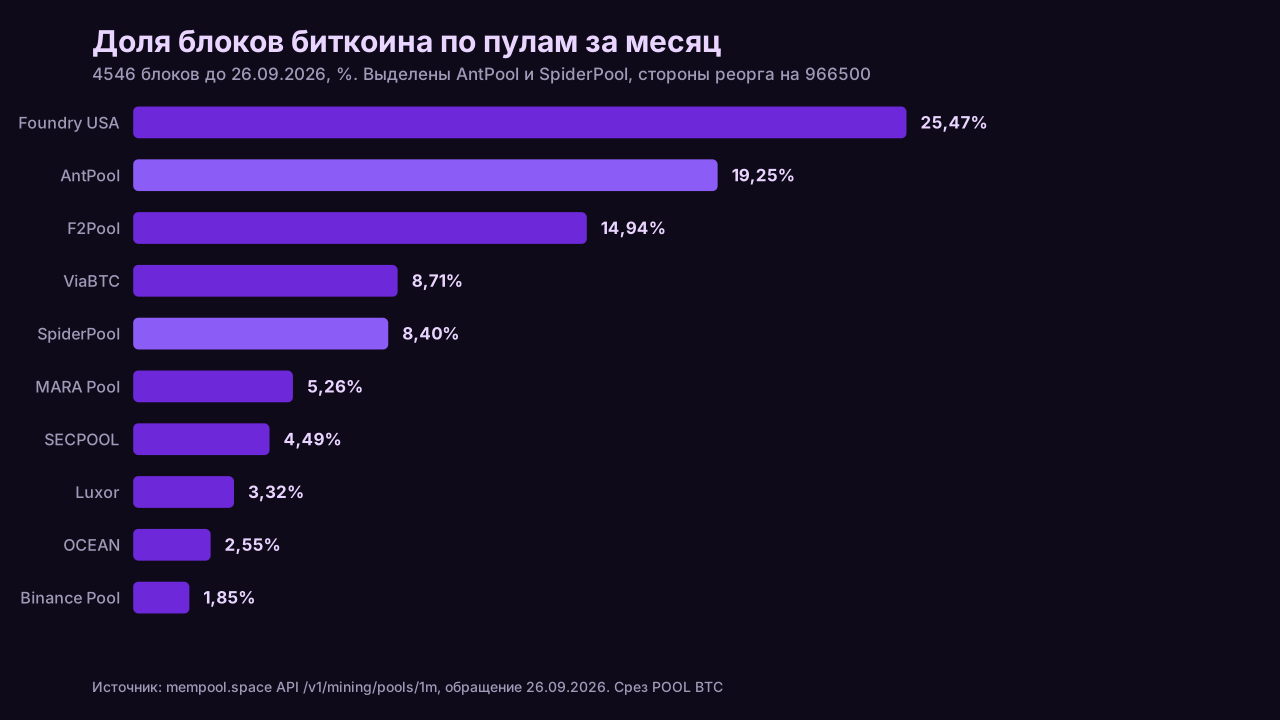
On these numbers AntPool alone had roughly one sixth of network hashrate on its side before other pools picked a branch. That does not prove AntPool wins races more often. For that you would need per-pool statistics, and nobody publishes them in ready form. The open dataset bitcoin-data/stale-blocks counted 3929 stale blocks across Bitcoin's whole history as of 2026-09-25, but its description has no breakdown by pool or by month. We also found no established figure for one-block reorgs per month in 2024-2025: Galaxy's "third in a month" describes one episode, not long-run statistics.
A separate and rarer case happened on March 24, 2026: a two-block reorg in which Foundry USA's branch replaced blocks from AntPool and ViaBTC. The Block and CoinDesk both reported it.
The Ocean and Braiins comparison covers how Stratum V2 and DATUM change who builds block templates, which is the other half of the concentration question.
Who loses money in a reorg: the pool, an FPPS miner, a PPLNS miner, a solo miner?
The stale block earns nothing, so somebody absorbs the missing reward. On FPPS and PPS the pool does, because it already paid for each share. On PPLNS the pool's miners do, because the round they were paid from never produced a spendable block. On SOLO the miner who found it loses the whole block reward.
| Scheme | Who carries the loss | What the miner sees |
|---|---|---|
| FPPS / PPS | The pool | Earnings per share do not change |
| PPS+ | The pool on the subsidy, the miners on the fee part | Subsidy part unchanged; the fee part is paid PPLNS-style, so fees from a stale block are not paid |
| PPLNS | The pool's miners | The block and its reward do not appear, or appear and then get marked orphan |
| RBPPS | The miner (the round is not paid) | Per-share rate is fixed, but a round ending in an orphan goes unpaid |
| SOLO | The miner who found the block | The whole reward disappears, no partial credit |
In the 966500 case the loser was SpiderPool's block, about 3.1389 BTC by aggregator figures. SpiderPool offers several schemes for BTC: PPS, PPS+, FPPS, PPLNS and SOLO. It publishes no separate rule on orphan blocks. Following the table above, miners on PPS and FPPS were not affected, while miners on PPLNS lost that block from their round. On the winning side nothing changes for AntPool miners, since their block stayed in the chain.
Our research shows most large BTC pools now pay on FPPS: Foundry USA, Binance Pool, Luxor and EMCD use only FPPS for BTC, Braiins Pool switched fully to FPPS in December 2023, and F2Pool defaults to FPPS with PPLNS as an option. For miners at these pools a single orphan does not change their accrual.
What that costs in dollars on the same hashrate is worked out in FPPS, PPS+, PPLNS and SOLO side by side. To see your own expected income without luck and orphans, use the POOL BTC calculator.

How many confirmations do pools wait before crediting a block?
The protocol sets one hard rule: coins from a coinbase transaction cannot be spent until 100 more blocks are built on top of the block. At a 10-minute target that is roughly 16-17 hours. Pools usually show a found block as unconfirmed or immature until then, because a reorg in that window would erase it.
Pools set their own rule for when to credit balances on top of that:
- Block found. The pool sees its block accepted by its own node.
- Unconfirmed / immature. The block counts, but the reward is locked by the protocol.
- Crediting. On PPLNS and SOLO the pool credits the reward after its own confirmation threshold. We could not confirm on official pages how many confirmations AntPool, F2Pool, ViaBTC and SpiderPool wait: their help sections sit behind anti-bot protection, and the open pages do not give the number. Ask your pool's support.
- Maturity at 100 blocks. The coinbase becomes spendable, and the pool can move those coins.
- Payout. Your balance reaches the payout threshold and a transaction goes out.
On FPPS this chain barely affects you. The pool credits shares from its own balance, and Foundry USA, for example, calculates daily earnings for the previous UTC day. Whether a specific block matures does not change that figure.
A one-block reorg is settled by the very next block, far inside the 100-block window. That is why the lost SpiderPool reward could not have been spent: it had not matured.
How does a pool show a lost block, and how can you check it yourself?
Pools that publish a block list usually mark a stale block with a status like orphan, rejected or invalid, instead of confirmed. On PPLNS the reward for that block drops out of the round. On FPPS your earnings line stays the same. You can check the block yourself by comparing its hash with the block explorer at that height.
What the statuses on a dashboard usually mean is covered in how to read pool stats: luck, orphan rate, unconfirmed. The exact labels differ by pool. ViaBTC's blog distinguishes orphan, stale, invalid and confirmed. We did not check the labels at AntPool, F2Pool and SpiderPool.
To check a specific block:
- Open the pool's block list and copy the height and hash of the block you are unsure about.
- Look up the block at that height in a block explorer. The mempool.space API, for example, returns the main-chain hash by height at `https://mempool.space/api/block-height/
`. - Compare the hashes. If they match, the block is in the main chain. If they differ, the pool's block at that height is stale.
- On PPLNS, check that the stale block's reward is not counted in your balance.
- On FPPS, check that your daily earnings did not change on the day of the reorg.
A pool's orphan rate says more than a single case. Neither the large BTC pools nor the open datasets we checked publish a per-pool orphan rate for 2025-2026. The only reference point is a network-wide figure from a 2013 study, 1.69%, and it is long out of date.

Should you switch pools because of reorgs? Checklist
Usually no. A one-block reorg is a normal network event, and Galaxy Research found no attack behind the three in a month. Switching makes sense when the pool's own orphan rate stays above peers for months, when stale blocks are hidden from the dashboard, or when your scheme puts the loss on you and you did not know it.
Go through this list before moving your hashrate:
- Know your scheme. FPPS means an orphan does not touch your earnings. PPLNS, RBPPS and SOLO mean it does.
- Check the terms. Find the pool's rule on stale blocks in its help pages. The wording varies more than the scheme names suggest.
- Look for a block list. A pool that shows stale blocks openly is easier to check than one that shows only confirmed blocks.
- Compare orphan rate over months, not days. One reorg is noise. Nobody publishes an accepted threshold for a "high" orphan rate, so compare your pool with its peers over the same period.
- Check a block against the explorer using the steps above if your PPLNS balance looks short.
- Count what switching costs you. Moving from FPPS to PPLNS to "win back" orphans increases variance, and your unpaid balance may stay below the threshold at the old pool.
- If you mine SOLO, accept that a stale block is part of the lottery. Our list of solo blocks found in 2026 shows how rare a find is in the first place.
If you are choosing a pool from scratch, orphan handling is one line in a longer list: see the guide to choosing a Bitcoin mining pool.
What was not accounted for
- Who was on both sides of the August reorgs at 962722 and 963853 is not in our data.
- Aggregator reward figures for 966500 were not checked against a block explorer.
- A pool's own confirmation threshold can differ from the protocol's 100 blocks, and pools rarely publish it.
FAQ
Did anyone lose bitcoin in the reorg at 966500?
The stale SpiderPool block, about 3.1389 BTC by aggregator figures, was never paid. Who absorbed it depends on the scheme each miner chose: SpiderPool offers PPS, PPS+, FPPS, PPLNS and SOLO for BTC and publishes no separate orphan rule.
Were transactions from the dropped block lost?
No. Transactions that were not in the winning block go back to the mempool and get included in later blocks.
Can a one-block reorg reverse my pool payout?
A payout is a normal transaction. If it was in the dropped block and not in the winning one, it goes back to the mempool and gets confirmed later. The coinbase reward itself cannot be spent until 100 blocks, so a pool does not pay out from an unconfirmed coinbase.
Is a stale share the same as a stale block?
No. A stale share is late work sent to the pool and not credited. A stale block is a whole valid block that lost a race in the network.
Does FPPS protect me from reorgs completely?
From the lost orphan reward, yes: the pool carries it and your per-share earnings stay the same. It does not protect you from a pool that shuts down or delays payouts, and the guarantee has a price: F2Pool, for example, charges 4% on FPPS and 2% on PPLNS.
You can estimate what your hashrate should earn in the POOL BTC calculator.
This article contains referral links to mining pools (marked as sponsored). We may receive a reward if you register through them. This does not change the figures or the order of rows in the tables: the terms are taken from the pools' official pages.