
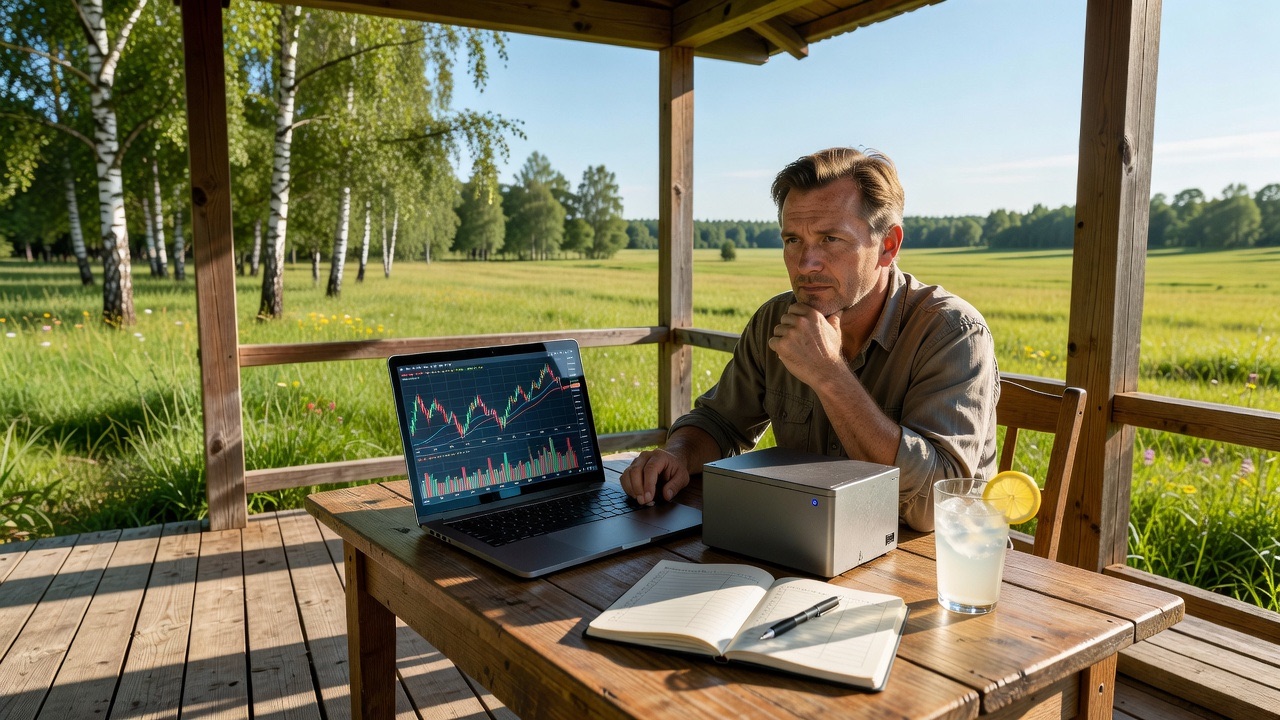
How to choose a Bitcoin mining pool in 2026
Pick a pool by your hashrate and by how much income variance you can live with, not by the logo. One ASIC at home does well on FPPS or PPS+ with a low minimum payout and a fee of 4% or less. A large farm negotiates fees and cares about stratum latency. A solo miner accepts that most months pay nothing. Every pool figure below comes from the POOL BTC dataset, last updated 2026-11-02.
POOL BTC is an independent comparison site. We do not run a pool and we do not take your hashrate.
Two questions first
Two answers decide most of it.
- How much hashrate do you have? One machine at 100 to 250 TH/s is a different problem from a container of 200 machines.
- Do you want steady income or a lottery ticket? Steady comes from a pool that pays for shares. The lottery is solo mining: the whole block or nothing.
Network hashrate was about 1,080 EH/s on 2026-10-27, and the block reward is 3.125 BTC since the April 2024 halving. At those numbers a single ASIC will practically never find a block alone, which is why nearly everyone mines in a pool.
Decision tree by scenario
| Your situation | What matters most | What to pick | Pools worth checking |
|---|---|---|---|
| 1 ASIC at home | Low minimum payout, simple dashboard, steady income | FPPS or PPS+, fee up to 4% | Trustpool (PPS+, 1%), Luxor (FPPS, 2.5%), ViaBTC (PPS+, 4%), EMCD (FPPS, 4%) |
| Small farm, 5 to 50 machines | Fee, worker monitoring, support that answers | FPPS, watch-only links, sub-accounts | Luxor, F2Pool, AntPool, Promminer |
| Large farm, hundreds of machines | Negotiated fee, uptime, regional stratum servers | FPPS with a personal fee agreement | Ask several pools for a quote and compare it with the public fee |
| Solo lottery | Zero fee, no payout threshold, a stratum that connects | SOLO | Public Pool (0%), Braiins Solo (0.5%), AtlasPool (1.5%), CKPool Solo (2%) |
Fees and schemes are the ones listed in our pool comparison. A public fee is a starting point. Large accounts often negotiate, but we have no verified numbers for those deals.
Scenario 1: one ASIC at home
You want money to arrive on a schedule you can predict, so you want a pool that pays for every valid share instead of waiting for blocks.
- Scheme: FPPS or PPS+. Both pay a fixed amount per share, so a bad-luck week for the pool does not touch your balance.
- Minimum payout matters more than it looks. At 200 TH/s and a 4% fee a machine earns about 0.00008 BTC per day (calculation below). A 0.005 BTC threshold, as listed by AntPool and F2Pool, takes about 62 days to reach. 0.001 BTC takes about 12 days. 0.0001 BTC, as at EMCD, Promminer and Tpool, takes a little over a day.
- Fee: 4% is the most common public number on large pools. Cheaper ones exist: Tpool is listed at 0.9% and Trustpool at 1%. The full list is in the pool comparison.
- Backup pool: most ASICs have three pool slots. Fill all of them so the machine keeps hashing if the first endpoint goes down.
Scenario 2: a small farm
At 5 to 50 machines one percentage point of fee is real money, and so is support quality.
- Use sub-accounts or worker names so you can see which machine dropped.
- Check whether the pool offers read-only dashboard links for a hosting provider or partner.
- Look at the payout interval and the withdrawal fee on your network, not only the pool fee.
- Run two pools in parallel for a month, each on part of the fleet, and compare accepted hashrate instead of the marketing page.
Scenario 3: a large farm
Hundreds of machines change the checklist.
- Ask for a written fee quote. The public number is a ceiling, not a price list.
- Ask which regional stratum servers exist and measure latency from your site.
- Ask about concentration. A pool with a big share of the network is a centralization risk for Bitcoin and a counterparty risk for you.
- Check what happens to your unpaid balance if the pool freezes the account.
We have no verified negotiated-fee data, so we quote none. The methodology page explains what we verify and what we do not.
Scenario 4: solo mining
Solo mining is a lottery. If your hashrate finds a block you keep the whole reward minus the pool fee. If it does not, you earn nothing.
- In the dataset, Public Pool lists a 0% fee, Braiins Solo 0.5%, AtlasPool 1.5%, and CKPool Solo and SoloPool.com 2%. BTC PoW Lab is recorded as a hybrid solo scheme at 5%.
- There is no minimum payout, because the reward arrives in one piece when a block is found.
- It suits small hobby machines and people who mine for the thrill. If the income has to cover the power bill, it does not suit you.
The seven-point checklist
Run any candidate pool through this before you point a machine at it.
- Is it a BTC pool? Several pools in the dataset do not mine Bitcoin, so check the coin column.
- Payout scheme. FPPS, PPS+, PPLNS or SOLO. The pool comparison explains the differences.
- Fee and what it covers. The same 4% can treat transaction fees differently. Ask how they are shared.
- Minimum payout and frequency. Work out how many days your machine needs to reach the threshold.
- Withdrawal costs. On-chain fees and any service fee.
- Fee check date. Pools change prices. In the dataset the check dates run from 2026-08-18 to 2026-11-02.
- Exit plan. With a standard pool you change the stratum URL in a couple of minutes and leave.
A worked income estimate
Take 200 TH/s and a network of 1,080 EH/s, which is 1,080,000,000 TH/s. Your share is 200 / 1,080,000,000, about 0.000000185.
There are about 144 blocks a day at 3.125 BTC, so the network earns about 450 BTC a day before transaction fees. Gross: 450 x 0.000000185 = 0.0000833 BTC per day.
BTC price on 2026-10-27: 80,522 USD. The table uses it.
| Fee | Net BTC per day | USD at the 2026-10-27 price | Days to 0.001 BTC |
|---|---|---|---|
| 1% | 0.0000825 | about 6.64 | about 12 |
| 2.5% | 0.0000813 | about 6.54 | about 12 |
| 4% | 0.0000800 | about 6.44 | about 12.5 |
The gap between 1% and 4% costs this miner 0.0000025 BTC a day, about 0.20 USD. Over years it adds up, but less than the gap between mining and not mining when electricity is expensive. Use the calculator for your own numbers. This is share-of-hashrate arithmetic, not a forecast: difficulty and price move.
What not to do
- Do not chase the lowest fee alone. A 0.9% pool with a scheme that suits you badly costs more than 4% on one that fits.
- Do not split a single machine across many pools to diversify. You reach every threshold more slowly.
- Do not trust screenshots of someone else's earnings. Hardware, uptime and luck differ.
FAQ
Which pool is best for one ASIC at home?
There is no universal winner. Look for FPPS or PPS+, a minimum payout of 0.001 BTC or lower, and a fee you accept. Trustpool, Luxor, ViaBTC, EMCD and Promminer all fit that in the dataset. Compare them on the pool list.
Is a lower fee always better?
No. The fee is a percentage of what the scheme pays. Scheme, transaction-fee sharing and downtime matter just as much.
Can I mine Bitcoin without a pool?
Yes, on a solo pool or with your own node. At 3.125 BTC per block and a network near 1,080 EH/s, a small miner hits a block rarely and mostly earns nothing.
How often should I switch pools?
Rarely. Switch if fees rise, payouts fail or the pool disappears. Switching costs only a stratum URL, but the wait for the minimum payout starts over.
Where does your pool data come from?
From each pool's official pricing and help pages, with a check date on every row. It sits in the open dataset under CC BY 4.0, and the methodology page describes the checks.
This article contains referral links to mining pools (marked as sponsored). We may receive a reward if you register through them. This does not change the figures or the order of rows in the tables: the terms are taken from the pools' official pages.