
AntPool review: the Bitmain pool, its payout schemes, and the numbers it does not publish
*Last updated: 02.09.2026. Author: POOL BTC editorial team.*
POOL BTC does not run a mining pool, does not accept hashrate and does not pay anyone a reward. We compare other people's pools from the outside, the way a miner does before deciding where to point a machine. AntPool is not a partner of ours and there are no referral links to it in this text.
One thing separates AntPool from every other pool near the top of the list: its owner, Bitmain, also builds a large share of the machines running on the Bitcoin network. What follows is a review of that single pool. If you want the three way fee comparison instead, we keep it in a separate piece: TRUSTPOOL vs Foundry USA vs AntPool, which also runs the income math on a specific ASIC.
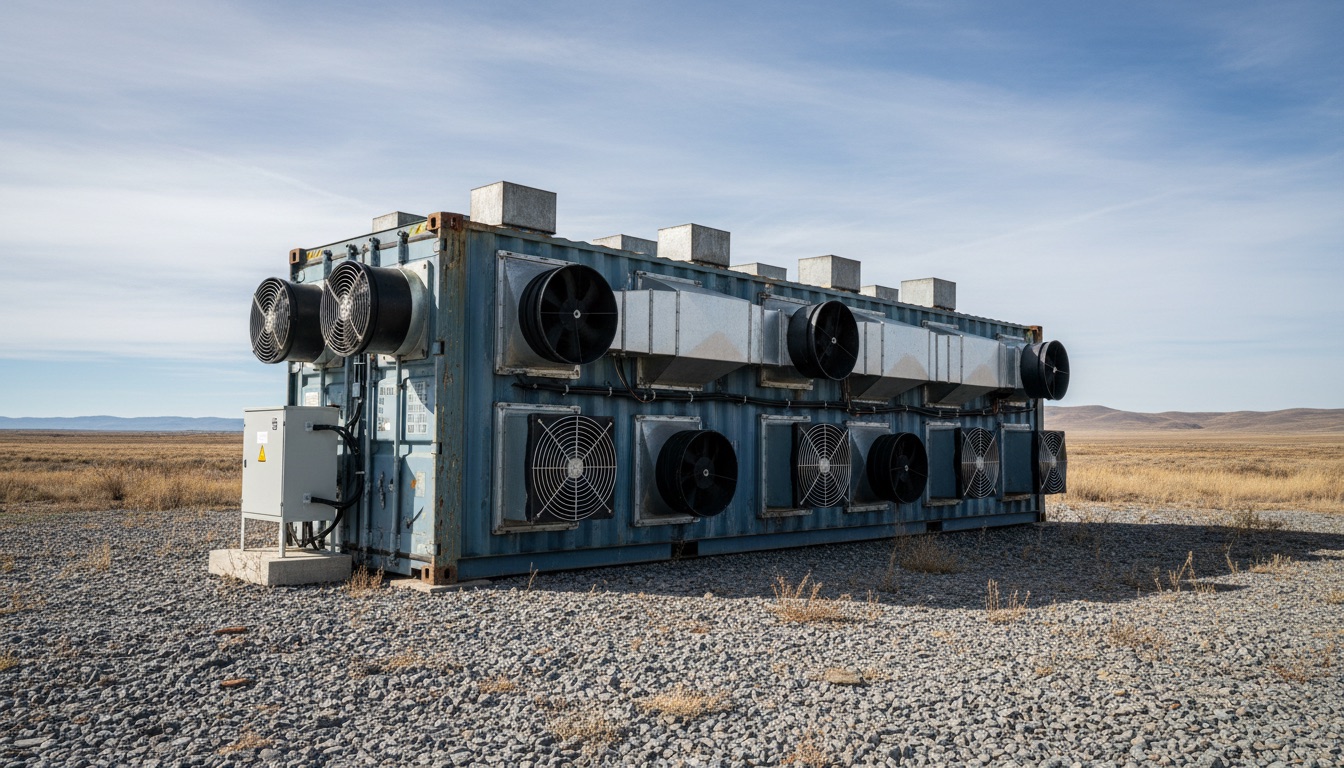
[IMAGE: container data centre on a green hillside, clear daylight, ventilation ducts and tall grass in the foreground, bright airy colours]
Where these numbers come from
Every figure here traces back to two internal checks: pool fees, payout thresholds and a network snapshot dated 29.08.2026, and a breakdown of payout schemes and PPLNS windows dated 01.09.2026. Where the pool says nothing, or where sources disagree with each other, the text says so instead of filling the hole. Invented placeholder figures in mining reviews have a habit of surviving for years and spreading into other people's articles.
The short version as of this update:
- Bitmain owns the pool and manufactures the Antminer line.
- The AntPool homepage lists FPPS, PPS and PPLNS support for Bitcoin.
- PPLNS is available as an option rather than the default scheme.
- The pool describes its PPLNS window as "the last N difficulty rounds" and never states N.
- Two official AntPool pages give opposite answers about who receives transaction fees under PPLNS.
- The pool publishes neither its fee rate nor its minimum payout on its own site, and third party sources disagree.
Who owns AntPool and why it matters
AntPool belongs to Bitmain. Among the large pools it is the only one whose owner also produces a meaningful share of the hardware securing the network.
The upside is easy to describe. Firmware, connection documentation and hardware service questions such as a dead hashboard all stay inside one ecosystem instead of bouncing a miner between a hardware vendor and a pool operator.
The downside is equally easy. A single company influences both what hardware reaches the market and where a noticeable slice of network hashrate ends up. That has no effect on your daily payout, but it belongs in any honest look at network risk. Per mempool.space data on 29.08.2026, AntPool remains near the top by blocks found. We are not quoting a share percentage, because our snapshot recorded the presence in the top group and not a number.
[PLACEHOLDER: confirm with the user whether to source AntPool's network hashrate share from mempool.space or miningpoolstats, over which averaging window, and as of which date]
We covered hashrate concentration and what Stratum V2 changes about it in a separate article on pool decentralisation and custom block templates.
Which payout schemes does AntPool offer?
The AntPool homepage lists FPPS, PPS and PPLNS support for Bitcoin, checked by hand on 29.08.2026. PPLNS is something the miner switches on, not what runs by default. Our 01.09.2026 review of scheme documentation found the same pattern across major Bitcoin pools: PPLNS is either missing entirely or offered as an alternative to the primary scheme.
Which scheme a fresh account starts on is not stated plainly on the pool's public pages. Across the pools in that review, the default sits in the PPS family, meaning PPS+ or FPPS rather than PPLNS.
[PLACEHOLDER: confirm with the user whether PPS+ is verified as the default scheme for a new AntPool BTC account, and on which pool page that is documented]
The practical difference between the families is about who carries variance. PPS and FPPS move that risk onto the pool, and the pool charges for taking it. PPLNS leaves the risk with you, so a run of bad luck lands directly in your payout. We walk through both models in the article on FPPS and PPLNS.
What fee does AntPool charge?
We do not have a confirmed number, and that is the honest answer rather than a hedge. As of 29.08.2026 AntPool publishes no rate on its own site: the homepage lists supported schemes only, and the fee help page returns a 404. Third party sources contradict each other, so any single percentage you see in a review is the author's pick, not the pool's statement.
Here is what existed on the date of the check, and how far each source can be trusted:
| Source | Fee | Minimum payout | Status |
|---|---|---|---|
| AntPool site, manual check 29.08.2026 | not published | not published | primary source, no figures, fee help page returns 404 |
| One group of aggregators | FPPS 2.5%, PPLNS 1.5% | 0.001 BTC | secondary source, not confirmed by the pool |
| Another group of aggregators | FPPS up to 4% | not stated | secondary source, not confirmed by the pool |
| POOL BTC pool table, snapshot before 29.08.2026 | 4% across schemes | 0.005 BTC | our own earlier aggregator based snapshot, not confirmed by the pool |
The threshold gap matters more than the fee gap here. A jump from 0.001 to 0.005 BTC is a fivefold change in how long earnings sit on the pool's balance, which for a single machine turns a payout every few days into a payout every few weeks. The check takes a minute: pull your daily output from the profitability calculator and divide the threshold you see in your pool dashboard by it.
Until you have confirmed that threshold yourself inside the account, treat any AntPool estimate as provisional. That includes the figures in our own pool table.
How large is the AntPool PPLNS window?
The pool describes the window in words and never in numbers. The official wording from its help centre reads: "calculated by the proportion of miners' hashrates in the pool's total in the last N difficulty rounds, when a block is found". So the window is measured in difficulty rounds, and the value of N does not appear on any official page we could check on 01.09.2026.
Window size decides how much of your older work still counts when the pool finds a block, and how badly a few hours offline hurts. Without N you cannot model that in advance. You can only watch what actually lands in the account.
For context, here is how other pools describe the same parameter in our 01.09.2026 review:
| Pool | Official description of the window |
|---|---|
| AntPool | "the last N difficulty rounds", value of N not stated |
| ViaBTC | "the past 5 difficulty rounds" |
| Ocean | TIDES scheme, window equals eight times network difficulty worth of shares |
| F2Pool | "last N shares", no difficulty multiple published for BTC |
| Binance Pool | PPLNS formula given in the general FAQ, N for BTC not stated |
| Braiins Pool | no PPLNS since December 2023, the pool moved fully to FPPS |
| Foundry USA | no PPLNS, FPPS accounted over the previous UTC day |
| Luxor | no PPLNS, FPPS with transaction fees averaged over 144 blocks |
Ocean publishes the most detailed window maths of any pool we checked. AntPool sits at the other end of that column: the sentence exists, the number does not.
[IMAGE: bright outdoor scene, a person with a laptop at a wooden table on a porch surrounded by greenery and sunlight, a share distribution chart on the screen]
Who gets the transaction fees under PPLNS: the pool answers twice
This is the strangest thing in AntPool's documentation. Two official pages answer the same question in opposite ways, and both were live when we checked on 01.09.2026.
The newer version, from the GitBook help centre:
> "Transaction fees will be allocated to miners too. The pool charges 0 commission fees for PPLNS."
The older version, from the Zendesk help centre, revision dated 14.12.2022:
> "Transaction fees not paid out to miners are for maintenance and bonus for our engineers."
One says transaction fees go to miners and the pool takes no commission on PPLNS. The other says fees that are not paid out to miners fund maintenance and engineer bonuses. We are not picking a side and we are not averaging them. Both are primary sources from the same pool, and only AntPool can resolve the conflict.
It helps to know the size of the disputed pot. Per mempool.space, transaction fees made up 0.73% of total block reward over the last 4320 blocks as of 29.08.2026, against a 3.125 BTC subsidy. In a quiet mempool that is a second order amount. During congestion the fee share climbs, and wording about undistributed fees stops being a footnote.
If you are seriously considering PPLNS here, email support, ask the question in writing, and keep the answer. A dated reply from the pool is worth more than any review, this one included.
Payout threshold, custodial balance and leaving the pool
Between the moment earnings are credited and the moment a transaction leaves, the coins sit on the pool's balance and you hold no keys to them. The smaller your hashrate, the longer that period runs. Wallet choice follows from that: see wallets miners actually use for payouts.
Leaving is the part with no published answer. In the 01.09.2026 review we looked for an official statement from twelve pools about what happens to an accrued balance and to unsettled shares when a miner disconnects. AntPool has no such wording on its public pages. That does not prove no policy exists. It means the policy is not published.
For contrast, only one pool of the twelve had an explicit legal rule: F2Pool's terms of service state that a user forfeits accrued rewards if no valid payout address is provided within six months of written notice. Unpleasant to read, but at least written down.
One detail AntPool does document clearly: a worker is marked Inactive after more than 20 minutes without a connection and Invalid after more than 24 hours, with invalid workers deleted automatically. That is monitoring behaviour rather than balance policy, though it is worth knowing when you are trying to explain a gap in your stats.
Who AntPool suits, and who it does not
| Profile | Verdict |
|---|---|
| A fleet of Bitmain machines, one vendor for hardware and pool | Worth a look, the integration saves real time on service and firmware |
| First machine at home | Confirm the current payout threshold in the dashboard first, it decides whether you wait days or weeks |
| You want steady daily income | The PPS and FPPS mechanics fit, but you will have to establish the fee somewhere other than reviews |
| You want transparent PPLNS maths | Poor fit, the window size is unpublished and nothing can be modelled in advance |
| Mixed fleet from several manufacturers | The integration advantage disappears, compare on ordinary criteria |
| Network decentralisation is a priority | Look at pools running their own block templates with Stratum V2 support |
| You need written rules about your balance if you leave | Ask support directly, we found no public rule |
Check these before you connect
- The fee rate for your scheme inside the dashboard after registration, not in anyone's review.
- The minimum payout, and whether you are allowed to change it.
- Whether a separate withdrawal fee applies and how much of a small payout it eats.
- The time and time zone in which the pool builds payout transactions.
- Which scheme the account runs on immediately after registration.
- Support's written answer on PPLNS transaction fees, if PPLNS is what you want.
- The revision date of whichever help page you are relying on.
[IMAGE: sunny morning, solar panels and a small equipment container against a field and treeline, calm bright colours]
Frequently asked questions
Does AntPool publish its PPLNS window size?
No. The help centre describes the window as "the last N difficulty rounds" with no value for N, checked 01.09.2026. ViaBTC by comparison states five difficulty rounds, and Ocean defines its window as eight times network difficulty worth of shares. At AntPool there is nothing to calculate from in advance.
What fee does AntPool actually charge?
As of 29.08.2026 the pool publishes no rate on its own site and the fee help page returns a 404. Aggregators disagree: some list FPPS at 2.5% and PPLNS at 1.5%, others list FPPS up to 4%. The only reliable source is your own dashboard after registration, where the rate is tied to your scheme.
Does pool size change my income?
Under PPS and FPPS, barely. Payouts follow the theoretical probability of finding a block rather than the pool's luck in a given week. Under PPLNS, size affects how smooth your income looks, because luck averages out faster in a bigger pool. Expected income itself does not move with size.
Can I leave AntPool without losing anything?
Switching pools is a settings change in the machine's web interface and takes minutes. What happens to an accrued balance and to unsettled shares on departure is not described on AntPool's public pages, and we found no such wording as of 01.09.2026. Clearing the payout threshold before you leave is the safer sequence.
How much does the transaction fee dispute matter?
Per mempool.space, transaction fees were 0.73% of total block reward over the last 4320 blocks as of 29.08.2026. While the mempool stays quiet the argument covers a small supplement. During network congestion the fee share rises, and the question of who receives those fees starts to carry real money.
---
*POOL BTC is an independent comparison site. We do not operate pools, do not accept hashrate and receive nothing from AntPool. Pool parameters change without announcements, so verify them in your own dashboard on the day you connect. Nothing here is investment advice.*
*Sources for figures: fee and network snapshot dated 29.08.2026 (mempool.space), payout scheme and PPLNS window review dated 01.09.2026 (official pool help centres).*
*Last updated: 02.09.2026.*
This article contains referral links to mining pools (marked as sponsored). We may receive a reward if you register through them. This does not change the figures or the order of rows in the tables: the terms are taken from the pools' official pages.