
ASIC hosting for 1 to 10 machines: providers compared on rate, minimum and repair terms
Simple Mining, Compass Mining ("where possible") and Abundant Mines take a single machine. Blockware Solutions starts at ten, Ihmining at five, EVI Mining at fifty. The rate per kilowatt hour is the easiest number to compare and the least useful one alone. Check three things first: who pays for a power supply swap, whether a status page exists, and whose pool the coins go to.
pool-btc.com hosts nothing and takes no money from the providers below. This is a summary of what the companies published themselves, on their sites and in their contracts, plus what courts and independent reviewers published about them. Sources were accessed on 01.09.2026 and 11.09.2026.
Comparison table: who accepts a small client
| Provider | Country | Min. machines | Rate | Included in the rate | Who pays for repairs | Status page | KYC |
|---|---|---|---|---|---|---|---|
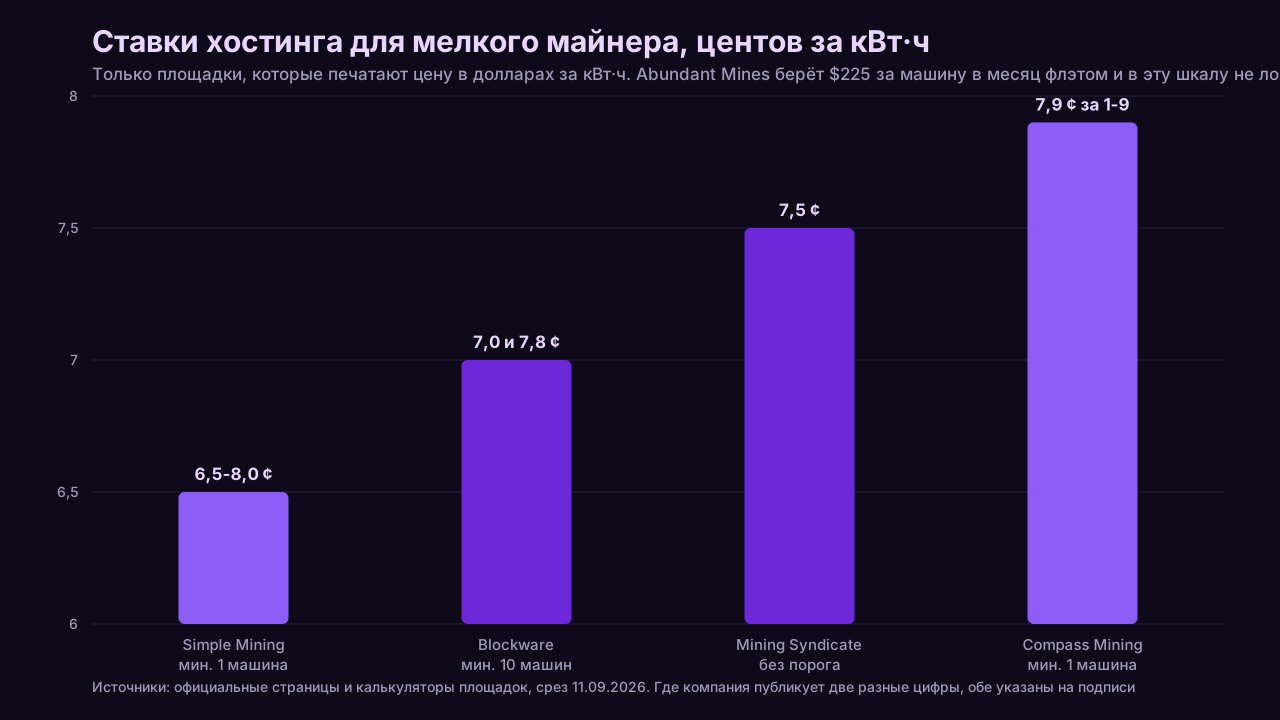
| Simple Mining | USA, Cedar Falls, Iowa | 1 | $0.065-0.08 by volume in their own calculator, while the marketing page says "from $0.065" | Power, cooling, monitoring, security, standard support. Billed on nameplate power, not actual draw | Free for the first 12 months on hardware bought from them: labour plus $500 per unit per year in parts. Marketplace hardware is not covered in year one | status.simplemining.net exists, but it reports dashboard and website availability, not the farm. "95%+" is claimed with no log | Not required by hosting, depends on the client's pool and wallet |
| Compass Mining | USA, entity in Wilmington, Delaware, partner facilities | 1 "where possible" | $0.079 for 1-9 units, $0.074 from 100 up, promo on the S21 XP at $0.07 | Power, troubleshooting, maintenance | Fan swap free, PSU replacement $299 paid by the client, outbound shipping to the repair centre paid by the client: $200 in the US and Canada, $400 international | status.compassmining.io, live, downtime credits count from 48 hours | Required for fiat payouts through the platform |
| Blockware Solutions | USA: Kentucky, Texas, North Dakota, Missouri, 7 sites | 10, roughly $40,000 | $0.07 on one page of the site and $0.078 on another, still unresolved on 11.09.2026 | Not itemised publicly | They inspect the hardware; if they call it inefficient, the client either pays for repair per their estimate or removes the machines at their own cost | statuspage.io, real outages and curtailment events show up there | Full beneficial owner due diligence per the contract: AML, SDN, PEP |
| Mining Syndicate | USA, Rockwall, Texas, plus up to 7 partner sites | None formally, "as little as 1% of a miner" | $0.075 on product pages, $0.10-0.11 in a voskcoin review dated 28.01.2025 | Not itemised publicly | New machines under manufacturer warranty, used ones 30 days from the company. Who pays for a PSU afterwards is not published | None public. The contract sets a target uptime of 90-95%, credits if actual falls below 95% | Basic contact details only |
| Abundant Mines | USA, Oregon | 1, discounts from 10, 25, 50, 100, 200 | $225 per machine per month, flat, not per kWh | Power, racking, monitoring, maintenance, full replacement cost insurance | Hashboards and PSUs are not covered without the EPP option at $10 per machine per month, except in the first year of ownership | None public. 98% is claimed along with a Hashrate Redirect mechanism, neither independently verifiable | Not stated as a contract requirement |
For contrast: CleanSpark and Core Scientific publish no retail offer at all. Their contracts are institutional, tens to hundreds of megawatts, and the rate is a share of revenue rather than dollars per kilowatt hour. A ten machine owner has nothing to compare there.
Not one provider in the table publishes an actual annual log of downtime hours. There is a contractual target, or a marketing figure with no methodology behind it. That is probably the single most useful finding in this comparison.
Why one company shows three different prices
Because pages get updated at different times and nobody reconciles them. The practical takeaway: a number from a landing page does not belong in your spreadsheet until a salesperson confirms it in writing or you read it in the contract. Four cases below are visible on public pages right now.
- Blockware Solutions. The marketdisruptors page says $0.07, the starter pack FAQ says $0.078. Both are official, both were live on 11.09.2026, and most pages carry no update date.
- Abundant Mines. Marketing says you keep 100% of the bitcoin. Section 4.2 of the hosting agreement says the host uses a preferred mining pool for payouts. Any pool fee on top of the hosting fee is not disclosed.
- Blockware on the same question. The contract mentions Blockware Pools, the company's own pools; marketing promises "Bitcoin flows to a wallet you control".
- New Mining Company. The current Russian page requires a minimum of 10 devices on both plans. The English version of the site, an outdated clone, offers a monthly plan with no device minimum and a fifteen year plan with a minimum of 50. Norway rate: 0.05-0.08 euro per kWh in the Russian version, 0.08-0.1 euro in the English one.
- R7miner. The official site lists Yamalo-Nenets and 5.1 roubles per kWh, the aggregator ultramining.com lists Troitsk and "from 5.50 roubles", trustmining.ru lists Vladimir region and 6.2 roubles. The legal entity, Right Group LLC, is registered in Saint Petersburg.
We are not claiming anyone misleads clients deliberately. We are recording that these companies' own public data contradicts itself, and that averaging the versions would hide the problem rather than solve it.
What is publicly on record about reputation
Below is only what has been stated publicly: filed complaints, Trustpilot reviews and independent write-ups. A lawsuit is not a finding of guilt and a review is not evidence. We give who said what and when, with a link, so you can read the primary source.
Compass Mining. Its Russian partner facility, BitRiver, was added to the OFAC SDN list on 20.04.2022, after which roughly 4,000 customer machines were left in Siberia. Clients sued: Veribi LLC claimed $1.5 million in damages in a California court, some fraud claims were dismissed in April 2023 while breach of contract and negligence claims continued; a separate $2 million suit was filed in Florida in 2023. Sources: Bloomberg, WIRED, Decrypt. Separately, the Terms of Service state that all sales are final and no refunds are issued.
Blockware Solutions. A federal suit by Faes & Company, December 2022, Northern District of Illinois, case 1:22-cv-07121. The plaintiff alleged the company displayed "100% uptime" on its public status page while actual uptime at a Pennsylvania site was around 70%, with roughly 50 days of curtailment not reflected. The case went to arbitration and was dismissed in August 2023 without a ruling on the merits, so the allegations were never tested in court. CoinDesk.
Mining Syndicate. Dozens of Trustpilot reviews from 2024 and 2025 describe months of downtime with no response, unreturned deposits, $5,000 and up for some clients, and machines moved to another host without refunds. These are user reviews, not facts established by a court. Trustpilot.
EVI Mining. A write-up on cryptorussia.ru dated 13.02.2026 reports that Evi Global Group was registered on 30.05.2024 at an address shared with 146 other companies, that licences shown on the site belong to unrelated legal entities with no explanation, that filed accounts are nil, and that no independent reviews exist. The author calls these markers of a potential scam. That is the author's assessment. cryptorussia.ru.
Ihmining and Irkutsk. Since 2024 the Irkutsk region has banned industrial mining until 2031, permitting no more than three licensed mining hotels. Ihmining operates a site in Irkutsk. What this means for an individual client contract is not explained publicly, so ask the company directly. Separately, an Ihmining marketing page promises 99.9% uptime while its own tariff grid is priced against 77% and 99%.
A market wide risk for Russian facilities, flagged by an independent review on vc.ru: some hosts write a reduced uptime figure into the contract, say 97%, then during the "idle" hours do not switch the machine off at all but point its hashrate at the data centre's own wallet. The contract is formally intact and the client earns less. There is one way to check: point the machines at your own pool and reconcile hashrate on its dashboard. Our article on how to check whether a pool pays fairly walks through the method.
CIS providers that take five machines
Russian retail hosts accept small clients more readily than American ones and publish considerably less. None of them posts a full contract, and almost none says who pays for a PSU.
| Provider | Region | Min. machines | Rate | Separately disclosed |
|---|---|---|---|---|
| Ihmining | Moscow, Kostroma, Irkutsk and others | 5 | 4.1-5.3 RUB per kWh, tied to a claimed 77% or 99% uptime | Repairs included per marketing, contract not published. Pool and wallet not published |
| DIGITAL NORTH | Russia | Not stated | from 3.3 RUB per kWh, 97% uptime claimed | The only one to state in writing that it does not use its own pool: the client mines to the pool they choose. Response within 4 working hours, repair within 48 hours |
| FastMine | Moscow, Domodedovo, Krasnoyarsk (store); gas generation (energy) | from 10 ASICs or 30 kW on energy, no explicit threshold on store | 3-5 RUB per kWh on gas generation, from 4.3 RUB per kWh on store | Listed in the Russian mining infrastructure operators register. Response within 30 minutes. Payouts, KYC and contract term not published |
| Interhost | Krasnoyarsk | "even 5 ASICs", discount from 50 | 4.1 RUB per kWh at night with 70% uptime, up to 6.15 RUB per kWh daytime | KYC, repairs, payouts and contract term not published |
| MinerWorld | Chelyabinsk, Saint Petersburg or Murmansk, client's choice | Built around 1 to 10 devices | from 5.5 RUB per kWh plus a separate service charge, so the total sits above the headline rate | The only one splitting terms explicitly for individuals (online offer) and companies (VAT contract). Intake at the Moscow office or by carrier straight to the facility. Registered with the ministry, operates under federal law 221 |
| IFT Mining | Tyumen, Kostroma, Solnechnogorsk, Krasnoyarsk, Murmansk, Irkutsk, Moscow region | No explicit threshold found, a dedicated container is proposed from 300 devices | 4.0-4.5 RUB per kWh at 80% uptime, 5.3-5.8 RUB per kWh at 97-99% | Free repairs plus substitute hashrate during repair are claimed. KYC, payouts and logistics not published |
| GIS Mining | Udomlya, Tver region, infrastructure of the Kalinin nuclear plant | Not stated | "from 4.39 RUB per kWh" per a third party aggregator | A rare direct answer on payouts: daily, to the client's own wallet. Repairs included in the contract |
| EVI Mining | Russia | from 50, so not a fit for a small client | 3.8 RUB per kWh at night, 5.2 RUB per kWh daytime | Payouts through their own Umhost app, not an independent pool. See the reputation section |
| New Mining Company | Novomoskovsk, Tula region; Tynset, Norway | 10 on both plans per the current Russian version | Either 30 RUB per watt once, buying 15 years of wholesale access, or 2.5 RUB per kWh plus 200 RUB per device per month | 98.5% uptime claimed. A historical figure for Novomoskovsk from 2018 is 94.3%. An unrelated American brand clone, new-mining.co, exists; do not confuse the two |
| R7miner | See the contradictions section | 5 per ultramining.com | 5.1 / 5.50 / 6.2 RUB per kWh across three sources | No detail published on repairs, logistics or payouts |
We deliberately leave rouble rates unconverted. No provider timestamps its quote, and the exchange rate moves faster than these pages get edited.
What one cent of rate difference costs
Across ten S21 class machines, one cent per kilowatt hour is roughly $252 a month. Against gross production of about $2,300 a month, that is a large slice of everything left after the hosting bill. So $0.07 versus $0.08 does not change your costs by 14%, it changes your net by a multiple.
The arithmetic. Daily production in bitcoin:
```
BTC per day = H * 86400 * R / (D * 2^32)
```
where H is hashrate in hashes per second, R is the block reward, D is network difficulty.
Network state on 08.09.2026 (mempool.space): D = 127,450,789,715,843.1, R = 3.125 BTC, BTC around $78,500 that day. For a 200 TH/s machine, H = 2e14:
- one machine: about 0.0000987 BTC per day;
- ten machines over 30 days: about 0.0296 BTC, roughly $2,323 at that day's price.
Costs. Take a nameplate draw of 3.5 kW per machine (substitute the figure from your own model's spec sheet, they differ): 10 machines × 3.5 kW × 24 h × 30 days = 25,200 kWh a month.
| Rate | Monthly bill | Left from $2,323 |
|---|---|---|
| $0.07 | $1,764 | $559 |
| $0.075 | $1,890 | $433 |
| $0.08 | $2,016 | $307 |
These numbers are dated. Difficulty rose 1.3% in the ten days to 08.09.2026, and the retarget expected on 19.09.2026 was estimated at about +5.24%. Rerun it for your model and today's price in the mining calculator and cross-check against the hosting and rates overview. How hosting rates stack on top of pool fees is covered in our article on hosting and tariffs.
Two billing quirks worth noting. Simple Mining bills nameplate power rather than actual draw, so undervolting saves wear but not money. Abundant Mines charges $225 per machine regardless of consumption, so to compare it with a per kilowatt hour rate you have to divide that by your own monthly kWh.
Ten questions to ask before you ship hardware
Ask in writing and insist on a written answer. A cheerful "of course it's all included" on a call does not exist later.
- Who pays for a PSU or hashboard replacement once the manufacturer warranty ends, and what does it cost on your price list?
- Which pool and wallet does the production go to, mine or yours? If yours, what is the pool fee on top of the hosting fee?
- Send the full contract before payment, including the tariff annexes.
- What uptime number is written into the contract, and what happens if the actual figure is lower: credit, recalculation, nothing?
- Is there a public status page, and does it report the farm or only your website?
- What deposit and prepayment do you require, under what conditions are they returned, and how quickly?
- Who pays shipping to the facility, back out, and to the repair centre in both directions?
- How long is the rate fixed for, and how do you notify clients of a change?
- What documents do you need from an individual, and do you work with individuals at all?
- What happens to my hardware if a payment is late, and after how many days can you hold or sell it?
If questions 1, 2 and 4 come back as generalities, treat that exactly like "not published" in the tables above. Not necessarily a bad provider, but not one you can build a profitability model on.
What this adds up to
The kilowatt hour rate is the one number providers print in large type and the one number you can verify in a minute. Everything else, repairs, pool, deposit, uptime, lives in the contract or nowhere. For someone running one to ten machines a cent matters, but the gap between "repairs included" and "PSU costs $299" eats that saving on a single fan failure.
Next: our pool comparison by net income, the calculator, and the cards for cashing out.