
No-KYC crypto cards: why a «verification-free card» is a myth
Crypto Twitter keeps praising No-KYC cards - supposedly anonymous plastic you top up with crypto, no passport required. POOL BTC crypto card rankings: here is why a fully anonymous card on the Visa/Mastercard network does not exist, and where the real risk to your money sits.
«No-KYC» is not the absence of verification - it is verification shifted onto a corporate shell. The legal entity passes KYC, while you are just a physical card user with no legal claim to the funds. The scheme lasts until the first serious bank review.
How is a card actually issued?
Every card - fiat or «crypto» - follows one path: a licensed bank issues it, the card gets a BIN (tied to issuer and network), and contracts with Visa/MC and the regulator oblige the bank to know the customer (KYC) and monitor activity (AML). You cannot bypass this foundation. So a «no-KYC card» seller distorts the picture: someone passed verification - just not you.
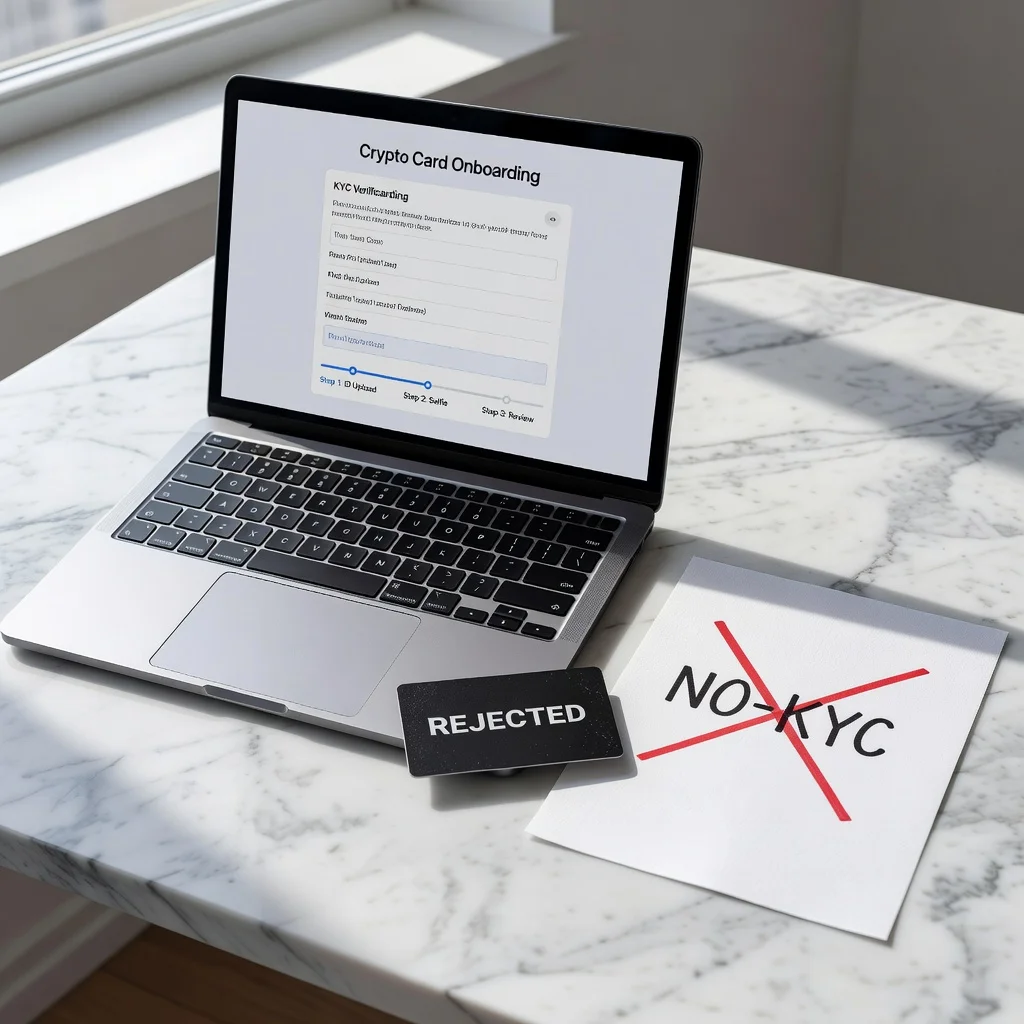
What is a No-KYC card really?
Almost always it is a corporate card. The legal holder is a company and its «employees», not you. The loophole works like this:
- A company is set up in a lenient jurisdiction.
- The company passes business verification (KYB).
- The bank approves corporate card issuance.
- Cards go to users, but on paper they belong to «employees».
KYC still happened - at the entity level. The end user is simply hidden behind a corporate shell.
Why does the scheme not last long?
The model works only while volumes are small. One employer cannot have tens of thousands of «employees» with active cards - to a bank that is an anomaly visible in the data.
| Signal | What the bank sees |
|---|---|
| Many cards on one entity | Mismatch with the company's real headcount |
| Transaction geography | Countries where the firm has no operations |
| Spending pattern | Does not look like corporate expenses |
| Chargebacks and AML flags | Rising complaints and suspicious activity |
When the mismatch surfaces - on average within six months - a review arrives. Then either the project shuts down and cards are frozen, or KYC is rolled out in a hurry and all the anonymity evaporates.
The main risk: the money was never yours
Since you are not the cardholder and not the bank's customer, you have no legal relationship with the issuer. If funds are frozen or the project vanishes:
- you cannot file a claim with the bank - you are not its customer;
- you cannot turn to the regulator - there is no contract;
- there is no deposit insurance;
- you cannot prove the money is yours without revealing the very identity you were hiding.
In practice the funds sat on another company's balance sheet the whole time. You trusted not a bank, but an anonymous scheme operator.
Is there a real way out?
In theory - bypassing Visa and Mastercard themselves with a payment network outside their KYC/AML rules. But that needs enormous capital, a merchant network, and pushing past the very regulators that exist to prevent anonymous rails. As long as the regulatory perimeter holds, any card on the Visa/MC network cannot be truly No-KYC. Transparent alternatives with a clear issuer are in the POOL BTC rankings.
FAQ
Do KYC-free cards exist at all?
Free of KYC on the end-user side - yes, but the issuing legal entity still passes KYC.
Is it legal?
The scheme lives in a grey zone and holds up only until a network or bank review.
What is safer for privacy?
Transparent custodial and self-custody cards with a clear issuer - compare them in the POOL BTC rankings.
The key question before depositing?
Who owns the funds on paper. If the answer is «not me», it is trust in an intermediary with no protection.