

How to Calculate Real Mining Income in 2026: Hashprice Matters More Than BTC Price
Most miners watch Bitcoin's price and assume that when BTC goes up, mining gets more profitable. That's not always true. There's a metric that more accurately reflects your actual income right now: hashprice. Here's what it is, how to calculate it, and why it determines your hardware's profitability better than the BTC price alone.
What Is Hashprice
Hashprice is a miner's revenue per unit of hashrate per day, usually expressed in dollars per petahash per second ($/PH/s/day). It captures three variables at once: Bitcoin's price, network difficulty, and the block reward size.
The formula is straightforward:
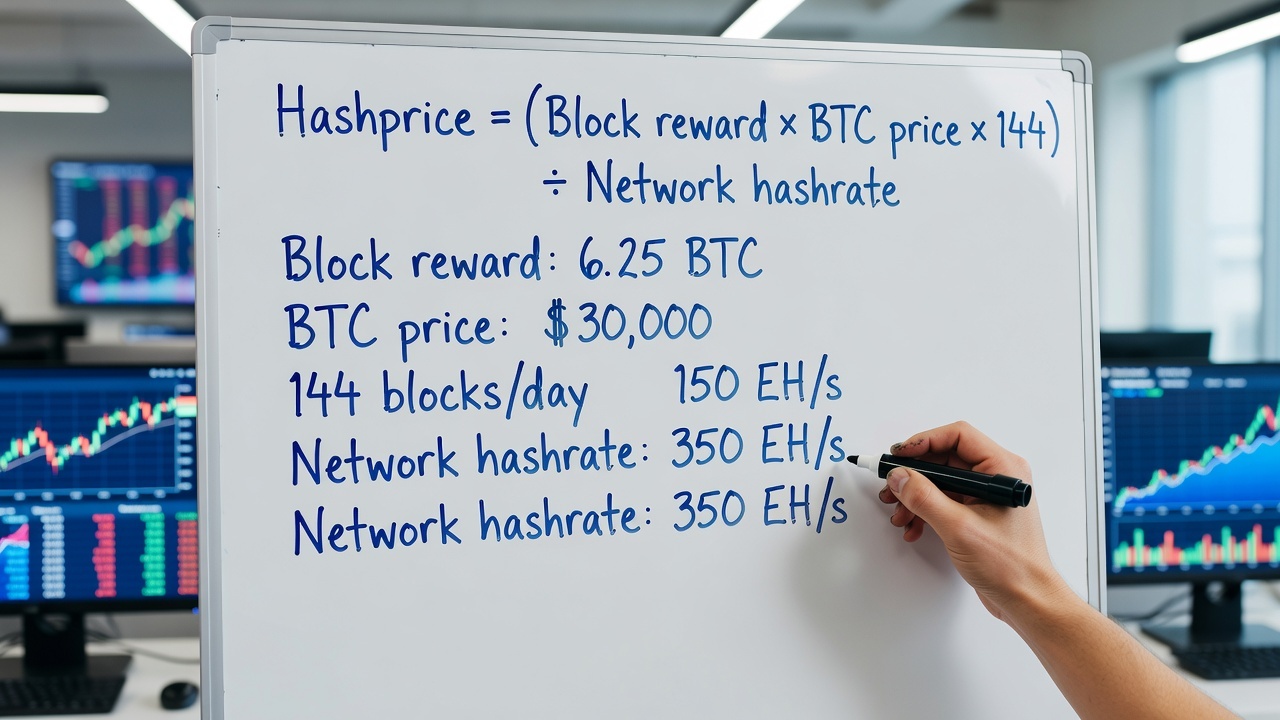
Hashprice = (Block reward x BTC price x 144 blocks/day) / Network hashrate
As of July 2026, hashprice sits in the $23-28 per PH/s/day range. For more on why it dropped from its peak, see our hashprice drop breakdown.
Why Hashprice Is More Accurate Than BTC Price
Consider this: BTC rises from $65,000 to $80,000, a 23% gain. But over the same period, network difficulty rises 30%. Your Bitcoin earnings per day fall - and so does your dollar income, despite the price increase. This is exactly what happened during several stretches of 2025-2026.
Hashprice already incorporates both BTC price and difficulty. If hashprice falls, your real income falls - even if BTC is up. If hashprice rises, you earn more - even if BTC is flat.
How to Use Hashprice in Practice
- Calculate revenue using your ASIC's hashrate. If your Antminer S21 Pro produces 234 TH/s = 0.234 PH/s, then at a hashprice of $25/PH/s/day your gross revenue is 0.234 x $25 = $5.85 per day before electricity costs
- Subtract electricity costs. The Antminer S21 Pro draws around 3.5 kW. At $0.07/kWh that's 3.5 x 24 x $0.07 = $5.88 per day. At a $25 hashprice this miner runs near breakeven
- Track hashprice changes, not just BTC. A sharp difficulty increase after the halving or a wave of new miners pushes hashprice down even when Bitcoin's price is stable
Hashprice Breakeven Point
To find the minimum hashprice at which your miner breaks even, use this formula:
Breakeven hashprice = (Power draw kW x 24 x Electricity rate $) / Hashrate PH/s
Example for an Antminer S21 Pro at $0.06/kWh:
(3.5 x 24 x $0.06) / 0.234 = $21.5/PH/s/day
At any hashprice above $21.5 this miner is profitable; below that it runs at a loss. At the current $23-28 range, it's slightly in the black.
Run these calculations for your own hardware and electricity rate using our mining profitability calculator.
Hashprice in the 2026 Context
After the April 2024 halving, the block reward dropped to 3.125 BTC. Network hashrate kept climbing through most of 2025, peaking near 1,066 EH/s in December 2025. In Q1 2026, it posted its first quarterly decline in six years, falling to ~940 EH/s (details in our CoinShares report breakdown). That partial retreat helped support hashprice in the $23-28 range.
Your pool's payout scheme (FPPS vs PPLNS) also affects real income - see our payout model breakdown for details.
Frequently Asked Questions
Where can I check the current hashprice?
Key sources: Hashrateindex (hashrateindex.com), Braiins Insights, CoinShares Research. Data updates daily.
Is hashprice the same across all pools?
No. FPPS pools pay a stable hashprice regardless of block-finding luck. PPLNS pools can pay more or less depending on the period. Over a long horizon the difference typically evens out, but short-term variance can be significant.
Should I shut down my miner when hashprice drops?
If hashprice falls below your breakeven point, yes - a temporary shutdown is economically sound. Many large miners do exactly this, which contributes to difficulty dropping at the next adjustment.