
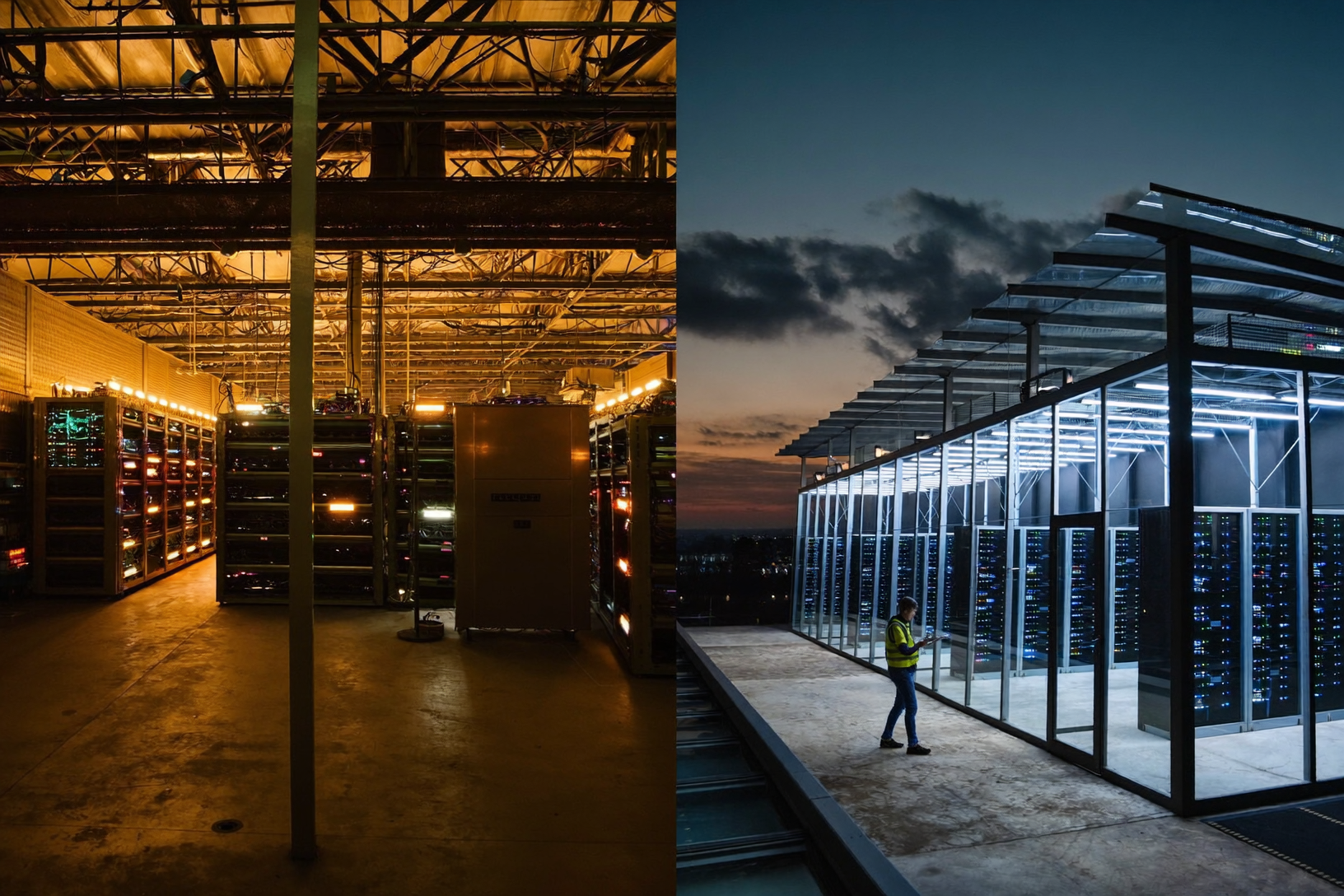
Public Bitcoin Miners Now Get Up to 70% of Revenue From AI, Not Mining
According to CoinShares' Q1 2026 report, Bitcoin's network hashrate fell 6.3% quarter over quarter, the first quarterly drop in six years. At the same time, public mining companies' cumulative AI and HPC infrastructure contracts surpassed $70 billion. CoinShares projects that by the end of 2026, listed miners could derive as much as 70% of revenue from their AI business, up from roughly 30% at the time of the report.
What the Numbers Show
The network's 30-day average hashrate fell to around 940 EH/s, about 12% below the December 2025 peak of 1,066 EH/s. As of July 24, 2026, network hashrate stood at 890.9 EH/s at a difficulty of 127.17 T.
At the same time, hashprice dipped to $23-28 per PH/s/day in early 2026 (see our hashprice drop breakdown), while Bitcoin's price fell from a 2025 peak near $126,000 to a range of $65,000-75,000.
Why Miners Are Pivoting to AI en Masse
The top public miners by hashrate, Bitdeer Technologies Group (73.0 EH/s), MARA Holdings (70.7 EH/s), and CleanSpark (42.6 EH/s), illustrate the industry's scale. But it's dollar-denominated returns, not raw hashrate, that determine where companies direct capital. At low hashprice and high energy costs, long-term AI infrastructure contracts offer more predictable and often higher returns than mining Bitcoin.
We've already covered a similar case with TeraWulf, which raised $3.5 billion for a 20-year contract with Anthropic (see our TeraWulf deal breakdown), and the broader trend of miners pivoting to AI (see our VanEck funding gap breakdown). The CoinShares data confirms this is no longer isolated cases but a structural shift across the publicly traded segment of the industry.
What This Means for Independent Miners
- Large players diversify, small ones stay in BTC, public companies have the capital and infrastructure for AI contracts, an option usually unavailable to home and small farms
- Hashrate may stabilize at a lower level, if large players redirect capacity to AI, competition for remaining hashrate in pure mining could ease
- Mining economics still depend on hardware efficiency and electricity rate, for those who keep mining, the basic rules of profitability haven't changed
To calculate your hardware's real profitability at current difficulty and hashprice, use our mining profitability calculator.
Frequently Asked Questions
Does this mean Bitcoin mining is dying?
No, the network continues operating, with hashrate holding around 900 EH/s. This is about a shift in revenue source at large public companies, not the end of mining itself.
Why did hashrate drop for the first time in six years?
A combination of low hashprice, high energy costs, and a more attractive alternative in AI contracts led to some capacity being redirected or temporarily taken offline from pure mining.
Should a small farm try to pivot to AI too?
Usually not, AI infrastructure contracts require scale, capital, and specialized hardware unavailable to most home and small farms. It's more rational for them to focus on mining efficiency and choosing a favorable pool.