

Bitcoin mining difficulty explained: how the retarget works and what each adjustment does to your payout
*Last updated: 08.09.2026. Written by the POOL BTC editorial team.*
POOL BTC is not a mining pool. We do not take hashrate and we do not pay anyone a reward. This is a comparison site, so everything below looks at the network and at other people's pools from the outside, the way a miner looks at them before deciding where to point his machines. Every calculation here runs on a published formula, and every input carries a date.
Difficulty is the one number in mining economics that nobody negotiates. You can sometimes renegotiate a power contract. You can move to a cheaper pool over a weekend. Difficulty applies identically to a single S21 in a garage and to a 200 MW site in Texas, and it recalculates on its own schedule whether anyone likes the result or not.
The useful thing about that is predictability. Difficulty moves in small steps you can see coming days ahead, which is more than can be said for the price of bitcoin.
The verified inputs behind this article
| Input | Value | Date and source |
|---|---|---|
| Network difficulty | 127.45 trillion (127.45T), up 1.31% | block 965664, 06.09.2026 |
| Difficulty on 29.08.2026 | 125,807,076,547,197.5 | our own mempool.space reading |
| Difficulty at the start of 2026 | 146.47T | 06.09.2026 summary |
| Retargets so far in 2026 | 18, of which 8 were increases | 06.09.2026 summary |
| Network hashrate | 934 EH/s | 06.09.2026 |
| Hashprice | $39.63 per PH/s per day, against $32.42 a month earlier | 06.09.2026 |
| Transaction fee share of daily reward | 0.43% | 06.09.2026 |
| Block subsidy | 3.125 BTC | current halving epoch |
| BTC price | roughly $79,900 to $80,100 | 06.09.2026 |
| Six month forward hashprice | $37.59 | Hashrate Index weekly roundup, 31.08.2026 |
| 2026 retarget history | 18 adjustments, from 146.4726T down to 124.9329T | mempool.space, 2026-09-08 reading |
| Next retarget | block 967,680, estimated around 2026-09-18 | mempool.space, 2026-09-08 reading |
Anything below that looks like a number came either from this table or from a formula printed in the text. Where a figure would be needed and we do not have one, the text says so instead of inventing it.
What is Bitcoin mining difficulty and how is it recalculated
Difficulty is the number that decides how hard it is to find a valid block. The protocol tunes it so blocks keep arriving roughly every ten minutes no matter how much hardware is hashing. The recalculation happens every 2016 blocks, which is about two weeks, and the new value holds until the next one.
The arithmetic nodes run is not complicated. They measure how long the last 2016 blocks actually took, then compare that against the target of 20,160 minutes, which is 2016 times 10. Faster than target and difficulty goes up. Slower and it comes down. The ratio is direct: an epoch that ran 3 percent fast produces roughly a 3 percent increase.
Why 2016 blocks and not some other number
Two weeks is a compromise between two bad options. A short window would make difficulty jump around on random luck, because block discovery is a Poisson process and a run of ten quick blocks says nothing about whether hashrate actually grew. A long window would mean that after a real drop in hashrate, the network keeps producing blocks every twenty minutes for months while miners collect half their expected income.
One detail trips up almost every published retarget calendar. The adjustment is anchored to block height, not to a date. It happens on the block whose height divides evenly by 2016, and not a day earlier. If the network slows down, the date slides right by itself. At an average interval of 570 seconds an epoch takes 13.3 days; at 625 seconds it takes 14.6.
The limits on a single adjustment
The protocol caps the move at a factor of four in either direction, so no single retarget can raise difficulty by more than 300 percent or cut it by more than 75 percent. Nothing in Bitcoin's history has come close to those bounds. They exist for the scenario where most of the network disappears at once.
There is also a known implementation quirk, the off by one bug: the calculation uses the span between the first and last block of the window, which is 2015 intervals rather than 2016. The practical effect is that the real target block time sits slightly under ten minutes. It changes nothing about your payout, but it explains why careful calculations sometimes disagree in the second decimal place.
How a difficulty change translates into BTC per TH/s per day
Income is inversely proportional to difficulty, and the whole conversion is one line: daily BTC per TH/s equals 86400 × 10^12 × 3.125 / (D × 2^32). At D = 127.45T that comes to about 0.00000049325 BTC per terahash per day, which is 0.0000493 BTC on 100 TH/s and 0.00049325 BTC on a full PH/s. No pool, no payout scheme and no power rate appear anywhere in that expression.
Run the September retarget through it step by step.
- Before the adjustment, on 29.08.2026, difficulty stood at 125,807,076,547,197.5, which works out to 0.00000049969 BTC per TH/s per day.
- After the adjustment at block 965664 it became 127.45T, or 0.00000049325 BTC per TH/s.
- On 100 TH/s the difference is about 0.00000064 BTC a day. At roughly $80,000 per coin that is about five cents.
- Across a full two week epoch the same 100 TH/s gives up around 72 cents compared with the old difficulty.
Five cents a day is not a reason to switch pools, and it is a useful sense of scale to carry into the next retarget headline.
One more framing that clears up a lot of confusion: difficulty does not change what the network pays out. The protocol issues 144 blocks a day at 3.125 BTC, so 450 BTC leaves the coinbase every day regardless of whether difficulty is 100T or 200T. At $80,000 that is roughly $36 million a day, plus another 0.43 percent in transaction fees. Difficulty only decides how that fixed pot gets divided. Your slice shrinks when other people add machines and grows when they unplug theirs.
Why a 5 percent difficulty rise is not a 5 percent income cut
Because the relationship is inverse, the revenue loss equals X / (1 + X). A 1.31 percent increase takes 1.29 percent of revenue. A 5 percent increase takes 4.76 percent. A 10 percent increase takes 9.09 percent.
| Difficulty change | BTC revenue change | BTC/day on 100 TH/s |
|---|---|---|
| down 13.0% (all of 2026 so far) | up 14.9% | from 0.0000429 to 0.0000493 |
| down 5% | up 5.26% | 0.0000519 |
| unchanged | 0% | 0.0000493 |
| up 1.31% (retarget of 06.09.2026) | down 1.29% | from 0.0000500 to 0.0000493 |
| up 5% | down 4.76% | 0.0000470 |
| up 10% | down 9.09% | 0.0000448 |
That top row is the one worth sitting with. Difficulty started 2026 at 146.47T and sits at 127.45T, a drop of 13 percent. The same untouched machine now mines almost 15 percent more bitcoin per day than it did on 1 January. A 200 TH/s miner went from about 0.0000858 BTC a day to about 0.0000986, which at $80,000 is roughly $6.87 against $7.89. Nobody upgraded anything. Competitors left.
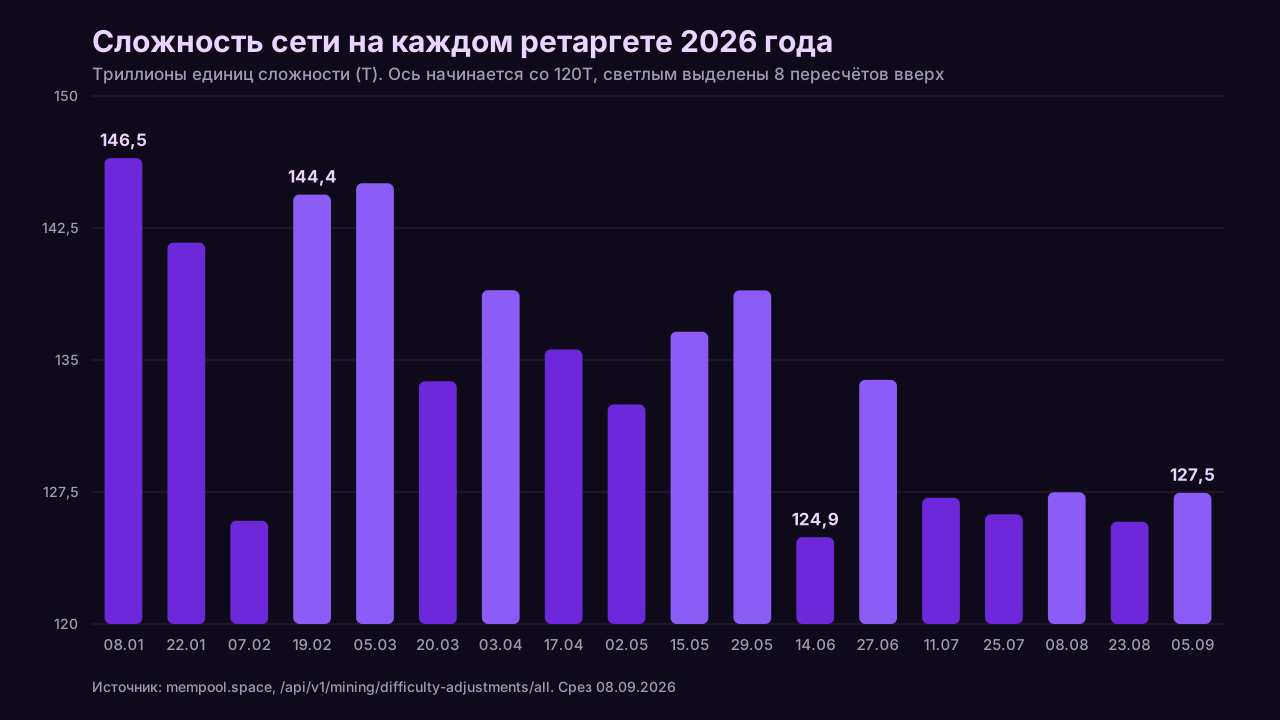
What the chart shows is that 2026 was not a year of growth in difficulty but a year of slow drift downward. The high was the first adjustment of the year, 146.4726T on 2026-01-08. The low was 124.9329T on 2026-06-14. The sharpest drop came earlier, minus 11.16 percent on 2026-02-07, and twelve days later the network took it all back with a plus 14.73 percent adjustment, the largest of the year. Since July the range has narrowed: difficulty has stayed between 125.81T and 127.48T, and the last four adjustments all fit inside one and a half percent either way.
Difficulty vs hashprice: which one you should actually watch
Watch hashprice. Difficulty only tells you how much bitcoin you get. Hashprice folds difficulty, the BTC price, the subsidy and the fee share into a single dollar figure per PH/s per day, which is the number you can put directly next to your power bill. It also moves in tens of percent where difficulty moves in ones.
The last month makes the point on its own. Hashprice went from $32.42 to $39.63 per PH/s per day between early August and 06.09.2026, up 22.24 percent. Over broadly the same stretch difficulty drifted down and came back to 127.45T. No retarget produces a 22 percent month. ETF flows, the Fed and the oil price do.
You can check that the two numbers agree using nothing but the formula above. Daily output on 1 PH/s at current difficulty is 0.00049325 BTC. Multiply by $80,000 and you get $39.46 per PH/s per day from the subsidy alone. The published hashprice for the same date is $39.63. The gap is about 0.43 percent, which is exactly the transaction fee share of the daily reward in the same summary. The formula closes on itself, and it puts a price tag on the fee market at the same time: today, almost nothing.
| Metric | What goes into it | How often it moves | Typical size of a move |
|---|---|---|---|
| Difficulty | competition for blocks, nothing else | once per 2016 blocks | usually single digit percent per retarget |
| Hashprice | difficulty, BTC price, subsidy, fees | continuously | tens of percent per month |
| Fee share | demand for blockspace | continuously | 0.43% of the daily reward on 06.09.2026 |
For planning purposes the split is clean. Difficulty gives you a slow, mostly predictable drift. Price gives you the shocks. If a single retarget breaks your budget, the retarget is not the problem. The metric itself gets a full breakdown in our hashprice explainer.
Why difficulty fell in 2026 and what that means for small miners
Difficulty fell because large public miners physically unplugged ASICs and converted sites to AI and HPC workloads. Tracked public companies shed roughly 56 EH/s of realized hashrate in the first half of 2026, down 15 percent against 10 percent for the network as a whole. Everyone still hashing picked up a bigger slice of every block found.
The decision behind it is a revenue per megawatt comparison, not a view on Bitcoin. Median colocation revenue for AI workloads runs at $174.90 per MWh, which is roughly comparable to mining on a current hydro machine in the S23 Hyd class. The difference is contract shape: colocation is signed for years and the power is often billed through to the customer, while mining revenue floats with the BTC price and gets repriced by the network every two weeks without asking. Directly reported HPC and AI revenue at a comparable group of companies grew 52 percent quarter on quarter, and at the firms furthest along in converting, it passed curtailable mining revenue for the first time.
Two specific moves from the same week. On 1 September 2026 Hyperscale Data, through its Alliance Cloud Services subsidiary, powered down every ASIC at its Dowagiac site in Michigan (617,000 square feet) and began converting it to AI colocation under a contract worth roughly $1.2 billion for 20 MW over ten years, with an option on another 32 MW. The same day, Bitdeer announced the purchase of about 200 acres next to its Rockdale site in Texas for around $100 million, also for AI and HPC.
What that adds up to for someone running one machine or ten:
- The 56 EH/s that left is your gain. Every competitor's ASIC that goes dark raises your share of the reward, and that is precisely where the extra 14.9 percent per terahash since January came from.
- The gain is structurally temporary. That capacity was moved, not destroyed, and some of it comes back the moment hashprice stops losing to AI contracts.
- Large sites now respond to weak prices in two stages rather than one. They used to idle and wait. Now they have an alternative revenue line worth leaving for.
- The network never broke 1 ZH/s and sits at 934 EH/s. That is a plateau, not a collapse.
For a small operator, a falling difficulty regime is the only situation where old hardware climbs back above water without you touching anything. Working out where that line sits for your own tariff is covered separately in our piece on the real cost of electricity in mining.
How to forecast your income when difficulty keeps moving
Stop trying to hit a point and build a range instead. One difficulty assumption plus one price assumption is not a forecast, it is a single guess with a spreadsheet around it. The minimum honest model is three scenarios over the same horizon, with difficulty and price allowed to move independently.
The procedure:
- Take the current difficulty and block height. Height modulo 2016 tells you where you are inside the epoch.
- Work out the average block interval since the epoch started: elapsed time divided by blocks mined so far.
- Estimate the coming retarget with change = 600 / average interval in seconds, minus one. At 570 seconds, 600 / 570 = 1.0526, so about plus 5.3 percent. At 625 seconds it is 0.96, or about minus 4 percent.
- Compute baseline output for your hashrate in the mining profitability calculator, then rerun it at 5 percent higher and 5 percent lower difficulty.
- Run the BTC price separately at current, minus 25 percent and plus 25 percent. Price has a wider distribution than difficulty, so its range should be wider too.
- Subtract electricity at your real measured rate and everything the pool takes. What actually gets deducted beyond the advertised percentage is broken down in our pool fee article.
- Rerun after every retarget instead of once a month. The retarget is a free trigger and it arrives on its own.
Accuracy improves as the epoch fills. Over the first couple of hundred blocks the estimate is noisy, because a run of fast blocks is randomness rather than a trend. From roughly the halfway point the estimate usually lands within a few tenths of a percent of the final number. If you would rather not do the arithmetic, the live estimate sits on the difficulty forecast page.
A note on horizon. Six month forward hashprice was quoted at $37.59 per PH/s per day on 31.08.2026, against a spot of $39.63 on 06.09.2026. The market is pricing conditions slightly worse half a year out. That is not a prophecy, but it is a price at which participants are willing to lock revenue, which makes it a more honest input for a payback model than today's spot.
Difficulty and the halving: two different clocks on the same wallet
They are independent counters running on the same block height scale with different periods and, more importantly, different reversibility. Difficulty recalculates every 2016 blocks and moves both ways. The halving arrives every 210,000 blocks, cuts the subsidy exactly in half, and never gives it back.
| Property | Difficulty | Halving |
|---|---|---|
| Period | 2016 blocks, about two weeks | 210,000 blocks, about four years |
| Direction | up and down | down only |
| Size of the step | usually single digit percent | exactly half the subsidy |
| Reversible | fully, the next epoch can undo it | never |
| Date predictability | approximate, depends on block speed | approximate, depends on block speed |
| Position in the formula | the denominator (D) | the numerator (subsidy) |
The subsidy today is 3.125 BTC and the next halving lands at block 1,050,000. From block 965664, recorded on 06.09.2026, that leaves 84,336 blocks. At perfect ten minute blocks that is a little over 585 days, which points at roughly the second half of April 2028. The real date will drift exactly the way retarget dates drift, according to how fast blocks actually come in.
The reason to keep the two clocks apart in your head is the shape of the loss. A 5 percent retarget takes 4.76 percent of revenue and the next epoch might hand it straight back. The halving takes half the subsidy in one block and nothing hands it back; only the BTC price or a much larger fee market can offset it, and the fee market was worth 0.43 percent of the reward on 06.09.2026. If you are modelling payback over anything longer than about eighteen months, the model has to switch the subsidy from 3.125 to 1.5625 BTC partway through. Otherwise the back half of your projection overstates production by a factor of two.
What variance does on top of difficulty, and why PPLNS feels it more than FPPS
Difficulty sets the expected value of your income. Variance decides how far the actual result over a short window lands from that expectation. The payout scheme decides who absorbs the difference: under FPPS the pool eats it, under PPLNS you do.
Block discovery is a Poisson process. The network averages 144 blocks a day and guarantees nothing about any particular day. Relative spread shrinks with the square root of the block count, so measuring your realized yield to within 5 percent takes roughly 400 blocks, and 10 percent precision takes about a hundred.
An illustrative case, not a claim about any specific pool. Take a pool holding 5 percent of a 934 EH/s network, which is about 46.7 EH/s and roughly 7.2 blocks a day in expectation. Standard deviation is around 37 percent of expectation over one day, around 14 percent over a week, and around 6.8 percent over a month. Over a single day, pool luck swamps the effect of a 1.31 percent retarget by more than twenty to one. Over a month, the two become comparable.
Two consequences follow.
On FPPS the retarget shows up almost immediately, because the rate per accepted share is calculated against current network difficulty and the next accounting day already uses the new figure. There is no luck component to blur it, which is why a plus 1.31 percent retarget produces a clean minus 1.29 percent.
On PPLNS the retarget is smeared across the window and mixed with the pool's luck. A bad week and a difficulty increase stack, and the drawdown looks far worse than the retarget percentage. A good week hides the retarget completely and you never notice it happened. Neither outcome says anything about the quality of the pool, it is just what the scheme does. The mechanics of every scheme are laid out in our payout schemes guide, and the usual suspects behind a shrinking daily accrual are collected in why your mining reward keeps dropping.
Solo deserves its own line, because there variance is the entire story. At 1 PH/s against a 934 EH/s network, the expected time between blocks is around 6,500 days, or roughly 18 years. A couple of percent of difficulty means nothing on that horizon. The only variable that matters is luck.
How difficulty changes the breakeven electricity price for a given miner
Breakeven power price is hashprice divided by daily consumption per terahash. In dollars per kWh that is hashprice in $/PH/s per day, divided by 1000, then divided by 0.024 times efficiency in J/TH. At a hashprice of $39.63 the whole thing collapses to 1.65 / (J per TH).
| Efficiency, J/TH | Breakeven $/kWh at hashprice $39.63 (06.09.2026) | Breakeven $/kWh at hashprice $32.42 (a month earlier) |
|---|---|---|
| 12 | $0.138 | $0.113 |
| 15 | $0.110 | $0.090 |
| 18 | $0.092 | $0.075 |
| 21 | $0.079 | $0.064 |
| 25 | $0.066 | $0.054 |
| 30 | $0.055 | $0.045 |
| 34 | $0.049 | $0.040 |
This is gross breakeven, revenue against electricity and nothing else. Pool fees, hardware depreciation, hosting and tax all sit outside it, and each one pushes the real line lower.
Now isolate what difficulty actually contributed. The plus 1.31 percent retarget lowered the breakeven tariff by 1.29 percent, which on a 21 J/TH machine means moving from about $0.0796 to about $0.0786, a shift of roughly a tenth of a cent per kWh. Over the same month, hashprice rising 22.24 percent moved that same line from $0.064 to $0.079, about a cent and a half. The BTC price moves your shutdown threshold roughly ten times harder than a single retarget does.
An independent reference point for sanity checking: the Hashrate Index weekly roundup of 31.08.2026 lists revenue per MWh by efficiency band at $136 for machines under 14 J/TH, $99 for the 14 to 19 J/TH band and $74 for 19 to 25 J/TH. Their methodology and date differ from ours, so the numbers are not obliged to match to the cent, but the order of magnitude lines up with the table above.
The fastest way to redo all of this for your own machine and tariff is the mining profitability calculator, and comparing efficiency across models is easier in the miner ranking.

Where to read difficulty data yourself and how often to recheck
The minimum useful dashboard is four numbers: current difficulty, the estimate for the next retarget, blocks remaining until it lands, and hashprice in dollars per PH/s per day. All four sit on the difficulty forecast page, along with the direction the current epoch is heading.
If you would rather compute it yourself:
- Pull the current block height from any explorer.
- Height modulo 2016 is how far the epoch has gone; 2016 minus that is what remains.
- Average interval equals the time since the epoch's first block, divided by the blocks completed.
- Put that interval into 600 / interval, minus one, for the expected adjustment.
- Multiply the remaining blocks by the average interval for the time to the retarget. With 300 blocks left at 570 seconds each, that is roughly 47.5 hours.
A sane checking cadence:
| What to check | When | Why |
|---|---|---|
| Next retarget estimate | weekly, around the middle of the epoch | before the midpoint the estimate is mostly noise |
| Next retarget estimate | again the day before it lands | by then the figure is effectively fixed |
| Hashprice | every few days | it moves faster and further than difficulty |
| Your pool's actual accrual | weekly, over a window of at least 7 full UTC days | a short PPLNS window measures luck, not yield |
| Full payback recalculation | after every retarget | a free trigger that arrives by itself |
Checking difficulty daily adds almost nothing. Inside an epoch the only thing that changes is the precision of the estimate. The number itself stands still until the retarget.
The publication day reading, 2026-09-08. Difficulty is unchanged at 127.45T, in force since block 965,664. The next adjustment falls on block 967,680, which mempool.space estimates at around 2026-09-18. The epoch is 20.63 percent complete and the preliminary estimate is plus 6.58 percent, which at one fifth of an epoch is still very noisy. Seven day average hashrate from 2026-09-02 to 2026-09-08 is 927.5 EH/s. The fee share of daily miner revenue on Blockchain.com was 0.58 percent for 2026-09-07 against 0.39 percent the day before, which is exactly why that number is read as an average over a period rather than for a single day. Hashprice on 2026-09-07 was $39.14 per PH/s per day according to bitcoin-data.com.
FAQ
How often does Bitcoin difficulty change?
Every 2016 blocks. At perfect ten minute blocks that is exactly 14 days, but in practice an epoch runs a bit short or a bit long, because the trigger is block height rather than the calendar. Through 06.09.2026 the network had gone through 18 retargets in 2026, 8 of them increases.
If difficulty rises 5 percent, how much do I lose?
BTC revenue falls 4.76 percent, not 5, because the relationship is inverse and the loss equals X / (1 + X). Net profit falls much harder, since your power bill does not retarget alongside the network. The closer you sit to breakeven, the more each percent costs you.
Can difficulty go down?
Yes, and through 2026 that has been the dominant direction: 146.47T in January against 127.45T on 06.09, a drop of 13 percent. It happens when total hashrate falls and blocks start arriving slower than ten minutes. In 2026 the main driver was public miners converting sites to AI and HPC.
Which matters more for planning, difficulty or hashprice?
Hashprice, because it already contains difficulty along with the BTC price, the subsidy and fees, and it is denominated in dollars, so you can put it straight next to a power bill. In the month to 06.09.2026 hashprice rose 22.24 percent while retargets over the same stretch moved income by single digit percentages.
Why did my income drop more than difficulty rose?
Usually several things at once. The retarget took its share of revenue, your electricity bill stayed flat and therefore ate a disproportionate share of margin, and if you are on PPLNS the pool's luck over the window is layered on top. The full list of causes is in why your mining reward keeps dropping.
How much are transaction fees worth right now?
As of 06.09.2026 fees make up 0.43 percent of the daily miner reward. Practically all income today rests on the subsidy and the BTC price rather than on demand for blockspace. Which pools actually pass those fees through to miners is covered in our pool fee breakdown.
---
POOL BTC is a comparison service, not a mining pool. We do not accept hashrate and we do not pay rewards. The calculations here use published formulas and dated, verified inputs, they are approximate, and none of it is financial advice. Difficulty, hashprice and the BTC price all move in real time, so check current data before making a decision about hardware or a pool.