

Bitcoin mining pool payout schemes: PPS, FPPS, PPLNS, PPS+, SOLO and TIDES
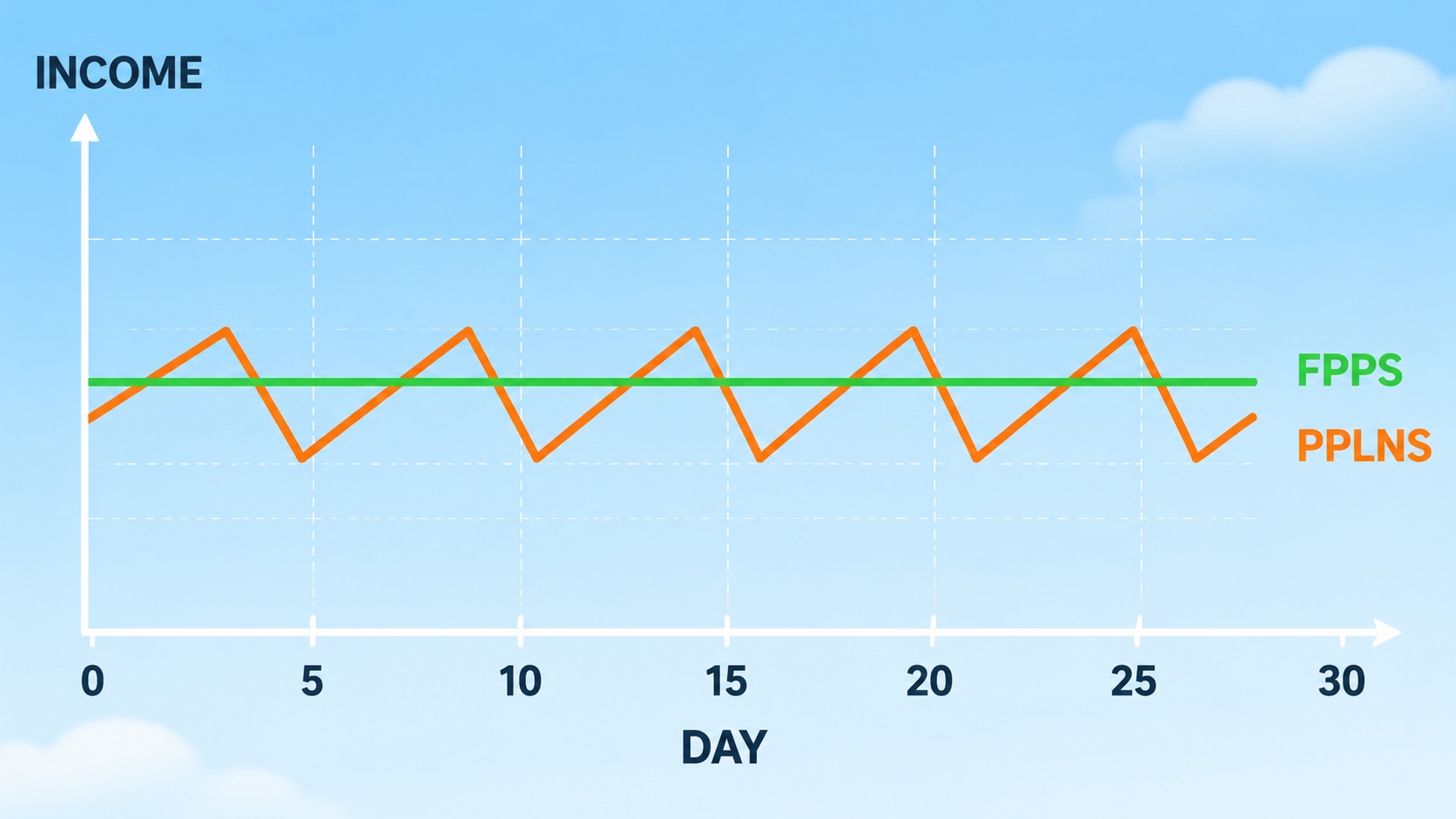
A payout scheme answers one question: who pays for bad luck. Under PPS and FPPS the pool pays, and you get a fixed rate per accepted share even in a week when no block lands. Under PPLNS and SOLO you pay, and your income swings with luck. PPS+ splits the roles, guaranteeing the block subsidy and passing transaction fees through only when blocks actually arrive. Ocean's TIDES is PPLNS with a long window and payment straight from the block.
The difference in average income between schemes is smaller than most miners expect. The difference in the shape of that income is large, and that is what decides whether you stay online long enough to reach the average.
What the pool is actually splitting
A pool finds a block and collects two things: the subsidy (3.125 BTC right now) and the transaction fees inside that block. It then divides the total among miners according to the shares they submitted, minus its own fee.
A share is a partial solution. It is useless to the network and useful to the pool as proof that your machine is working. Your ASIC sends thousands per hour. Every payout scheme is a rule for converting shares into bitcoin, and the whole family tree comes down to two forks: do they pay for shares or for blocks, and do transaction fees reach you.
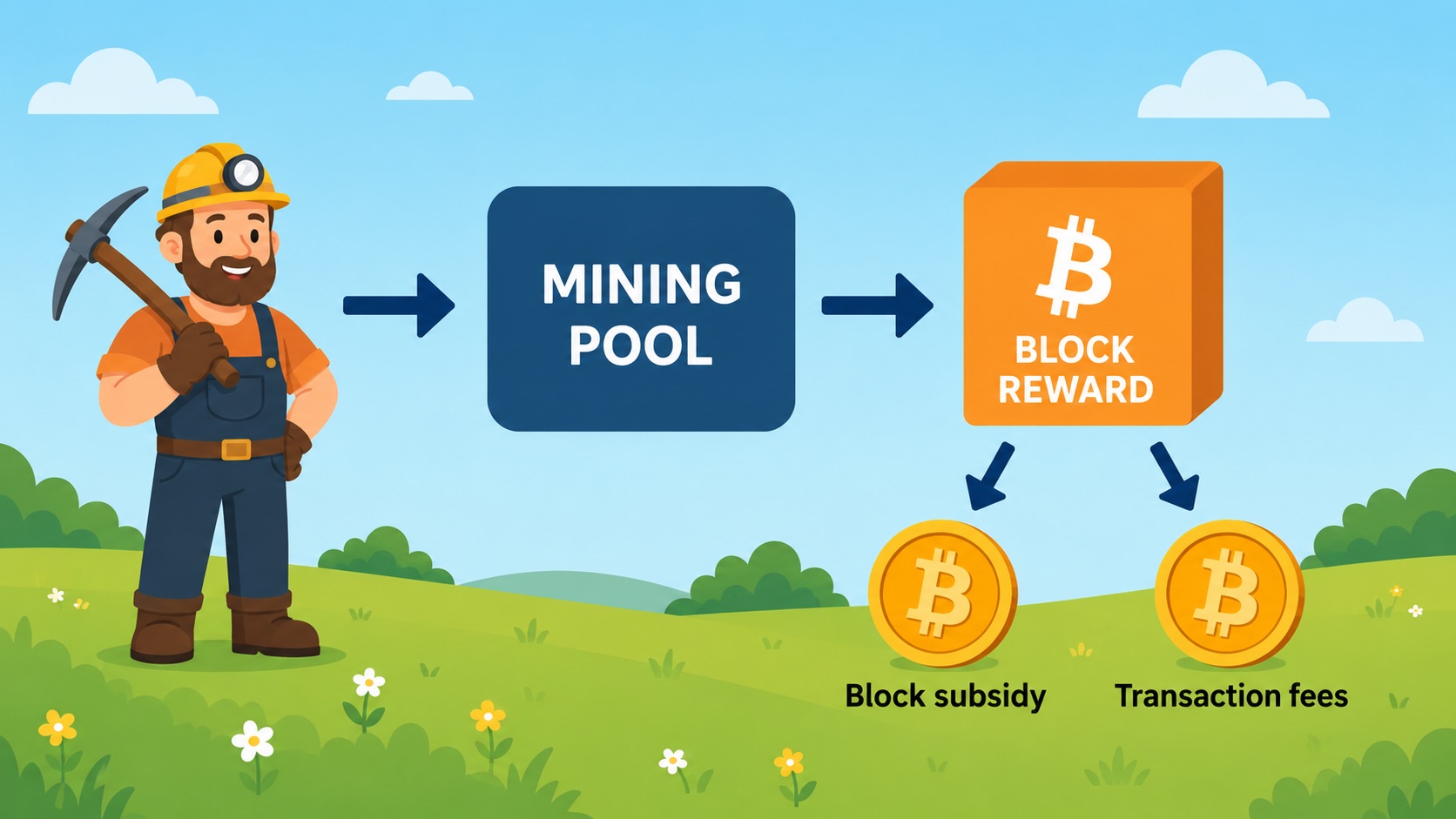
What is the difference between PPS and FPPS?
PPS pays a fixed rate covering the block subsidy only. FPPS adds a share of network transaction fees, averaged over a recent window. Both pay per accepted share whether or not the pool found a block. The whole difference sits in one line of income: transaction fees are either yours or the pool's.
You can price it. Over the 4320 blocks up to 2026-08-14, transaction fees ran at 0.70% of the subsidy. On roughly $3.10 a day at 100 TH/s that is about two cents a day, near seven dollars a year. In a quiet mempool, noise. In congestion periods that share has run far higher, and pure PPS then costs the miner real money, though the peak numbers depend entirely on the window you measure.
That is why pure PPS has nearly died out. In our verified pool table as of 2026-08-18, PPS survives as a selectable mode at AntPool and nowhere else.
What is PPS+ and is it better than FPPS
PPS+ pays the subsidy on a PPS basis and distributes transaction fees on a PPLNS basis. The core of your income is guaranteed, the top-up arrives only when the pool actually finds blocks. The reasoning is straightforward: a pool will insure you against variance on the predictable part of the reward, but not on the part that itself swings by multiples.
Whether it beats FPPS depends on the pool's luck over your horizon. At average luck the two land in the same place. In an unlucky stretch FPPS pays more, in a lucky one PPS+ pays more, and over years the gap washes out.
From data verified 2026-08-18: Trustpool runs PPS+ at a 1% fee, Kryptex Pool runs PPS+ at 3%, ViaBTC offers a choice of PPS+ or PPLNS at 4%. The full net income breakdown sits in our August 2026 pool comparison.
How PPLNS works and why pool hopping fails against it
PPLNS pays only for blocks the pool genuinely found. When a block lands, the pool takes the last N shares in its history and splits the reward among their authors in proportion. No block for a week means no payment for a week. Three blocks in a row means a triple helping.
The window N sets the personality of the scheme. A short window gives frequent but jagged payouts. A long one smooths luck out, at the cost of mining longer before your contribution is fully counted and losing a longer tail when you leave.
This is where the anti-hopping property comes from. A hopper joins a pool right after a block, when schemes like PROP price a share highest, and leaves when the round drags on. Against PPLNS the manoeuvre backfires. Joining, you earn below expectation while the window fills. Leaving, you abandon shares that keep earning for the pool's next block without you. Entry and exit hurt symmetrically, so the scheme punishes tourists and rewards miners who stay for months.
Each pool sets N itself, and most major pools do not publish the exact number in their public docs, so you cannot realistically compare pools by window size. The one verifiable exception on our list below is Ocean, with a window of eight network difficulty blocks.
What TIDES is, as used by Ocean
TIDES is a PPLNS variant with a window tied to network difficulty: the pool scores contribution over a rolling share window sized in expected blocks, and pays rewards directly in the coinbase transaction of the block it finds, with no intermediate balance held at the pool. The point is custody. The pool never holds your money, so it cannot fail to hand it over.
The practical cost is the ordinary PPLNS cost. Income is uneven, and at small hashrate the road to a payout threshold is long. Coinbase payouts also arrive only when the pool finds a block, so payout frequency follows the pool's block cadence rather than your preference. We have covered Ocean and its block policy separately on the blog.
Ocean does document its window size: eight network difficulty blocks, which the pool says lets 99.97% of shares land in at least one payout (source: ocean.xyz/docs/tides, checked August 20, 2026). Ocean does not clearly publish its current fee or minimum payout on its public pages, so we are not quoting exact percentages here; check them in the pool dashboard before switching.
SOLO: the odds, counted honestly
SOLO is less a payout scheme than a refusal to split. You mine to your own coinbase, and when you find a block you keep all of it, transaction fees included. The pool in solo mode only hands out work and charges for the service. No block means nothing, no matter how many shares you sent.
Arithmetic from the verified 2026-08-14 snapshot, network hashrate 933.99 EH/s:
- 100 TH/s is roughly one 9.34-millionth of the network. Expected wait for your block is about 64,850 days, near 178 years.
- 1 PH/s cuts the wait to about 6,485 days, near 17.8 years.
- 10 PH/s brings it to about 648 days, near 1.8 years.
That is an expectation, not a schedule. The distribution is geometric, so a 100 TH/s miner has about a 0.05% chance of a block in the first month and exactly the same chance every month after. Solo does not get closer because you have gone a long time without winning.
Who it fits: people treating solo as a lottery ticket with positive expected value and not budgeting around the income. The economics against pooled mining are worked through in our solo mining payback article.
Who eats the orphan blocks
An orphan is a block the pool found that the network then discarded, because a competing block at the same height propagated faster. There is no reward for it.
Under PPS and FPPS the pool carries the orphan risk, since the per-share rate is already paid whatever happens to the block. Under PPLNS the miners carry it: the round simply goes unpaid and the shares stay in the window for the next attempt. Under SOLO the loss is entirely yours. Some pools run an RBPPS variant where payment is tied to closing a round, and there an orphaned round goes unpaid even under a fixed per-share rate. Read the specific pool's terms, the wording varies more than the labels suggest.
Orphan rates at large pools are low today thanks to fast relay networks, but they are never zero.
Scheme comparison table
| Scheme | Paid for | Who carries variance | Transaction fees | Income stability | Best fit |
|---|---|---|---|---|---|
| PPS | shares | pool | kept by the pool | highest | miners who need predictable cash flow and do not care about fees |
| FPPS | shares | pool | passed to the miner | highest | most miners, the market standard |
| PPS+ | subsidy per share, fees per block | shared | passed to the miner as blocks land | high | miners trading a floating top-up for a lower pool fee |
| PPLNS | blocks, last N shares | miner | usually passed to the miner | medium, depends on N | long-term miners who can sit through drawdowns |
| TIDES | blocks, difficulty-sized window, coinbase payout | miner | passed to the miner | medium | miners who want payment straight from the block |
| SOLO | your own block only | miner entirely | all yours | none | lottery strategies and large farms |
What the scheme actually does to your income
Expected income barely depends on the scheme. Your slice of the network is the same wherever you point the machines: 100 TH/s against 933.99 EH/s carries identical expectation everywhere. The scheme redistributes the timing of that money, not its size, and decides where transaction fees end up.
What genuinely moves the result:
1. Electricity tariff. On the 2026-08-14 calculation, the gap between $0.05 and $0.12 per kWh at 100 TH/s was $2.02 a day.
2. Pool fee. The spread between 1% and 4% is exactly 3% of income, about 9 cents a day at 100 TH/s.
3. The transaction fee share, meaning PPS against FPPS. On the 2026-08-14 snapshot, 0.70% of income.
4. Payout threshold. At 100 TH/s a 0.005 BTC threshold fills in about 107 days, 0.001 BTC in about 21 days.
The payout scheme ranks roughly third for your wallet and first for your nerves. Run your own numbers in the mining profitability calculator, and the pool terms sit next to them in our pool comparison.
Picking a scheme for your setup
One ASIC at home: take FPPS or PPS+ with a low payout threshold. A PPLNS drawdown at small hashrate looks exactly like a broken rig even when it is ordinary statistics, and there is no reason to live with that if you do not have to.
A multi-petahash site with debt or a hosting contract: FPPS, because the payment schedule has to be predictable. This is also the scale where negotiating the fee starts to be worth the phone call.
A steady miner with no obligations and patience: PPLNS or TIDES. Over a long horizon you get roughly the same money while paying the pool less for insurance, and these schemes tend to live at pools with a more opinionated block policy.
A hobby machine: SOLO makes sense only as a deliberate lottery, with the waiting times above in view.
Scheme and fee comparisons across named pools are in our breakdown of twelve Bitcoin pools, and the narrow head to head sits in the FPPS versus PPLNS article.
FAQ
Is PPLNS more profitable than FPPS over the long run?
At an equal pool fee the average difference is small, since both split the same network reward. PPLNS more often appears at pools charging less, and that fee gap is where any real edge comes from. You pay for it with uneven income and the share tail you leave behind when you switch pools.
Can I game PPLNS by switching pools?
No. The N-share window makes joining and leaving equally costly: you earn below expectation while the window fills, then leave shares working for a block you will not be paid for. The scheme was designed against hopping.
What happens to my shares if the pool finds no block?
Under PPS and FPPS, nothing, you were already paid at the fixed rate. Under PPLNS they stay in the window and count toward the next block until they age out past N. Under SOLO they are simply gone.
Which scheme is best when mempool fees are high?
Any scheme that passes fees to the miner: FPPS, PPS+, PPLNS, TIDES, SOLO. Only pure PPS loses out, because the fees stay with the pool.
Does the scheme affect the risk of the pool not paying me?
Indirectly, yes. Coinbase payouts like TIDES arrive straight from the block. In every other scheme the pool holds your balance until the threshold, and there the pool's reputation and the threshold size matter more than the label on the scheme.
---
Published by POOL BTC. We are not a pool and we do not accept hashrate: we compare other people's pools, run the profitability maths and check what pools publish about themselves. Fees and schemes verified 2026-08-18, network snapshot 2026-08-14. Figures are indicative and not financial advice.
This article contains referral links to mining pools (marked as sponsored). We may receive a reward if you register through them. This does not change the figures or the order of rows in the tables: the terms are taken from the pools' official pages.