
Mining pool fees: what actually gets deducted from your payout beyond the advertised rate
*Last updated: 02.09.2026. Written by the POOL BTC editorial team.*
POOL BTC does not accept hashrate and does not pay anyone a reward. This is a comparison site. We look at other people's pools from the outside, the way a miner does when deciding where to point his machines. None of the pools below is a partner of ours and there are no referral links in this text.
The percentage a pool prints on its front page answers exactly one question: how much the pool keeps from the block subsidy under its own formula. Everything else that shrinks the number landing in your wallet lives in other documents, and sometimes it is not documented at all. What follows is every deduction in order, with a clear note on what a primary source confirms and what it does not.
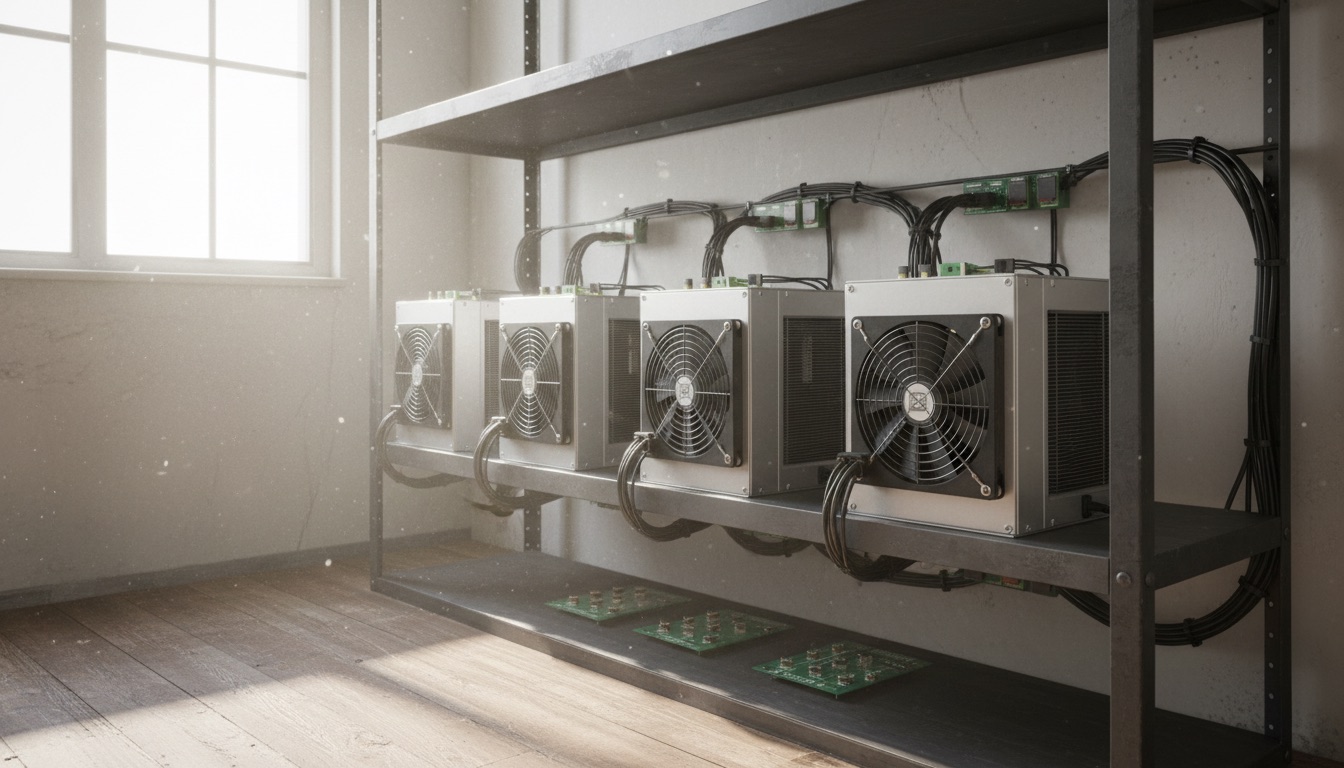
[IMAGE: dark vector graphic in the site palette, near black purple background, hexagonal grid behind. A schematic row of several ASIC chassis in a shed, outlines and fans drawn as lines, purple accent light glowing along the edges. No photorealism, no people]
Where these numbers come from
Every figure here rests on two of our own checks: pool fees and payout thresholds as of 29.08.2026, part of which were verified by hand in a browser that same day, plus the breakdown of payout schemes, PPLNS windows and transaction fee rules from 01.09.2026. The network snapshot comes from the mempool.space API, the baseline on 29.08.2026 and a refresh on 02.09.2026.
Where a primary source stays silent or two sources contradict each other, the text says so. We do not drop in an approximate number to fill a hole. In mining, a filled hole travels through other people's reviews for years and eventually reads like common knowledge.
Network parameters on 29.08.2026, which all examples below are based on:
| Parameter | Value |
|---|---|
| Network hashrate | 896.89 EH/s |
| Difficulty | 125,807,076,547,197.5 |
| Block subsidy | 3.125 BTC |
| Transaction fee share of total reward over 4,320 blocks (heights 960211 through 964530) | 0.73% |
| BTC price | about $77,817 (morning of 29.08.2026, from secondary press, not a direct API) |
A control reading by the same method on 02.09.2026 returns 0.699% over the last 4,320 blocks (heights 958787 through 963106, mempool.space). The share barely moved in a week.
What the advertised percentage covers and what it does not
The advertised rate is a cut taken from the pool's accounting base, usually the block subsidy. It does not cover the network fee for sending coins to you, it says nothing about the payout threshold, it does not describe conversion, and it does not guarantee that the transaction fees inside a found block reach your share. Each of those lives in a separate document.
| Deduction | Usually inside the advertised rate | Where to look |
|---|---|---|
| Cut from the block subsidy | Yes | Fees or pricing page |
| Transaction fees from found blocks | Depends on the scheme and the pool | Payout scheme description, not the pricing page |
| Network fee for the transfer to your address | Usually not | Payouts and thresholds section |
| Minimum payout threshold | Not a fee, but it locks your money up | Payouts section |
| Conversion into another coin or into fiat | No | Pool wallet rules |
| Dormant account and unclaimed balance rules | No | Terms of Service, not the help center |
Only the first row makes it to the shop window. The other five rows are what creates the gap between "2% fee" on the landing page and the history you read in your wallet a month later.
How the payout scheme changes the real price of a fee
The scheme decides who pays for the pool's bad luck. Under FPPS and PPS the pool absorbs that risk and prices it into the rate. Under PPLNS the risk stays with the miner, which is why the rate is lower. Comparing 4% against 2% head on is meaningless: those are prices for two different services.
The same pool often sells both schemes at once, which is where the difference shows up cleanly. From our 29.08.2026 check:
| Pool | FPPS | PPS+ | PPLNS |
|---|---|---|---|
| F2Pool | 4% | 2.5% | 2% |
| ViaBTC | no separate FPPS line | 4% | 2% |
| AntPool | schemes are advertised, rates are not published on the site (manual check 29.08.2026, the fee help page returns 404) |
At F2Pool the gap between FPPS and PPLNS is 2 percentage points. Those 2 points buy predictability. Under FPPS your daily income depends on your hashrate and on difficulty, but not on whether the pool got lucky this week. Under PPLNS a bad week for the pool goes straight into your income, and a good one adds to it.
After that it becomes a question of horizon. Over several months the expected value of both schemes converges and the cheaper one is simply the one with the lower rate. Over two weeks, especially if you move machines between pools, PPLNS will almost certainly cost more than its 2%, because you pay to spin the window up and never collect the tail. We priced that move separately in the piece on what switching pools costs, and the mechanics of all six schemes are covered in the payout schemes guide.
ViaBTC deserves its own paragraph, because it is a rare case of a pool spelling out a hybrid honestly: the block subsidy is paid under PPS at a 4% rate, while transaction fees are distributed under the PPLNS formula at 2%. One payout, two different rates inside it, and the "4%" on the pricing page describes only half the structure. Verified against the pool's official page on 01.09.2026.
[IMAGE: dark vector graphic, near black purple background, hexagonal grid. A schematic screen showing a payout table, rows drawn as lines, one deduction row lit in bright glowing purple and pulled out to the side with an arrow. No photorealism, no people]
Where the block's transaction fees end up
Transaction fees are the second half of a block reward, and every pool handles them its own way. Over the 4,320 blocks ending 29.08.2026 they came to 0.73% of the network's total reward, and 0.699% by the same method on 02.09.2026. That looks small, and it is worth remembering when you compare rates: the whole argument about who gets the fees was worth less in that period than the gap between 2% and 4%.
What pools state officially, from the 01.09.2026 check:
| Pool | Transaction fee rule |
|---|---|
| Braiins Pool | "we believe the transaction fees belong to the miners", distributed as a daily average under FPPS |
| Luxor | the FPPS formula includes fees averaged over 144 blocks, with the 5th and 95th percentile outliers trimmed |
| Foundry USA | FPPS rate = 1 + (sum of block transaction fees / sum of block subsidies) per UTC day, with the top three and bottom three fee blocks excluded |
| ViaBTC | PPS+: subsidy under PPS at 4%, transaction fees separately under PPLNS at 2% |
| F2Pool | FPPS includes fees averaged over the previous day; PPLNS distributes the actual fees of found blocks |
| Binance Pool | the FPPS formula includes the "Whole Network Average Transaction Fee per Block" |
| EMCD | BTC runs on FPPS only, and the payout moves directly with network fees |
| Ocean | TIDES splits the entire block reward, subsidy plus fees, through the window formula |
| AntPool | two official pages contradict each other, see below |
The AntPool case is worth reading closely, because it is a ready made illustration of what opacity looks like in practice. The current GitBook help says that on PPLNS transaction fees are allocated to miners as well and that the pool charges zero for that scheme. An older version of the same document on Zendesk, dated 14.12.2022, says the opposite: "Transaction fees not paid out to miners are for maintenance and bonus for our engineers." We do not average those two statements and we do not pick the more convenient one. Both sit on the pool's own resources.
The practical takeaway is short. If the transaction fee rule is not written on the official page for the specific scheme you are joining, treat those fees as not guaranteed to you and price your comparison accordingly.
Withdrawal fees and the minimum payout threshold
A payout threshold is not a fee, but for a small farm it hurts more than the percentage does. Until your balance reaches the threshold, the money sits with the pool. A withdrawal fee, where a pool charges one, comes out on top of the advertised rate and does not scale with your hashrate.
Thresholds from our 29.08.2026 check:
| Pool | Minimum payout | Verification status |
|---|---|---|
| NiceHash | 0.00001 BTC | matches the previous snapshot, the official page failed to load |
| Promminer | 0.0001 BTC | unconfirmed, site unreachable |
| EMCD | 0.0001 BTC | conflicts with a 0.001 BTC figure, the manual check on 29.08.2026 did not settle it |
| Trustpool | 0.001 BTC | not confirmed by a primary source |
| F2Pool | 0.001 BTC | confirmed by the official help center |
| Kryptex Pool | 0.001 BTC at a 3% PPS+ rate | confirmed by hand on pool.kryptex.com, 29.08.2026 |
| Neopool | 0.001 BTC | from aggregators, the site did not load |
| Luxor | 0.001 BTC plus a 0.000075 BTC network withdrawal fee | confirmed by official documentation |
| AntPool | 0.001 BTC per aggregators, 0.005 BTC in our previous snapshot | unresolved, the pool does not publish it |
| ViaBTC | not confirmed | the pricing page did not return a threshold |
| Foundry USA | not confirmed, 0.01 BTC in the previous snapshot | the figures did not come off the page |
| Binance Pool | not published publicly | the fee page redirects to a login screen |
The Luxor row is the most useful one here, because Luxor is among the few pools that put the network fee in writing as a number. A 0.001 BTC threshold plus 0.000075 BTC means your balance has to clear 0.001075 BTC before the first payout moves. At the 29.08.2026 price that is roughly $83.7 in total, of which about $5.8 goes to the network. That arithmetic is ours, built from two confirmed numbers.
Now the small farm part. If your machine earns enough to clear a 0.001 BTC threshold in a week, a fixed withdrawal deduction spreads across that week and barely registers. If the threshold takes a month, the same deduction costs four times as much per day, and your money spends that month somewhere other than your wallet. Working out your own timeline takes a minute: take daily BTC output from the mining profitability calculator and divide the threshold by it. We covered this separately in the article on time to your first payout.
Hidden deductions: conversion, service charges, network fees
This is the category nobody compares in reviews. These deductions do not appear when the reward is calculated. They appear when the money moves from the pool to you, and in the rules covering balances you never quite reach.
What is known for certain:
- The network fee for sending coins. Luxor states it as a number (0.000075 BTC). The other pools in our check do not publish it as a separate line. That does not mean there is none, it means it is undocumented.
- Balances below the threshold. F2Pool, ViaBTC and Luxor officially confirm that a sub-threshold balance carries over rather than expiring. For the other nine pools no direct statement was found on official pages.
- Unclaimed balances. F2Pool is the only one of the twelve with an explicit legal rule: if no payout address is set for 90 days or more, the reward "may be treated as a donation", and under the Terms of Service, failing to provide a valid address within 6 months of written notice turns the accrued amount into Forfeited Rewards. That is not a fee, but it is a way to lose everything you earned.
- Conversion inside the pool wallet. This is the least transparent layer of the lot, and it is worth going through service by service.
Conversion spreads: what EMCD, NiceHash and Kryptex actually disclose
Short answer: of the three, only Kryptex documents its conversion mechanism officially, and even then in the app rather than the pool. EMCD confirms that autoconversion exists but publishes no spread anywhere. NiceHash describes no spread as such, but it does charge two documented deductions in sequence. Checked 02.09.2026.
| Service | What is taken as money moves | Disclosure status |
|---|---|---|
| EMCD | autoconversion (BTC to USDT, for example) exists as a feature; under Terms of Service clause 4.19 the network fee on a payout is paid by whoever pays the remuneration, meaning the service itself | the spread is published nowhere; fiat conversion is handled by a separate entity, EMCD FINTECH CORP, under its own terms, which are not on the pool site |
| NiceHash | a 2% service charge on payouts credited to NiceWallet, plus a separate withdrawal fee: from 0.0001 BTC on-chain, a few satoshi over Lightning, and 5-10% plus network fee for the Virgin Bitcoin option (0, 1 or 2 hops) | both deductions are officially documented |
| Kryptex Pool | the fee page names an exchange fee and a withdrawal fee charged by exchanges | existence acknowledged, amount not published |
| Kryptex App | a bid-ask spread: your balance is valued at the average market rate while the payout is calculated at the purchase rate, which is lower, and the spread widens with volatility. Separately, fixed withdrawal fees: 0.00003 BTC on-chain, 2% over Lightning, 5 USDT on TRC20, 1.95% for USD and EUR via Volet | the mechanism is described officially, with no fixed spread percentage; withdrawal fees are published as a table |
Two conclusions come out of this. First, Kryptex has to be split into two products, because the pool and the app deduct in different ways, and reviews mix them up routinely. Second and more general: a pool's advertised fee is not the same thing as the amount that reaches your wallet. At NiceHash the withdrawal stacks on top of the 2%. At Kryptex App there is formally "no withdrawal fee", but the exchange rate spread does the same economic job. At EMCD you simply cannot size that layer in advance, because it is not published. A missing number tells you something about the service too.
If you are weighing where to hold and cash out mining income, the crypto card and wallet overview runs on the same principle: the headline fee and the final exchange rate live in different documents.
One more layer waits outside the pool entirely. An exchange may ask you to prove the source of funds, and for mining income both Coinbase and Kraken publish an explicit list of acceptable documents, including pool payout statements carrying your name. No direct fee is charged there, but time and paperwork are a cost too, particularly on a first large withdrawal.
Solo pools and how their fee model works
A solo service takes a percentage only from the block you find. Over any stretch of time without a block there is effectively no fee, and no income either. Rates tend to sit below those of normal pools, which makes sense: the service carries no variance risk for you, it only builds block templates and hands out work.
From the 20.08.2026 check:
| Service | Fee | How you connect |
|---|---|---|
| solo.ckpool.org | 2% of a found block | username is your BTC address, no registration |
| Braiins Solo | 0.5%, paid to the ckpool developers whose stack Braiins runs | username is your BTC address, no Braiins Pool account needed |
| kano.is | 0.5% per bitcointalk discussions, not confirmed by an official page | account required, switch to solo mode |
| ViaBTC | SOLO exists as a separate payout mode, its rate is not published officially | account required, change the payout method |
| Ocean | not a solo pool, but a DATUM Gateway for solo mining through your own node | a full node is required |
Reference points such as Public Pool at 0%, AtlasPool at 1.5%, SoloPool.com at around 2% and NerdMiners at 0% come from a d-central review published in June 2026, not from those services' own pages. Treat them as orientation, not as verified fact.
Zero fee pools: what the catch is
A zero on the front page means precisely one thing: the pool takes no percentage from its accounting base. It says nothing about who gets the transaction fees, what the payout threshold is, who pays the network fee, or how long that zero lasts. The same four questions apply as at any paid pool.
The live example is already above. AntPool's GitBook states "The pool charges 0 commission fees for PPLNS", while the older version of the same document explains that transaction fees not paid out to miners fund maintenance and engineer bonuses. Two official texts, one pool, mutually exclusive answers to the question of where the revenue comes from at a zero rate.
Questions worth asking any pool with a zero or suspiciously low rate:
- Who receives the transaction fees from found blocks, and which page says so.
- Whether the zero is a permanent rate or a promotional period, and what happens when it ends.
- Whether there is a withdrawal fee and what the payout threshold is.
- Whether the pool's owner sells your account anything else: hardware, hosting, a wallet, an exchange desk.
- Whether the pool publishes its found block history so you can reconcile your own accruals.
Marketplaces are a separate animal. NiceHash, by its own documentation, is not a pool but a venue where hashrate buyers bid against each other while the seller receives RTPPS. The platform rate recorded on 29.08.2026 is 2%, and that is only the first of two deductions, the second one sits in the withdrawal. The economics differ from a pool's, and putting that number next to an FPPS rate is not a like for like comparison.
[IMAGE: dark vector graphic, near black purple background, hexagonal grid. Two schematic rectangles side by side, a printed sheet of rows on the left and a tablet showing the same list on the right, glowing purple lines matching them row by row, one pair failing to match. No photorealism, no people]
How to check what your pool actually kept
The honest answer comes from reconciling your accruals against theoretical income for the same period, not from the pool's marketing page. The method works and takes an evening:
- Record the average accepted hashrate for the period from the pool's statistics, accepted rather than whatever your firmware reports.
- Use a window of at least seven full UTC days so intraday swings wash out. For PPLNS that is the bare minimum, and two or three weekly windows are better.
- Compute theoretical network income for that hashrate over that period in the profitability calculator, using the difficulty that actually applied, not today's.
- Add up everything the pool accrued over the same window from the earnings history, before withdrawal.
- Separately add up what actually arrived in your wallet, so the gap between accrued and received becomes visible.
- Divide what arrived by the theoretical income. One minus that ratio is your effective fee for the period.
- Subtract the advertised rate from it. The remainder is everything the front page never mentioned: network fees, the transaction fee share, conversion spread, stale and reject losses, rounding.
The traps that skew this calculation most often: mismatched time zones between the pool and the calculator, using mid-period difficulty instead of the actual retarget values, folding last month's carried balance into the payout total, and forgetting a few hours of downtime on the farm.
What counts as an effective fee and how to compare pools on it
An effective fee is the share of theoretical income that never reached you, for any reason. There is one formula:
effective fee = 1 minus (amount actually received in the period / theoretical income for your hashrate over the same period)
That number only compares across pools under matched conditions. The minimum requirements for a fair comparison:
| Condition | Why it matters |
|---|---|
| The same hashrate | Thresholds and fixed withdrawal deductions bite differently at different scales |
| The same calendar period | Difficulty and the transaction fee share shift every couple of weeks |
| The same window length | A short PPLNS window returns a random result rather than a measurement of the scheme |
| Withdrawal deductions included | Otherwise a pool with a low rate and expensive withdrawals looks better than it is |
| Conversion spread included | If income is converted inside a service wallet, the deduction hides in the rate rather than in a fee line |
| Time locked under the threshold counted | Money sitting with a pool for a month costs you something too |
Worked figures for 12 pools with source and check date are collected in our net income pool comparison, and picking a pool for your farm size is covered in the 2026 pool ranking.
What to read in a pool's rules before you connect
A ten minute checklist that removes most unpleasant surprises:
- The rate for each scheme separately, not one number on the landing page.
- The transaction fee rule for the specific scheme you are enabling.
- The minimum payout threshold, and whether it is adjustable or fixed.
- The withdrawal fee as a number, and who pays the network fee.
- Whether payouts are autoconverted, and whether that rate or spread is published.
- The payout schedule and the time zone of the accounting period.
- What happens to a balance below the threshold: does it carry over or reset.
- The dormant account clause in the Terms of Service, not only in the help center.
- Supported payout address formats. As of 01.09.2026 bech32m (Taproot) is explicitly confirmed only at Braiins Pool, Ocean and Kryptex; ViaBTC officially lists only 1, 3 and bc1q.
- Whether the pool publishes its found block history and per worker share statistics, and when the fee page was last updated.
That last point is not a formality. Of the twelve pools in our check, at least four gave up no rate at all on 29.08.2026: AntPool does not publish one, Binance Pool hides it behind a login, EMCD serves an empty JavaScript shell, Promminer was unreachable. A pool that will not show its rate before you register has already told you something useful.
FAQ
Is a 4% FPPS fee always more expensive than 2% PPLNS?
No. Those are prices for different terms. Under FPPS the pool pays you for accepted shares whether or not it found blocks, and charges a premium for carrying that risk. Under PPLNS you pay less and take the pool's bad luck onto your own books. Over several months the lower rate usually wins; over a couple of weeks, predictability often earns its two points.
How much are transaction fees worth inside the total reward?
As of 02.09.2026 fees account for 0.699% of the total reward over the last 4,320 blocks, per the mempool.space API. The same method gave 0.73% on 29.08.2026 and 0.70% on 14.08.2026. Daily metrics from other aggregators on that date land at 0.40-0.56%: the gap is methodological, they use a different averaging window and a different denominator, not bad data.
How high has the fee share gone in the past?
The all time record was set on 20 April 2024, the day of the halving and of the Runes launch: fees delivered between 73.8% and 75% of daily miner revenue depending on how you count. That was a one day spike rather than a level, and the share fell back to roughly 40% the next day.
That day deserves a closer look, because it is the clearest example of fees outweighing the subsidy:
- the subsidy dropped from 6.25 to 3.125 BTC per block overnight into 20 April 2024 UTC;
- fees brought miners roughly 80 to 81 million dollars in a single day, with Glassnode and The Block a million apart;
- the average transaction fee hit $127.97, a record;
- in block 840000, the first after the halving, fees came to about $2.4 million against a subsidy of roughly $200,000;
- a run of 104 consecutive blocks followed in which fees exceeded the subsidy.
April 2023, the Ordinals and BRC-20 era, is a different story: no single canonical figure exists for that period. Aggregators use different windows and report different percentages, and it is more honest to show them side by side than to average them.
| Date and method | Fee share | Source |
|---|---|---|
| 1 January 2023, pre-Ordinals baseline | 0.73% | CryptoSlate |
| 8 May 2023, single day peak | 42.59% | CryptoSlate |
| 8 May 2023, same day, different methodology | 40.8% | btcoak.com |
| 29 May 2023, monthly figure | 14.3% | The Block |
| 16 December 2023, later Ordinals peak | 38.6% | btcoak.com |
| 20 April 2024, all time record | 73.8-75% | btcoak.com, Glassnode |
The distance between 14.3% and 42.59% is not a dispute about facts. It is the difference between a monthly figure and a single day peak. Which is why "the fee share in April 2023 was X%" means nothing without a source and a window attached.
Can the fee tables in other reviews be trusted?
Check the date and the source behind every row. In our 29.08.2026 check, four pools out of twelve did not confirm their rate through a primary source, and for AntPool and EMCD the sources openly contradict each other. A tidy table with no verification notes has almost certainly been copied from another tidy table.
This article contains referral links to mining pools (marked as sponsored). We may receive a reward if you register through them. This does not change the figures or the order of rows in the tables: the terms are taken from the pools' official pages.