

OCEAN pool review 2026: TIDES payouts, DATUM, fees, who it fits
OCEAN suits bitcoin miners who want a 2% fee, no KYC and block rewards paid straight from the coinbase instead of held by the pool, and who can wait for a 0.01048576 BTC payout. It fits less well if you need small daily payouts, working Lightning today, or a pool with a long clean record.
POOL BTC is an independent comparison site for bitcoin mining pools. We are not OCEAN and not a mining pool, and nothing here is investment advice. The facts below come from OCEAN's official site, its documentation, terms and announcements, checked on 2026-10-17, plus public block data from mempool.space and news reports where named.
What is OCEAN?
OCEAN is a bitcoin-only mining pool run by Bitcoin Ocean, LLC, a subsidiary of Mummolin, Inc., a Wyoming corporation. The homepage names Ian Northon as co-founder, Mark Artymko as President, Nick Watkins as CFO and Jason Hughes as CTO. Its main idea is that the pool does not hold your money.
The Block reported on 2023-11-29 that Luke Dashjr, a long-time Bitcoin Core developer, is a co-founder of Mummolin. Jack Dorsey led a $6.2M seed round announced on 2023-11-28, with Accomplice, Barefoot Bitcoin Fund, MoonKite, NewLayer Capital and Bitcoin Opportunity Fund also investing. Barefoot Mining was the first customer. Dashjr's earlier pool, Eligius, ran from 2010 to 2017.
The exact launch date is not stated on the official site (checked 2026-10-17); the public announcement was on 2023-11-28.
How much does OCEAN charge, and what are the payout limits?
The standard fee is 2% of block rewards and fees. Miners who build their own blocks with DATUM pay 1%, which OCEAN also describes as a 50% discount. The on-chain minimum payout is 0.01048576 BTC, or 1,048,576 satoshis. TIDES itself has no minimum; the threshold is a payout rule.
| Item | OCEAN |
|---|---|
| Standard fee | 2% of block rewards and fees |
| Fee with DATUM block templates | 1% |
| DATUM template-creation fee | Not stated on the official site (checked 2026-10-17) |
| Minimum on-chain payout | 0.01048576 BTC |
| Discretionary payout after you stop mining or change address | Attempted for balances above 0.00065536 BTC |
| Payout frequency | Not stated; paid automatically once the threshold is reached, no schedule guaranteed |
| Lightning payout fee | Not mentioned in the docs |
| Coins | BTC only |
The threshold is the number to look at. At 0.01048576 BTC, a small home miner can wait a long time for a first payout. Use our mining calculator to estimate how many days your hashrate needs to reach it.
The terms say payouts are not guaranteed on any schedule. Also, earnings below one satoshi per block are lost, which is the rounding cost of paying inside the coinbase.
How does TIDES work on OCEAN?
TIDES stands for Transparent Index of Distinct Extended Shares. Accepted proofs go on a share log, each counted at target difficulty. When the pool finds a block, the reward is split by each miner's share of a window equal to 8 times the block difficulty in shares. Rewards include transaction fees and can be audited.
Because the window is large, a single share is paid about 8 times on average, and there is a 99.9665% chance it is paid at least once. OCEAN's documentation says this lowers variance to an acceptable level, without giving a numeric figure. Our guide to payout schemes explains how TIDES differs from FPPS, PPS+ and PPLNS.
The practical difference from FPPS is luck. On OCEAN you are paid when the pool finds blocks, so your income follows the pool's block luck, smoothed by the window. With FPPS the pool carries that risk and charges for it.
DATUM is a separate thing: it is the protocol for building your own block templates. The payout scheme stays TIDES either way.
What is DATUM, and do you need it?
DATUM lets a miner build block templates on their own node instead of taking the pool's. It needs a fully synced bitcoin node as host, which OCEAN calls the heaviest part. Knots is recommended over Core for more template controls. You install DATUM Gateway and point your miners at the node.
The reward is the lower fee: 1% instead of 2%. The costs are a node to run and a gateway that, per its repository, remains in public beta under an MIT licence. Miners connect to the gateway at stratum+tcp://your_datum_node_ip:23334.
You do not need DATUM to mine on OCEAN. Most miners use the standard endpoint and the default template policy, which includes only transactions and reasonably small data. If you run one or two machines and no node, skip DATUM.
Which template options does OCEAN offer?
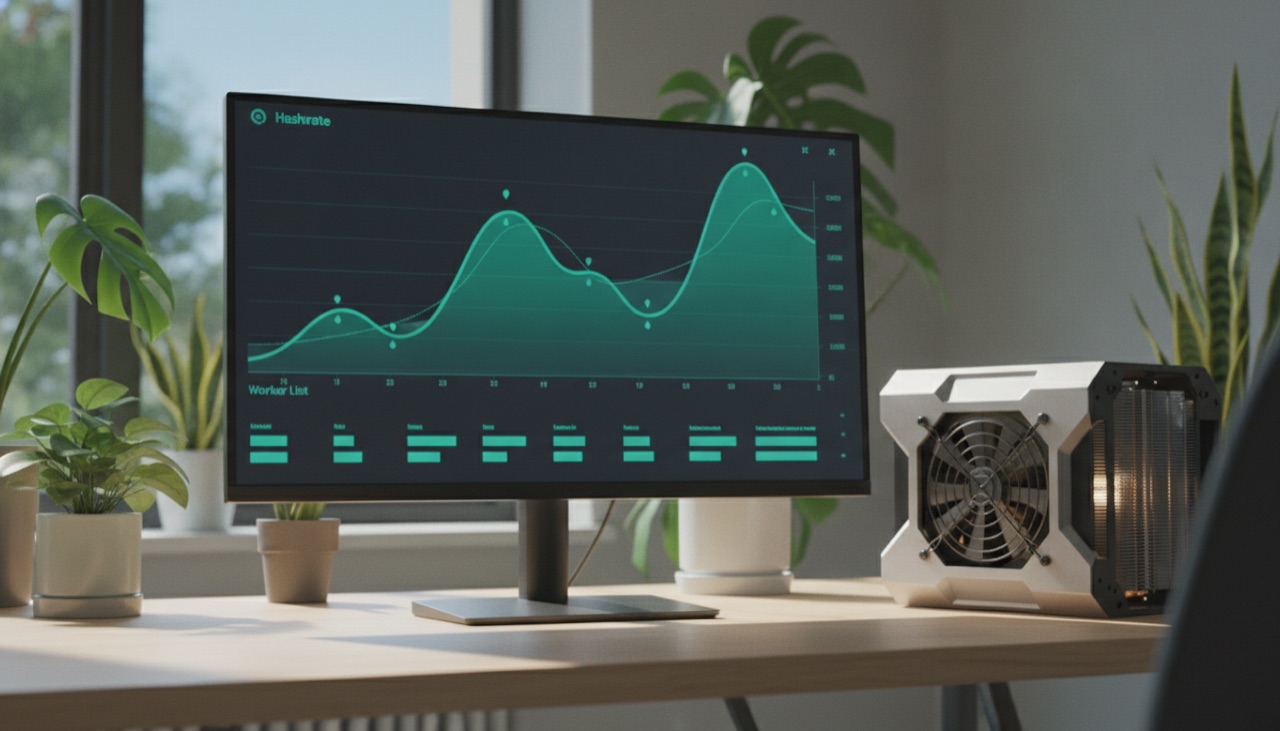
The template page lists OCEAN Recommended as the default, plus Core+Antispam, Core and Data-Free, all at 2%. The same page says the alternate template options were decommissioned on December 21st, 2025, so whether the last three still work is unclear. Treat the default as the only sure option.
This is an open conflict on the official site. At launch, OCEAN Knots and Core+Ordisrespector templates carried a 0% promotional fee while Core cost 2%, according to Bitcoin Magazine on 2023-12-22. Current pages do not repeat that offer.
The node policy page, which references Knots v29.2, says non-standard transactions are off and rejectparasites is set to 1. Bare multisig and bare pubkey outputs are not relayed, OP_RETURN is allowed up to 42 bytes, and blockmaxweight is 3,985,000. If you care which transactions your hashrate confirms, read that page before you point a miner at the pool.
What happened with BIP-110 on OCEAN?
On 2026-07-08 OCEAN launched two extra Stratum endpoints for BIP-110 signaling. On 2026-08-08 the BIP-110 chain split at block 961,632, and the enforcing chain stalled after about 2 blocks. On 2026-08-10 OCEAN said that for about 18 hours some miners believed they were on the main chain while their hashrate went to the BIP-110 chain.
OCEAN pledged about 0.3 BTC in rebates within 72 hours and moved the default endpoint back. Whether the rebates were paid is unverified. Critics, including Peter Todd, objected to the defaults. CriptoNoticias reported on 2026-07-14 that Lopp and Adam Back criticised earlier statements, and that BIP-110 signaling was concentrated at OCEAN, at about 2.25% of hashrate.
On 2026-08-29 OCEAN discontinued BIP110 chain support. Post-split BIP110 rewards are frozen at BIP110 block 961,639 and will not be paid on the main chain. We report these events as published and take no side in the underlying debate. The practical lesson is to check which endpoint your miner uses after any announcement.
Do Lightning payouts work on OCEAN?
Not at the moment, as far as the documentation shows. Lightning payouts have been paused since 2026-08-07, block 961,488, "while dual-TIDES is possible", and are to resume when a single share log is active. We found no resume notice as of 2026-10-17, so the status is unverified and worth checking with OCEAN before you plan around it.
When it works, the setup uses a reusable BOLT12 offer linked to your bitcoin address by a signed message. Failed payments are retried each block until the balance reaches the on-chain threshold, then it is paid on-chain. You need a BOLT12 node, inbound liquidity and a wallet that can sign messages.
Known limits: Alby Hub v1.21.2 and newer is incompatible, Phoenix is not yet compatible, and the terms say you cannot open channels directly with OCEAN. There was an earlier Lightning outage that lasted until 2025-06-11. For other pools, see our overview of Lightning payouts at mining pools.
Who is OCEAN a good fit for, and who should skip it?
OCEAN fits miners who value non-custodial payouts, a 2% fee and no KYC, and who have enough hashrate to reach 0.01048576 BTC in reasonable time. It fits node operators who want to build their own templates for a 1% fee. It fits less well if you want small frequent payouts or working Lightning now.
A good fit:
- Miners who do not want the pool to hold balances, since rewards come from the coinbase whenever possible.
- Node operators ready to run DATUM Gateway in exchange for 1%.
- Miners who accept the pool's transaction policy and variance from TIDES.
A weaker fit:
- Home miners with one machine, who face a long wait for the first payout.
- Anyone who needs Lightning right now.
- Miners who want a guaranteed payout schedule.
- Farms that need a long track record: OCEAN has found 1,593 blocks in total, and the official site gives no security audit or bug bounty (checked 2026-10-17).
Which countries can use OCEAN, and is KYC required?
OCEAN requires no KYC. The terms call it permissionless: it needs only bitcoin addresses and proof-of-work data. There is no country list. Users must not be barred under US law and must be allowed to mine where they live. They also represent that they are not subject to US, UN, EU or UK sanctions.
Wyoming law governs, with courts in Laramie County. For Russia and the CIS, no country is named as blocked, but the sanctions representation applies to each user, so check your own position. For Argentina and the rest of Latin America we found no stated restriction.
The terms also ask you to use only addresses you hold the keys for, so do not point a miner at an exchange deposit address you do not control.
How safe is OCEAN?
The main safety feature is structural: there is no account balance to steal. Miners are paid in the coinbase transaction whenever possible, and your username is a bitcoin address. We found no hacks or fund losses in the official announcements. A security audit or bug bounty is not stated on the official site (checked 2026-10-17).
The incident list is short but real: maintenance and the Lightning outage in June 2025, a statistics incident on 2025-08-29 that was resolved, unscheduled maintenance from 2026-01-11 until 2026-01-12 at 22:00 UTC, and the BIP-110 misrouting in August 2026.
Orphan and stale rates are not stated on the official site. Average block health on mempool.space is 92.14%. Support runs through mining@ocean.xyz, lightning@ocean.xyz, chat on the site, X, Nostr, Mastodon and Bluesky.
How do you start mining on OCEAN?
You need a bitcoin address you control and access to your miner's settings. There is no account to create: the address is your username. The address types OCEAN accepts are not stated on the official site (checked 2026-10-17), so confirm yours with support if it is unusual.
- Prepare a bitcoin address whose keys you hold.
- In the miner's web panel, set the pool URL to mine.ocean.xyz:3334, adding the stratum+tcp:// prefix if the firmware needs it. The alternate is default.mine.ocean.xyz:3101.
- Enter your bitcoin address as the username, optionally followed by .workername, and any password.
- Start the miner and watch the stats at portal.ocean.xyz.
- For DATUM, sync a node, install DATUM Gateway and point miners at the gateway instead.
Payouts happen automatically once the balance passes the threshold. The main page is ocean.xyz. OCEAN has no referral program, so there is nothing for us to earn from this link.
How big is OCEAN's share of the Bitcoin network?
On mempool.space on 2026-10-17, OCEAN found 32 of 1,096 blocks over seven days, a 2.92% block share, ranked ninth. Over a month it found 118 of 4,448, about 2.65%. Weekly hashrate was 24.50 EH/s, or 2.40% of the network, while the homepage showed 24.74 EH/s. The 24-hour figure was 13.96 EH/s.
Hashrate swings a lot: the weekly range over the last two months ran from 16.42 to 29.00 EH/s. In total OCEAN has found 1,593 blocks, 0.16% of all blocks, with 5,131.97 BTC in rewards. The latest block height in our data was 971761 on 2026-10-16.
Pool size matters more under TIDES than under FPPS. A smaller pool finds blocks less often, so your income arrives in lumpier steps even with the large window.
What are the risks of mining with OCEAN?
The main risks are a high payout threshold, variance, a Lightning pause and a recent chain-split incident. There is no custody risk of the usual kind, but there is operational and policy risk. Everything below comes from the official pages and the reports named above.
- High threshold. 0.01048576 BTC means small miners wait, and sub-satoshi earnings are lost.
- No schedule. The terms do not guarantee payouts on any schedule.
- Variance. TIDES pays when the pool finds blocks, so income follows block luck.
- Heavy DATUM. It needs a synced node, and the gateway is in public beta.
- Lightning paused. Paused since 2026-08-07, with compatibility limits.
- Chain-split incident. About 18 hours of misrouted hashrate in August 2026; rebates unverified.
- Policy. Template and node policy filter some transactions, which you may or may not want.
- Unclear options. The template page lists options that it also says were decommissioned.
- Chain splits. The terms set a fee per chain and promise no payout timetable for non-Bitcoin chains.
How does OCEAN compare with Braiins Pool, Luxor and F2Pool?
OCEAN has the lowest standard fee here, tied with F2Pool's PPLNS option, and is the only one that pays from the coinbase, but it has the highest payout minimum. Braiins Pool and Luxor charge 2.5% on FPPS with far lower thresholds. F2Pool charges 4% on FPPS. Figures are from our earlier reviews.
| Pool | BTC fee | Scheme | Minimum BTC payout |
|---|---|---|---|
| OCEAN | 2%, 1% with DATUM | TIDES, paid from the coinbase | 0.01048576 BTC |
| Braiins Pool | 2.5% | FPPS | 0.0002 BTC on-chain, 1 sat via Lightning |
| Luxor | 2.5% | FPPS | 0.001 BTC, plus 0.000075 BTC withdrawal fee |
| F2Pool | 4% FPPS, 2% PPLNS | FPPS / PPLNS | 0.005 BTC |
Both Braiins Pool and Luxor offer a 0% pool fee, but only with their own firmware, which carries a separate fee. For a full walkthrough of the closest rival, read our OCEAN vs Foundry USA comparison. For the FPPS side, see the Braiins Pool review and the Luxor review.
FAQ
What fee does OCEAN charge?
2% of block rewards and fees on the standard setup. If you build your own block templates with DATUM, the fee is 1%. A separate DATUM template-creation fee is not stated on the official site (checked 2026-10-17).
What is the minimum payout on OCEAN?
0.01048576 BTC, which is 1,048,576 satoshis, paid on-chain. After you stop mining or change address, OCEAN attempts discretionary payouts for balances above 0.00065536 BTC.
Does OCEAN require KYC?
No. The terms describe it as permissionless and ask only for bitcoin addresses and proof-of-work data. Users represent that they are not subject to US, UN, EU or UK sanctions.
Do Lightning payouts work on OCEAN?
They have been paused since 2026-08-07, and we found no resume notice as of 2026-10-17. Treat the status as unverified. When active, they use a BOLT12 offer and need a compatible node and wallet.
Is OCEAN custodial?
No. Miners are paid in the coinbase transaction whenever possible, and your username is a bitcoin address. The pool holds no account balance in the usual sense, though payouts are not guaranteed on a schedule.
Do I need a node to mine on OCEAN?
No. A node is needed only for DATUM. Standard mining needs the pool URL, your bitcoin address and any password.
Is OCEAN worth it in 2026?
OCEAN is worth considering if non-custodial payouts and a 2% fee matter more to you than frequent small payments, and if your hashrate can clear 0.01048576 BTC in reasonable time. DATUM adds a 1% fee for those who run a node. The paused Lightning, the August chain-split incident and the unclear template options are real reasons to start small.
If it looks like a fit, point one machine at the pool on ocean.xyz, check that shares appear in the stats, and confirm your payout address before moving the rest of the fleet.