
ASIC miner value in September 2026: the price per terahash test before you buy
Two sellers list the same model on the same week and the asking prices differ by half. Neither of them is wrong, because a mining machine has no price of its own. It has a margin, and that margin depends on your electricity tariff, on hashprice the day you plug it in, and on how much of the machine's life is already behind it. This page is about turning an asking price into a number you can defend.
POOL BTC is an independent comparison site. We take no hashrate, we pay no rewards, we sell no hardware, and there are no affiliate links to resellers here. Every figure below carries its source and its date. Datasheet specs come from the manufacturers' own pages, and official store prices were taken on 23.09.2026. Where a manufacturer does not publish a price openly, we say so rather than borrow a number from a listing.
What decides the price of a used ASIC miner?
Efficiency in watts per terahash decides it, not raw hashrate. The buyer is paying for whatever the machine earns above its own power bill, and efficiency sets that figure. Hashrate only scales the result. Two machines at the same efficiency return the same margin per dollar of electricity, whatever their sticker hashrate says.
That single fact explains most of the confusion in second-hand listings. A seller quotes terahashes because terahashes sound like the product. A buyer who pays per terahash without checking watts per terahash can end up with a machine that has to be switched off nine months a year.
| Factor | How much it moves the price | Why |
|---|---|---|
| Efficiency, W/TH | The dominant factor | It decides which electricity tariffs the machine survives at all |
| Current hashprice | Sets the level for the whole market | Revenue per terahash is the same for every machine on earth |
| Expected difficulty path | Sets the discount rate | A retarget cuts tomorrow's margin without touching the hardware |
| Physical condition | From a small discount to worthless | Dead hashboards, a tired PSU, immersion residue, rework marks |
| Remaining warranty | Adds a little, transfers rarely | Bitmain gives 180 days on new models and 365 days on the 19-series per support.bitmain.com on 27.09.2026. The page says nothing about a second owner, and third-party guides on Bitmain and MicroBT agree that cover stays with the first buyer |
| Shipping, duties, PSU | Raises your real entry price | These belong in the purchase price, not in a footnote |
| Repairability of the revision | Matters inside one model | Parts availability differs between batches of the same model |
Brand and build year reach the price only through those rows. A 2022 machine is not cheap because it is old. It is cheap because its watts per terahash no longer clear the bill at ordinary tariffs.
How do you compare miners on price per terahash?
Divide the asking price by the machine's rated terahashes. That gives dollars per terahash, the only unit that lets you set a 100 TH/s machine against a 400 TH/s one. Then check the efficiency of each, because two machines at the same price per terahash are not the same purchase when one burns twice the power.
The comparison in four steps:
- Price per terahash = total landed cost divided by rated TH/s. Landed cost means the machine plus shipping, duties, the power supply if it ships separately, and any cable or rack you have to buy.
- Write down efficiency in W/TH for each candidate. Efficiency is rated watts divided by rated terahashes. Figures for current models are in the table below.
- Work out the daily margin per terahash at your own tariff, using the formula in the shutdown section below.
- Divide price per terahash by daily margin per terahash. The answer is payback in days, and it is the number that actually ranks the candidates.
| Model | TH/s | W | W/TH | Official store, 23.09.2026 |
|---|---|---|---|---|
| Antminer S23 Hyd. | 580 | 5510 | 9.5 | not in stock |
| SEALMINER A3 Pro Air | 260-320, rated 290 | 3250-4000 | 12.5 | price not published openly |
| Antminer S21 XP | 270 | 3645 | 13.5 | $17 per TH, $4,590 per unit |
| Avalon A16 | 282 | 3900 | 13.8 | price not published openly |
| Antminer S21 Pro | 234 | 3510 | 15.0 | not in stock |
| Whatsminer M60S++ | 200-226 by bin | 3230-3570 | 15.5 | $10 per TH, one configuration |
| SEALMINER A2 | 226 | 3729 | 16.5 | price not published openly |
| Whatsminer M60S+ | 188 | 3384 | 18.0 | $16 per TH, one configuration |
Source: specification pages, manuals and official stores of Bitmain, MicroBT, Canaan and Bitdeer, checked 23.09.2026. Manufacturer tolerances are usually ±3-10% on hashrate and ±5% on efficiency.
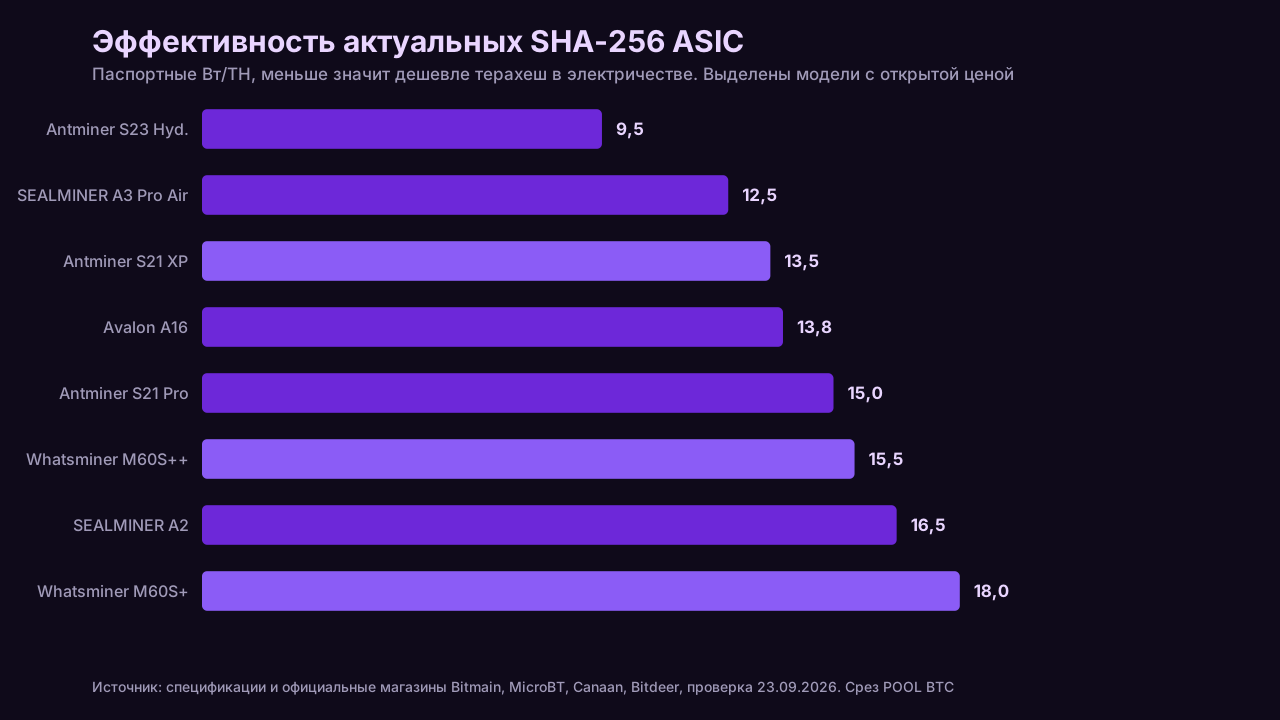
A machine at a low price per terahash and a bad efficiency is not a bargain. It is a machine whose payback clock only runs during the hours when hashprice happens to be high enough, and those hours are not under your control.
Manufacturer prices in the table were taken on 23.09.2026, and not every maker publishes them openly. For used units, the latest dated sample we found is ingmining.com's count of completed eBay sales for 15.05-14.08.2026: S19j Pro $145 median (43 sales), S19 $150 (29), S19 XP at 141 TH/s $298 (34), S19k Pro $300 (15), S21 at 200 TH/s $1,005 (15). That is a third-party count, not an index, and the sample is more than a month old. Read it as an order of magnitude, not as today's deal price.
How do hashprice and the difficulty retarget move hardware prices?
Hardware prices track hashprice, which is revenue per unit of hashrate per day. Hashrate Index put the spot figure at $39.25 per PH per day in its snapshot of 14.09.2026. That is the revenue every machine on the network shares, so it sets the ceiling on what any of them can be worth to a buyer.
The mechanics are unglamorous. Your share of the network equals your hashrate divided by the total. When the total grows, your share shrinks, and your revenue falls even if bitcoin has not moved a cent. That is why a seller who anchors on the BTC chart and a buyer who anchors on hashprice will disagree by a wide margin, and why the discount usually lives in that gap.
What is dated and verified right now:
| Figure | Value | Source and date |
|---|---|---|
| Spot hashprice | $39.25 per PH per day | Hashrate Index snapshot, 14.09.2026 |
| Network hashrate, 7-day SMA | 943 EH/s (30-day SMA 928 EH/s) | Hashrate Index, 14.09.2026 |
| Difficulty | 127.45 T | Hashrate Index, 14.09.2026 |
| Retarget of 19.09.2026 | +4.16%, difficulty 132.76 T | Hashrate Index roundup, 21.09.2026 |
| Spot hashprice after the retarget | $40.93 per PH per day, 30-day average $39.08 | Hashrate Index roundup, 21.09.2026 |
| Monthly average hashprice low, June 2026 | $27.7 per PH per day | CoinShares Q2 2026 report, cited 16.09.2026 |
| Average all-in cost to mine one BTC, public miners, Q2 2026 | about $75,500, against a quarter-end BTC price of $58,400 | CoinShares Q2 2026 report, cited 16.09.2026 |
The forecast on 14.09 was +4.7% to +5.3%, and the actual adjustment on 19.09 came in at +4.16%. Until an epoch closes every block shifts the estimate, so a retarget forecast is more honestly carried as a range than as one number.
Apply that to the machine you are being offered. A 4.16% rise in difficulty, with the BTC price and the fee share unchanged, takes hashprice from $39.25 to roughly $37.7 per PH per day. That is a four percent cut to the top line. Further down, after the power bill is subtracted, the same cut is far larger, and the next section shows by how much. Spot hashprice was back at $40.93 on 21.09.2026 on the bitcoin price, so the sums below at $39.25 sit close to the 30-day average.
The fee share of the block reward is small right now, but it is not fixed. Per mempool.space on 27.09.2026, fees made up 0.69% of the total reward over the last 1,008 blocks, about a week, and 0.48% over the last 144 blocks, about a day. POOL BTC calculation from reward-stats.
Live values and the running forecast sit on the difficulty and hashprice page.
At what electricity price does a miner stop paying for itself?
The shutdown tariff is the electricity price at which daily revenue equals daily power cost. Above it the machine loses money every hour it runs, and its resale value collapses towards scrap and spare parts. Below it the machine holds value. The threshold depends only on efficiency and on current hashprice.
The formula, written out:
- Revenue per terahash per day = hashprice divided by 1000, then multiplied by (1 minus the pool fee).
- Power cost per terahash per day = efficiency in W/TH multiplied by 0.024, multiplied by your tariff in dollars per kWh. The 0.024 is simply 24 hours converted from watt-hours to kilowatt-hours.
- Margin per terahash per day = revenue minus power cost.
- Break-even efficiency = revenue per terahash per day divided by (0.024 multiplied by your tariff).
At the 14.09.2026 hashprice of $39.25 per PH per day, before any pool fee, the ceiling on efficiency looks like this:
| Your tariff, $/kWh | Highest efficiency that still breaks even, W/TH |
|---|---|
| 0.04 | 40.9 |
| 0.05 | 32.7 |
| 0.06 | 27.3 |
| 0.07 | 23.4 |
| 0.08 | 20.4 |
| 0.10 | 16.4 |
| 0.12 | 13.6 |
The 19.09.2026 adjustment of +4.16%, with nothing else moving, takes hashprice to roughly $37.7 and pushes the ceiling at eight cents down from 20.4 to roughly 19.6 W/TH. A machine sitting between those two numbers is profitable one week and unprofitable the next, which is the whole reason second-hand prices move faster than anyone expects.
A worked example, with an efficiency chosen to sit near the current ceiling rather than copied from any datasheet. Take 20 W/TH, a six-cent tariff and a 2 percent pool fee:
- Revenue per terahash per day: 39.25 / 1000 = $0.03925, times 0.98 = $0.038465.
- Power cost per terahash per day: 20 × 0.024 × 0.06 = $0.0288.
- Margin: $0.009665 per terahash per day, or about $0.29 per terahash per month.
- Fair price at an 18-month payback: 0.009665 × 548 days = $5.30 per terahash. At 24 months, $7.06. At 12 months, $3.53.
- The same machine at an eight-cent tariff: power cost 20 × 0.024 × 0.08 = $0.0384, margin $0.000065 per terahash per day. It is running to stay level.
- The same machine after a 5 percent retarget at the six-cent tariff: revenue $0.036554, margin $0.007754, down about 20 percent from step 3.
Step six is the point worth carrying away. A five percent move in difficulty cut the margin by twenty percent, because the power bill did not move with it. That leverage is what a price per terahash comparison hides and what a payback calculation exposes.
Finding your own number for step two is its own job, and metered rate plus delivery charges plus taxes rarely equals the number on the advert. The method is in mining electricity cost: how to find your real $/kWh, and the wider version of the shutdown question is in hashprice risk and your shutdown price.

Why is the move to AI hosting putting used fleets on the market?
Because leasing a megawatt to an AI tenant currently pays about three times what mining bitcoin with it pays, so operators are converting sites and the machines that used to fill them have to go somewhere. CoinShares puts AI and HPC leasing at roughly $1.5 million of annual profit per megawatt against about $0.5 million per megawatt from mining, in reporting dated 17.09.2026.
The supply side of the second-hand market in September 2026 is not made of hobbyists upgrading. It is made of balance-sheet decisions at companies with tens of thousands of machines:
- Keel, formerly Bitfarms, stopped mining at all of its sites on 29 June 2026 and expects no mining revenue at all in Q3, the first public miner to reach zero. Its gross margin for the quarter was minus 285 percent. Source: CoinShares Q2 2026 coverage, 16.09.2026.
- Core Scientific paid Block Proto $41.9 million to cancel delivery of roughly 15 EH/s of next-generation 3nm chips and redirect the capacity to AI colocation. Source: same coverage, 16.09.2026.
- CoinShares expects up to 35 EH/s to leave the public mining group by the end of 2026. The report gives the absolute figure without a fixed percentage of network hashrate, and the derived percentages in circulation disagree with each other, so we carry the absolute number only. Source: CoinShares, 17.09.2026.
- CleanSpark announced a 20-year triple-net lease worth $6.6 billion for a 250 MW site in Sandersville, Georgia, with the first data hall due in December 2027. Source: H.C. Wainwright panel coverage, 17.09.2026.
- Cipher received conditional ERCOT approval for up to 3.2 GW across six Texas sites on 16.09.2026, against 807 MW currently operating.
Two things follow for a buyer. Supply of used machines is rising for reasons that have nothing to do with whether those machines work, which is good news on price. And the same economics that free up the machines also free up the cheap industrial power they were running on, which is bad news for anyone counting on hosting capacity staying cheap. Note that building the liquid-cooled halls those leases require now costs $10 to $10.5 million per megawatt, up from about $4.5 million at the end of 2023, per the same panel on 17.09.2026. Operators paying that are not competing with you for retail hosting slots, but they are competing for the grid connections.
How much of the retired fleet actually reaches open resale, rather than being scrapped or moved inside the same company, the public filings do not show. Core Scientific's 10-Q for Q1 2026 discloses $41.9 million paid to cancel an order, IREN discloses impairments on mining equipment, but none of the four companies publishes unit volumes of resale.
For the difference between buying from a maker, an official reseller and a private seller, see where to buy an ASIC miner in 2026.
How do you inspect a used ASIC before you pay?
Check the things that a seller cannot photograph cheaply: the hashboards under load, the real uptime, the firmware it is running, the power supply under sound, and any trace of immersion or repair. A machine that hashes for five minutes on a bench can still fail at hour three under a warm roof, so insist on a sustained test rather than a screenshot.
- Ask for a sustained run, at least a few hours, with the pool-side hashrate visible rather than the miner's own dashboard. The miner reports what it thinks it is doing. The pool reports what arrived.
- Count working chips per hashboard in the status page. A board running below its chip count is a board with a repair in its future. Reference counts from the zeusbtc.com and d-central.tech repair guides, not from manufacturer documents: S19j Pro 126 chips per board, S19 XP 110, S21 108, S21 Pro 65, S21 XP 91. Revisions differ within a model, so check the hashboard part number.
- Check total uptime and the error and hardware-error counters. High hours are not fatal by themselves. High hours plus a rising error rate is.
- Identify the firmware. Custom firmware raises questions about how hard the machine has been overclocked and whether it can be returned to stock. Ask whether the unit has ever been undervolted or run above rated power, then verify against the power reading during the test run.
- Look for immersion or hydro history. Residue on the boards, discoloured connectors, a missing or replaced fan assembly. A machine from a dielectric bath is not worse by physics, but its operating history is much harder to verify. We found no published discount for immersion history from any index or marketplace, so negotiate from what the burn-in shows.
- Listen to the power supply at full load. Whining, clicking or a fan that ramps and never settles is the cheapest warning you will get.
- Check the serial numbers against the maker's lookup, and check whether any warranty still exists and whether it survives a change of owner.
- Ask what tariff the machine has been running at and for how long it has been idle. Machines parked in a hot, humid warehouse for six months carry a different risk than machines that came straight off a rack.
- Price the missing parts. A unit without its power supply, or with a controller from a different batch, is a different purchase.
- Agree the return terms in writing before paying. Some marketplaces run an all-sales-final policy, and that policy is part of the price.
When is a cheap old miner still a bad buy?
When its efficiency puts it above your tariff's break-even ceiling, which makes the purchase price irrelevant. A machine that cannot cover its own electricity is not cheap at any figure. The test is one line of arithmetic, and it takes precedence over every other consideration on the listing page.
Run the numbers on an older machine at 45 W/TH, again an illustrative figure rather than a datasheet quote, at the 14.09.2026 hashprice:
- Revenue per terahash per day, before pool fee: $0.03925.
- Power cost at $0.06 per kWh: 45 × 0.024 × 0.06 = $0.0648.
- Margin: minus $0.0256 per terahash per day. The machine burns money whether you paid $500 for it or nothing.
- The tariff at which it breaks even: 0.03925 divided by (45 × 0.024) equals $0.0363 per kWh. Under about 3.6 cents it works. Above that it does not.
- After a 5 percent retarget, that ceiling falls to roughly $0.0345 per kWh.
So the question for an old machine is never the price. It is whether you have power under four cents, and whether you will still have it in six months. If you do, cheap old hardware can be the best value on the market, because everyone bidding against you is paying eight cents. If you do not, the correct price for that machine is the scrap value of its aluminium.
One more case where cheap is wrong: a machine bought to run seasonally. If your plan involves switching off through summer peak pricing, halve the running days in the payback calculation before you compare it to anything. The number usually stops looking attractive.
How do you check payback for a specific model at your own tariff?
Put the model's rated hashrate, its rated power, your tariff and the pool fee into a calculator that models the payout scheme rather than assuming a flat one. The output you want is net income per day after electricity, then the asking price divided by that figure. Everything else on the listing is decoration.
The sequence:
- Take the rated TH/s and W/TH from the manufacturer's datasheet, not from the listing text.
- Enter your real tariff, all charges included.
- Enter the pool fee and the payout scheme you will actually use. FPPS and PPLNS do not produce the same monthly figure from the same hashrate, and on a single machine the difference is large enough to move the payback by weeks. Run both in the mining profitability calculator.
- Read net income per day, then divide the landed price by it for payback in days.
- Repeat with hashprice five percent lower. If the payback moves from acceptable to unacceptable, you are buying a machine whose value depends on difficulty standing still, which it has not done.
- Compare the result against the alternative use of the same money, including simply holding BTC. Public miners averaged about $75,500 of all-in cost per BTC in Q2 2026 per CoinShares, while MARA bought coins on the open market at about $76,347 each on 15.09.2026. When those two numbers sit that close, buying hardware and buying the coin are genuinely competing options, and the hardware only wins on a cheaper power input.
The longer pricing walkthrough, including how depreciation behaves on either side of the shutdown ceiling, is in ASIC miner value: what a used miner is really worth.
What this page cannot tell you
- Fresh second-hand medians. The latest sample we found closed on 14.08.2026, and Hashrate Index's ASIC price index cannot be read by model and day in open text.
- Prices for Canaan, Bitdeer and Auradine. On 23.09.2026 their official stores did not show a price openly, and on 27.09.2026 the S21 XP and S21 Pro were marked sold out on shop.bitmain.com.
- Datasheet figures for models not in the table above. For those, take the manufacturer's datasheet rather than the listing text.
- The BTC price on the day you read this. The last dated figure we hold is about $76,347 per coin, the price MARA paid on 15.09.2026; bitcoin traded below $76,000 on 15.09.2026 after the CLARITY Act cloture vote failed 49-50.
- Whether a given seller's warranty transfers. Check with the maker before paying, not after.
Three numbers change the answer to almost every question above: hashprice, your tariff, and the machine's watts per terahash. Two of them are public. The third is the one most buyers never verify before the money moves.