
ASIC miner value: what a used miner is really worth and how to price one yourself
*Draft of article 121. Date: 2026-09-02. Status: awaiting approval, not published.*
POOL BTC takes no hashrate and pays no rewards. It is a comparison site: pools, calculators, hardware rankings. We do not sell hardware, there are no affiliate links to ASIC sellers in this text, and we do not price anybody's listing for them. What follows is the method for pricing one yourself, plus a breakdown of what that price is actually made of.
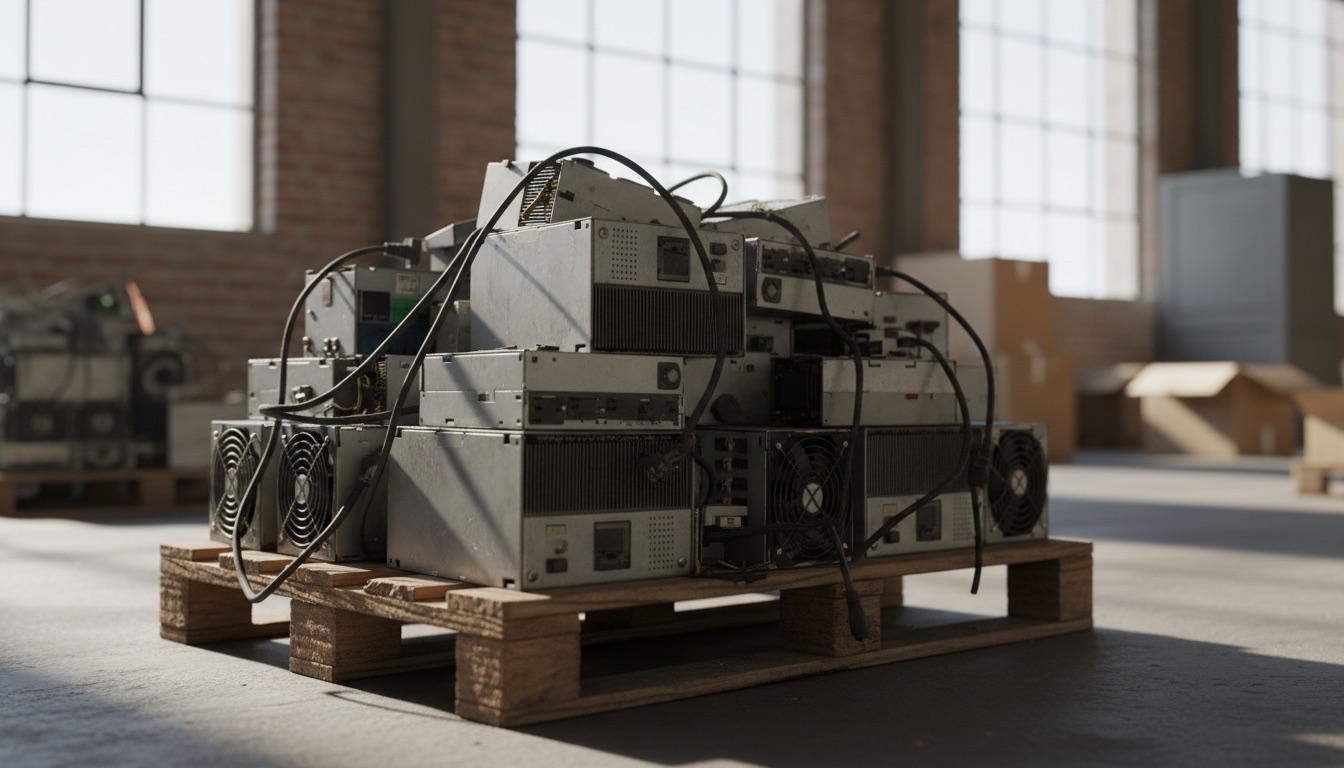
[IMAGE: dark vector graphic in the site palette. Near-black purple background, hexagonal grid behind, several ASIC miner silhouettes on a pallet inside a warehouse, purple accent outlines with a soft glow along the casings. Flat shapes, no photorealism, no people]
The short version
A used ASIC is worth exactly what it can earn above the power bill before it stops covering its own consumption. Everything else, brand name and build year included, only reaches the price through that one number.
- Hardware prices follow hashprice, not the BTC exchange rate. In mid 2026 hashprice sank to $29 per PH/s per day, with roughly a fifth of the network estimated to be mining at a loss.
- On the 2026-08-14 network snapshot, one terahash returned $0.030687 a day after a 2% pool fee. Every model's economics start from that figure.
- Break-even is set by your tariff: 25.57 W/TH at $0.05 per kWh, 15.98 at $0.08, 10.65 at $0.12. A model that crosses the ceiling loses resale value almost overnight.
- Depreciation is not a straight line. Below the ceiling a machine holds value, above it the machine is priced closer to parts.
- On eBay sold-price medians the Antminer S19 XP fell from $1,080 to $290 in twelve months, down 74%.
- Manufacturer warranty usually does not follow the unit to a second owner, and some marketplaces run an "all sales final" policy.
Run a specific seller's price against your own tariff in the mining profitability calculator, and pull model specs from the ASIC profitability ranking.
Where these numbers come from
The numbers here rest on two of our own research passes plus one external price sample. Ours: the 2026-08-14 network snapshot (933.99 EH/s hashrate, difficulty 127,479,855,693,691, a 3.125 BTC subsidy, BTC at $64,558) and the ASIC vendor review of 2026-08-27. External: a collection of sold prices and listings pulled on 2026-09-02, broken out in its own table below with the source status marked on every row.
Prices in this article are not a negotiating benchmark. They are there to show the scale of depreciation. The spread between marketplaces runs to multiples, so any printed figure goes stale within months. Wherever a price feeds the maths, the formula keeps a variable rather than a constant.
What determines the price of a used ASIC?
Five things set the price: efficiency in watts per terahash, current and expected hashprice, whatever warranty is left, the physical condition of that specific unit, and shipping plus customs. Raw hashrate barely moves the number, because a buyer is not paying for terahashes. They are paying for the margin those terahashes leave after the electricity bill.
| Factor | Effect on price | Why |
|---|---|---|
| Efficiency, W/TH | The strongest single factor | It decides which tariffs the machine still survives. Break-even at $0.08 per kWh is 15.98 W/TH |
| Hashprice | Sets the whole market level | Revenue per terahash falls, and the ceiling for every machine on the market falls with it |
| Remaining warranty | Adds value, rarely transfers | Per the raxmining procurement guide (2026-07-17), OEM warranty is non-transferable on resale |
| Unit condition | A discount from zero to total | Working chip count, PSU health, immersion residue, rework marks on the boards |
| Batch and revision | Matters within one model | Revisions of the same model differ in real-world hashrate and in how repairable they are |
| Logistics and duties | Raises your entry cost | Shipping, customs, a separate PSU and the wiring all belong in the cost of ownership |
A note on immersion and hydro units. A machine pulled out of a dielectric bath is not worse by definition, but its history is much harder to verify, and residue on the board tells you it lived in a different regime than the datasheet describes. The discount for that is set by the market, not by physics.
Why ASIC prices track hashprice rather than the BTC price
The exchange rate only reaches hardware prices through hashprice, meaning revenue per unit of hashrate per day. Hashprice combines the BTC price, the block subsidy, the transaction fee share and network difficulty. Bitcoin can rally while hashprice sits still, if difficulty climbed by the same proportion.
The mechanism is plain. Your share of the network is your hashrate divided by the total. The total grows, your share shrinks, and revenue falls with the price unchanged. Hashrate Index data we quoted in the shutdown-threshold breakdown put the seven day moving average network hashrate at 932 EH/s on 2026-08-11, up 6.2% in a week. A weekly move that size eats income faster than most buyers build into their sums.
Practical consequence for negotiation: the seller usually anchors on the BTC price, because it shows up in every app on their phone. The buyer should be doing the maths from hashprice. That gap in framing is where the discount lives. How to read both is covered in network difficulty and hashprice, with live values on the difficulty forecast page.
The fee share is a second-order term right now. Per mempool.space, across the last 4320 blocks as of 2026-08-29, transaction fees came to 0.73% of total block reward against the 3.125 BTC subsidy. In a quiet mempool that is noise. In a congested one it stops being noise.
How to price a model yourself, step by step
- Take rated TH/s and W/TH for the model from the ASIC ranking. Efficiency in W/TH is watts divided by terahashes.
- Work out daily revenue: terahashes times the current per terahash rate. On the 2026-08-14 snapshot that rate was $0.030687 per day after a 2% pool fee.
- Work out daily power: TH/s times W/TH times 0.024 gives kWh per day. Multiply by the tariff on your actual bill, not the advertised off-peak rate.
- Subtract one from the other. That is your daily net margin, called N below.
- Pick a payback horizon in days. This is a decision about your own risk appetite, not a property of the hardware.
- Multiply N by the horizon. That is the price ceiling above which the purchase never pays back, even with difficulty frozen.
- Subtract shipping, duties, a PSU if it is not included, and any electrical work. What remains is the most it makes sense to pay for the box itself.
- Apply a risk discount. Difficulty rises, the unit is used, there is no warranty. You choose the size, and it grows as the model gets closer to its shutdown threshold.
- Redo the sum after the next retarget. An estimate older than two weeks is not an estimate.
A worked example on our snapshot numbers
Antminer S21 XP: 270 TH/s at 13.5 W/TH. Gross revenue $8.29 a day after a 2% pool fee. Net margin: $3.91 at a $0.05 tariff, $1.29 at $0.08, minus $2.21 at $0.12.
Price ceilings by payback horizon, before shipping and duties and before any risk discount:
| Horizon | $0.05/kWh | $0.08/kWh | $0.12/kWh |
|---|---|---|---|
| 6 months | $714 | $235 | never pays back |
| 12 months | $1,427 | $471 | never pays back |
| 18 months | $2,141 | $706 | never pays back |
Three columns, one machine. The ceiling moves by a factor of three on the tariff alone, which answers the question of why the same unit sells for wildly different money in different regions, and why an averaged market price is useless to you.
Those ceilings are also optimistic, because difficulty is frozen in them. Retargets land every 2016 blocks, roughly every two weeks, and usually upward. Do not compute N x 365. Sum two week chunks with N stepping down each time. The corrected method is laid out in ASIC miner ROI.
[IMAGE: dark vector graphic in the site palette. Near-black purple background, hexagonal grid, a flat screen showing a falling value curve with a purple glow along the line, an open notebook with schematic rows of calculations beside it. No photorealism, no people]
How much value does an ASIC lose per year, and why is the curve not straight?
There is no flat annual percentage. A machine holds its price while its draw fits under the break-even ceiling at the market's typical tariff, then loses most of its value within weeks once the ceiling drops below its efficiency. Nothing smooth connects those two states.
The ceiling is one line: `W/TH <= rate per terahash / (0.024 x tariff)`. At $0.05 the ceiling is 25.57 W/TH, at $0.08 it is 15.98, at $0.12 it is 10.65.
What that does to real models from our snapshot. At $0.08 the S21 XP at 13.5 W/TH still clears $1.29 a day, while the plain S21 at 17.5 W/TH is already down $0.58. Four watts per terahash apart, opposite signs. Resale prices step the same way.
An even sharper pair from the same dataset: the WhatsMiner M56S++ at 230 TH/s ranks third on gross revenue, $7.06 a day, and only ninth on net at $0.05. At $0.08 it loses to machines with half its hashrate. Buyers who shop on rated terahashes overpay for exactly this class of unit.
Three forces move the ceiling, and none of them are under the owner's control: difficulty growth, the BTC price and the halving. The non-linearity is not a market quirk. It is normal behaviour for an asset whose revenue declines in steps.
The annual drop measured on completed sales
The most reliable public picture of the twelve month drop comes from closed eBay sales rather than from an index. ING Mining's roundup "Used ASIC Miner Sold Prices: 90 Days of eBay Comps" (Edition 2, published 2026-08-15, data pulled by us on 2026-09-02) tracks monthly medians of actually sold used single units, USD sales only, with the sample size printed on every row.
| Model | Median a year earlier | Median in August 2026 | Change |
|---|---|---|---|
| Antminer S19 XP (141 TH/s) | $1,080 (September 2025) | $290 | down 74% |
| Antminer S19j Pro (96 to 104 TH/s) | $260 (November 2025) | $147 | down 43% |
One counterexample from the same dataset: the Canaan Avalon Q (90 TH/s) median went up rather than down over the same window, from $827 in April 2026 to about $1,075 in August. The idea that used ASICs only ever get cheaper breaks on a specific model.
The index question deserves a straight answer, because it comes up first. Hashrate Index (Luxor) does publish an ASIC price index, updated weekly, and it groups machines by efficiency band rather than by model: the current schema has five bands, under 19 J/TH, 19 to 25, 25 to 38, 38 to 68 and above 68, where the original had three. The dollar per terahash values by date are served only through an interactive request and a keyed API, and are not publicly indexed. We are not reproducing them, and we are not relaying them second hand from review blogs, so the depreciation here is shown on sales instead.
Reference prices for popular models
Below is a price sample as of 2026-09-02 across nine popular models. The source status column matters more than the price itself. A median of completed sales and an estimate from a review site are different grades of data, and putting them on the same scale would be misleading.
| Model | Price | Source status |
|---|---|---|
| Antminer S19 (90 to 95 TH/s) | $150 used median (n=29, window 2026-05-15 to 2026-08-14) | Completed sales, ING Mining eBay comps |
| Antminer S19j Pro (96 to 104 TH/s) | $145 used median (n=43) | Completed sales, same source |
| Antminer S19 XP (141 TH/s) | $298 used median (n=34) | Completed sales, same source |
| Antminer S21 (200 TH/s) | $1,005 used median (n=15), full range $504 to $1,972 | Completed sales, same source |
| Antminer S21 Pro (234 TH/s) | $1,849 to $3,083 per new unit across vendor aggregators on 2026-09-02 | Listings (asking prices), no confirmed sales |
| Whatsminer M50 (122 TH/s) | $582 per unit, about $4.77 per TH | Reseller shop listing |
| Whatsminer M50S (138 TH/s) | $993 per unit, $7.2 per TH | Reseller shop listing |
| Whatsminer M60 | $1,100 to $1,600 new (January 2026) and $4,000 to $5,000 (April 2026) | Review site estimate, two publications that disagree |
| Whatsminer M60S (188 TH/s) | $1,800 to $3,500 on the secondary market (May 2026) | Review site estimate |
The M60 row is left as found on purpose. The same site quotes $1,100 to $1,600 for a new M60 in January 2026 and $4,000 to $5,000 on its own pages in April of the same year. That is a three to fourfold gap with no explanation in either publication. Averaging the two would be a fabrication: nobody says whether the difference is a revision, a batch, or an editorial mistake.
The lesson runs wider than the M60. Public data on the used market consists mostly of review articles that copy each other and never mark where a figure came from. The checkable numbers are the ones attached to a completed sale with a date and a sample size. Read everything else as an order of magnitude, nothing more.
What to do with that practically: take the order of magnitude from the table, put it into the mining profitability calculator with your own tariff, and look at the payback period. If it runs past your horizon, the price is too high no matter who quoted it.
How to inspect a used miner before buying
The inspection takes about an hour per unit and has seven steps. None of them is replaced by the seller's word.
- Measure real hashrate under load for at least an hour, not the peak reading in the first minute. A gap larger than 5% against the rated figure points to hardware or connectivity, not to bad luck.
- Read the working chip count on every hashboard in the web interface. Missing chips are not "slightly less hashrate". They are a board that has already been repaired or soon will be.
- Check temperatures and fan speeds on the same run. Fans pinned at maximum from minute one mean clogged heatsinks or dried out thermal paste.
- Inspect the PSU: scorch marks on connectors, smell, bulging capacitors. A PSU costs less than a hashboard, but when it fails it usually takes something else with it.
- Look for immersion history: oily residue, no fans in the package, non-standard shrouds. Ask outright what cooling the unit ran in and compare the answer with what you see.
- Check the firmware. Custom firmware can be a selling point or it can be hiding years of aggressive overclocking. Find out whether you can flash back to stock before you pay, not after.
- Request serial numbers before sending money and match them against the case labels on delivery. Obvious advice, and the step where most private deals fall apart.
On timing: vendor material describes an industry norm of 48 to 72 hours to report dead-on-arrival units (a characterisation from the MiningStore page dated 2026-07-15, not a guarantee from any particular seller). If that window is not in your correspondence, assume it does not exist.
What to read in the Antminer web interface
Bitmain keeps an official description of the Miner Status page in its knowledge base (support.bitmain.com, article "Miner Status Page Explained", created 2018-12-13, last updated 2026-08-24, checked by us on 2026-09-02). The page splits into three blocks: Summary, Pools and ANTMINER. Chip inspection happens in the last one, where every hashboard gets its own row. Field names below are given exactly as the interface labels them.
- Chain#: the hashboard number. Start by confirming there are as many rows as the model has boards. A missing row means the board is not detected at all, which is a repair conversation rather than a discount conversation.
- ASIC#: detected chips on that board. Compare against the rated chip count for the model. Any shortfall is a red flag, even when the hashrate looks close to spec.
- ASIC status: a per chip status string where zero means healthy. The count of zeros should match the rated chip count exactly (Bitmain's own example shows 63 chips and 63 zeros). An "x" in a chip position means that chip is not responding.
- Frequency: board frequency. Noticeably different frequencies across boards in one machine suggest firmware has already been pushing the clocks to hit the rated hashrate.
- GH/s (ideal) and GH/s (RT): nominal and real-time hashrate. Read the gap between them rather than either number alone. A persistent shortfall in RT is a symptom, not measurement noise.
- HW: the hardware error counter. A counter climbing visibly during your one hour run is worse news than a large total accumulated over a long service life.
- Temp chip and Temp PCB: chip and board temperatures. The warning sign is not the absolute value but the spread between boards under identical conditions, which points to uneven thermal interface condition.
- Fan: fan speeds. Maximum from minute one at normal ambient temperature means clogged heatsinks, or a fan curve the firmware has already been asked to change.
Bitmain does not tie this description to a firmware version, so labels can differ on custom builds. If the interface looks unlike the above, that in itself is a reason to ask which firmware is installed.
Why there is no equivalent list for Whatsminer
As of 2026-09-02 we could not find an official MicroBT page describing the web interface sections at anything close to Bitmain's level of detail. The manufacturer site is a shop window, and the API documentation loads through a script and does not read in search. The section names, hashboard numbering and error codes circulating online come from third party repair sources, independent workshops and service guides. They agree with each other, but they are not MicroBT primary material, and we are not going to present them as official.
The practical takeaway for a buyer is simple. On an Antminer you can check readings against the manufacturer's own document. On a Whatsminer you are leaning on service technician experience instead. That does not make Whatsminer worse. It means the inspection takes longer and needs a seller willing to give you access to the machine under load.
When to sell an old miner and when to run it into the ground
One rule: compare today's resale value against what the machine will actually earn over its remaining life at your tariff. If the daily margin is negative, so is that second number, and every day of waiting shrinks both. In that state you should have sold yesterday.
An illustration from our snapshot. The Antminer S19j Pro, 104 TH/s at 29.5 W/TH, grosses $3.19 a day. Electricity at $0.05 costs $3.68. The gap is 49 cents a day, roughly $180 a year per machine, before the purchase price enters the picture at all. The model still sells briskly on the secondary market as the sensible home rig, at a $145 eBay median as of the 2026-09-02 price pull.
| Situation | What to do |
|---|---|
| Positive margin, ceiling far away | Keep mining. Selling locks in the spread between your buy and sell price |
| Positive but thin margin | Recheck every retarget. Sell before the sign flips, not after |
| Margin near zero | One fan replacement wipes out a month of profit. Sell while the model is still in demand |
| Negative margin at your tariff | Either change your power situation or sell. Waiting does not fix it |
| Negative margin across the market | Waiting for a buyer is pointless, prices fall for every owner at once |
One seasonal caveat. In winter, if the exhaust genuinely heats the room, part of the power bill honestly belongs to the heating budget, and your real shutdown threshold sits below the table value. In summer the same machine in a hot room draws above spec, because the fans work harder. One box can be profitable in January and underwater in July.
Manufacturer, reseller, secondary market: three different products
The three channels sell different things under the same model name. From the manufacturer you buy a new unit with factory warranty and batch terms. From a reseller you buy speed and logistics. On the secondary market you buy price, and all of the risk.
| Channel | What you get | What our 2026-08-27 vendor review confirmed |
|---|---|---|
| Manufacturer (Bitmain, MicroBT, Canaan) | New units, full factory warranty | Live catalogs at shop.bitmain.com, shop.whatsminer.com, shop.canaan.io. Per the raxmining guide (2026-07-17), competitive Bitmain pricing starts around 50 to 100 unit orders, with 60 to 90 day backlogs during demand spikes |
| Large reseller | New and used, fast shipping, customs handled | ASIC Marketplace ships to 90+ countries, offers manufacturer warranty only, 6 to 12 months depending on brand, runs an "all sales final" policy and has no buyback or trade-in program |
| Reseller with a service arm | New and refurbished, in-house repair | D-Central runs its own component-level board repair lab and states DOA and defect protection. MiningStore states every unit is powered on and hash-tested before shipping |
| Private sales and Telegram channels | The best price | No warranty, and seller reputation rests entirely on transaction history. In forum threads we reviewed, some operators carry both long-standing buyer endorsements and unresolved claims at the same time |
| CIS market | New and used, local logistics | Miner World states its own Moscow service center, bench testing before shipment and a trade-in credit for old ASICs. Interhash states a one year warranty and leasing. We found no independent review coverage for either |
The full channel breakdown with sources and caveats sits in where to buy an ASIC miner.
A practical note on trade-ins. A vendor buyback program is worth more than a discount, because it gives you an exit price at the moment of entry. The trade-in number is almost always below market, and that spread is the fee for not having to find a buyer yourself.
What actually goes wrong on the secondary market
First and biggest: factory warranty usually does not transfer. Per the raxmining procurement guide (2026-07-17), OEM warranty is non-transferable on resale. So "still a year of warranty left" in a listing means a promise from the seller, not from the manufacturer, and the question is what backs that promise.
Second: return policy. Review coverage of ASIC Marketplace records an "all sales final" rule, and a Trustpilot snapshot dated 2026-01-10 contains a detailed complaint from a buyer refused a refund on units both the store and the manufacturer confirmed as faulty, offered replacement parts instead. The same snapshot shows a 4.8 of 5 rating across 427 reviews. Both facts are true at once, and the lesson is that a strong average rating does not soften an inconvenient clause.
Third: refurbished boards. A unit with reworked chips looks identical to an intact one and lives noticeably shorter. That is what makes vendors with their own repair lab worth something: they at least know what was fixed.
Fourth: grey imports and crypto payment. A crypto payment is irreversible by design, so escrow or a real legal entity on the other side is worth whatever premium is attached to it. A seller who exists only as a Telegram channel is functionally anonymous, however long the list of happy customers.
Fifth: contradictory information about the seller itself. In our 2026-08-27 pass, one well known marketplace could not be pinned to a single headquarters location between its own profile and a third-party comparison. Not damning on its own, but registration details are worth checking before the wire goes out.
[IMAGE: dark vector graphic in the site palette. Near-black purple background, hexagonal grid, an opened ASIC casing with a hashboard pulled out, a schematic magnifier with a purple glowing rim over a row of chips. Flat shapes, no photorealism, no people]
How halvings and difficulty retargets hit resale value
Both mechanisms hit the same place: future revenue per terahash, which is what hardware prices are made of. The difference is speed. A retarget moves it by percentage points every two weeks. A halving cuts the subsidy in half in a single block.
Retargets. Revenue is inversely proportional to difficulty, so an increase of X costs you X / (1 + X). A 5% rise takes 4.76% of revenue, a 2% rise takes 1.96%. Revenue slips by percent, and net margin slips by far more, because the power bill does not retarget alongside the network.
Halving. The subsidy is currently 3.125 BTC per block, and the next halving cuts it to 1.5625. The block height is known exactly: 1,050,000. The "every 210,000 blocks" rule is written into the protocol and depends on nobody's estimate. The date is another matter. As of 2026-09-02 public countdowns spread from 2 to 20 April 2028: Blockchair shows early April, NiceHash 10 April, CoinGecko 13 April, CoinGape 18 April, CoinWarz 20 April.
The spread exists because the date is a calculation, not a calendar entry. A countdown takes the blocks remaining to 1,050,000 and divides by an assumed average block time. The protocol targets ten minutes, and the real average is almost always slightly under, because hashrate grows between retargets. Assume a flat ten minutes and you land later. Use the trailing real average and you land earlier. Over eighteen months, a few seconds per block turns into a fortnight on the calendar.
For residual value the exact date is not the point. What matters is how many blocks and months the machine still runs at the current subsidy, and what happens to it afterwards. The market prices a halving in ahead of time, and the models that soften first are the ones already sitting near their shutdown threshold. A machine barely in the black today stays in the black after the cut only at a roughly twice cheaper kilowatt. Whether that lands on 2 April or 20 April changes nothing about that conclusion.
What to do with a miner that went negative at your tariff
Four options, all of them the same equation. Either the cost per kilowatt goes down, or consumption goes down, or the machine moves to somebody who has better numbers on both.
- Change site. Moving to hosting or to a different tariff region shifts the one variable that dominates the arithmetic. On the 2026-08-14 snapshot, the difference between $0.05 and $0.12 per kWh at 100 TH/s was $2.02 a day, while the entire fee spread across twelve pools, 1% to 4%, came to 9 cents. Switching pools does not solve this.
- Undervolt. It only wins when consumption falls by a larger percentage than hashrate does. Verify it with a wattmeter at the socket, not with the firmware's description of itself.
- Count the heating honestly. If the exhaust really warms the space, part of the bill belongs to heating and your shutdown threshold moves in your favour. The credit equals whatever you would otherwise be heating with.
- Sell. A negative machine deepens the loss every hour it runs, and its resale price is falling at the same time for every other owner of the same model. There is no better market coming to wait for.
The full model list with three tariff columns is in the ASIC profitability ranking, which also shows which generations no longer clear the ceiling at any residential tariff.
FAQ
What is a used Antminer S21 worth today?
The median of closed eBay sales for the 2026-05-15 to 2026-08-14 window is $1,005 across a sample of fifteen units, while the full range of those same sales runs from $504 to $1,972. There is no single correct figure: condition, completeness and the buyer's local tariff all move it. Work out your own ceiling from daily net margin and your payback horizon.
Which matters more on a used purchase, hashrate or efficiency?
Efficiency. Hashrate sets gross revenue, efficiency decides whether anything survives the power bill. The WhatsMiner M56S++ in our dataset is third on gross and ninth on net, and at $0.08 per kWh it loses to machines with half its hashrate.
Does the manufacturer warranty transfer to the second owner?
Usually not. Per the raxmining procurement guide (2026-07-17), factory warranty is non-transferable on resale. A reseller warranty is a separate product issued by the seller, and it is worth exactly as much as that seller's solvency and reputation.
Should expected resale value go into a payback calculation?
Yes, if you genuinely plan to sell. The numerator becomes your entry cost minus the price you expect to get within your horizon, rather than the full entry cost. We will not forecast the secondary market, but ignoring residual value on a machine you will definitely sell in two years is wrong in the other direction.
How often should the estimate be redone?
After every difficulty retarget, so roughly every two weeks, and the same day after a sharp move in price or tariff. Network figures here are tied to the 2026-08-14 snapshot, prices to the 2026-09-02 pull, and both live exactly as long as the parameters behind them.
Where to go next
Test a specific seller's offer against your own tariff: mining profitability calculator. Check model specs and net income rank: ASIC profitability ranking. Understand where the per terahash rate comes from and where it is heading: difficulty and hashprice plus the difficulty forecast. The payback method with downtime and difficulty corrections: ASIC miner ROI. Purchase channels with their terms picked apart: where to buy an ASIC miner.
---
*Author: POOL BTC editorial team. Network parameters from the 2026-08-14 snapshot, vendors from the 2026-08-27 review, prices and manufacturer documentation checked 2026-09-02. Estimates only, not financial advice.*
*Last updated: 2026-09-02*