

Stratum V2 and who actually picks the transactions in a block
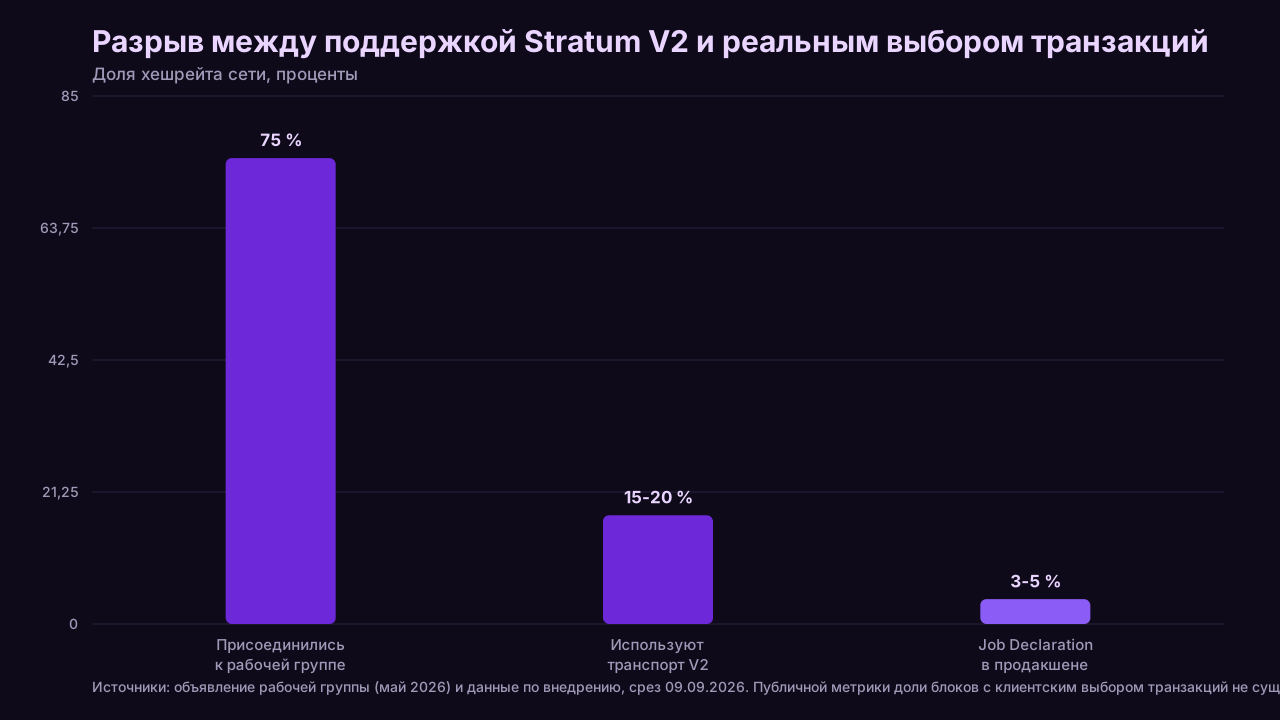
Three different numbers get quoted about Stratum V2, and headlines keep welding them into one. 75 percent of hashrate. 15 to 20 percent. 3 to 5 percent. All three showed up in mid-2026 coverage, and each one measures something different. Collapse them together and you end up with a story where miners have already taken block construction back from pools. They haven't. Which pools support it: Stratum V2 pools.
Here is what sits behind each number, and where the line runs between "this pool signed on to the standard" and "this miner builds the block template."
What the three Stratum V2 numbers mean
Short version: 75 percent is the share of network hashrate held by pools that joined the open standard; 15 to 20 percent is an estimate of hashrate actually running V2 transport; 3 to 5 percent is an estimate of hashrate running Job Declaration, which is the part that hands transaction selection to the miner. Three separate measurements, not three refinements of one.
| Number | What it actually measures | Data status |
|---|---|---|
| ~75% of hashrate | Seven of the largest pools joined the Stratum V2 working group (May 2026). A statement of intent to adopt an open standard | Widely reported (Coindesk, 11.05.2026) |
| 15-20% of the network | Connections using V2 "in some form," mostly for channel encryption and efficiency. The block template still arrives from the pool | Aggregated estimate, not official statistics |
| 3-5% of the network | Running Job Declaration in production. In the data we collected that means Braiins Pool and DEMAND (DMND) | Aggregated estimate, not official statistics |
The gap between the first row and the last is roughly twentyfold. That gap is the whole story.
What is wrong with Stratum V1
Stratum V1 is the protocol a pool uses to hand out work and collect shares. The pool builds the entire block template and decides which transactions go in. The miner's hardware iterates the nonce inside the header it was given. The channel itself is plaintext, with no encryption and no authentication.
Two separate problems come out of that, and they are worth keeping apart.
The technical one: messages travel in the clear, which opens the door to hashrate hijacking, where shares are intercepted and redirected in transit, and to MITM attacks (Deribit Insights, on migration to Stratum V2). The verbose JSON-RPC format also adds traffic overhead at farm scale.
The structural one: even over a perfectly secured channel, the pool operator still decides what goes into the block. The miner supplies the computation without any say in what that computation signs.
The parts of Stratum V2
It helps to see V2 as layers rather than a single switch. A pool can adopt the first two, skip the third, and still say truthfully that it supports Stratum V2.
| Component | What it gives you | Does it change transaction selection | Running in production, per collected data |
|---|---|---|---|
| Encrypted transport | Channel security, authentication, no share hijacking | No | Estimated 15-20% of the network |
| Compact binary format instead of JSON-RPC | Less traffic and overhead at scale | No | Same group |
| Job Declaration | The miner proposes the template, the pool accounts shares and pays | Yes | Braiins Pool, DMND. Estimated 3-5% |
The spec states the purpose plainly: the Job Declaration Protocol coordinates the creation of custom work, avoiding scenarios where pools unilaterally impose work on miners, and pools that opt into it are only responsible for accounting shares and distributing rewards (stratumprotocol.org, Job Declaration Protocol).
Architecturally there are two pieces. A Job Declarator Server runs on the pool side, a Job Declarator Client on the miner or farm side. The client pulls templates from a Template Provider and declares them to the server. In Full-Template Mode the miner sends DeclareMiningJob with a full transaction list, the pool checks it against its own mempool and requests anything missing. A single declaration can cover an entire farm, which keeps the computational load reasonable at scale.
Refusal is designed in too. If the pool rejects a declaration, the spec recommends the client fall back to solo mining or to another pool. A pool declining someone else's template is an expected path, not a hole.
Ocean DATUM: a different route to the same place
DATUM stands for Decentralized Alternative Templates for Universal Mining. A detailed look at both pools and how transaction selection works there is in our Ocean and Braiins breakdown. It is Ocean's own protocol, layered on top of ordinary Stratum V1, and it needs neither new firmware nor V2 infrastructure on the miner side. That compatibility with stock hardware is the main difference from Job Declaration.
Secondary sources put Ocean's share of network hashrate at roughly 2 percent. To be explicit about the sourcing: that comes from aggregators, we did not confirm it against Ocean's own statistics, and we could not pull an exact figure for 09.09.2026 from the primary source.
Two Ocean terms also get mixed up constantly. TIDES is a payout distribution formula with a window of eight times current difficulty, close in spirit to PPLNS. DATUM is the block template protocol. Different jobs, separate systems. For payout mechanics, see our breakdown of FPPS versus PPLNS.
Why transaction selection gets argued about at all
Direct answer: because block composition is where a technical protocol meets a jurisdiction. When one operator builds the template, any demand placed on that operator, regulatory or commercial, reaches every bit of hashrate pointed at it. Job Declaration moves the decision toward the people who own the hardware.
Concentration is the useful context here. Aggregated Spark Research data for mid-2026 puts roughly five pools at about 70 percent of global hashpower: Foundry 34.2%, AntPool 14.2%, F2Pool 11.3%, SpiderPool 10.5%. Even with all of them formally inside the Stratum V2 working group, as long as Job Declaration is not switched on for end users, block content for most of the network is decided by a very small number of people.
That is an observation, not an accusation. We collected no public evidence of systematic transaction filtering at any of those pools, and we are not implying any.
Can anyone measure how many blocks miners built themselves
No. There is no public metric of the form "X percent of BTC blocks were mined with client-side transaction selection," and that is expected. On chain, a template produced through Job Declaration is indistinguishable from one handed down by a pool without telemetry or voluntary disclosure from the operator.
What exists are hashrate proxies: the 15 to 20 and 3 to 5 percent figures, plus Ocean's roughly 2 percent. Those describe connections, not the composition of blocks already mined. Swapping them in for a metric that does not exist would be wrong, so we don't.
One end-to-end data point is on record: DMND and GoMining together mined the first known block using Stratum V2 Job Declaration, so a miner-constructed template on mainnet is no longer hypothetical. We did not verify that block against a primary source directly, so treat it as partially confirmed.
What this changes for someone running one or two ASICs
Direct answer: almost nothing about your income today. Payouts follow your pool's scheme and your share of the work, not who assembled the template. Job Declaration adds no satoshis and speeds nothing up. It matters at the moment you pick a pool, and only if control over transaction selection matters to you on its own terms.
There is a practical side too. Real Job Declaration means running a Job Declarator Client on your side, which is a long way from changing a URL in a web dashboard. For a home setup with a couple of machines that is real work. Ocean's DATUM is easier on that front, since it sits on top of V1 and needs no new firmware.
If you run the economics first and look at protocols second, start with the profitability calculator and the full guide to choosing a BTC pool. The difference between going alone and joining a pool is covered in our solo versus pool comparison, and operator fees in the Trustpool, Foundry and AntPool fee comparison.

Criticism of Stratum V2, and the honest gaps
An awkward admission belongs here. Our research turned up almost no substantive public criticism of V2 specifically, as opposed to V1. Searches mostly returned explanatory and promotional material about the protocol's benefits. We are not going to invent arguments on behalf of hypothetical opponents. That absence could mean genuine industry consensus, or it could mean critical voices simply did not surface for the queries we ran.
Still unverified on this topic:
- The working group projection of 40 to 60 percent of network hashrate on V2 by the end of 2026. That is a target, not a measurement, and we only saw it through a secondhand retelling.
- Ocean's current hashrate share from the pool's own statistics.
- Primary sources for the 15-20 and 3-5 percent estimates. Both came from aggregated summaries rather than a report with a stated methodology.
- Real cases where a pool rejecting a declaration caused trouble for a miner. The mechanism is in the spec; documented incidents are not in the open.
The takeaway
Stratum V2 is not one switch. Encryption and the compact format are easy to adopt and pay off for the pool immediately. Job Declaration needs infrastructure on both ends and gives the pool less control, so it moves slowly and currently rests on two names, Braiins and DMND.
Next time a headline says 75 percent of hashrate is moving to Stratum V2, check one thing: is it about signing on to a standard, or about miners gaining the ability to build their own templates. For now those are two different stories, and the second one has not happened yet.