
FPPS, PPS+, PPLNS and SOLO on the same hashrate: what each one pays per month
*Last updated: 08.09.2026. POOL BTC editorial.* Side by side: FPPS vs PPS+.
POOL BTC is not a mining pool. We take no hashrate, credit no balances and pay nobody. This is a comparison site: we look at other people's pools, their fee tables and their formulas from the outside, the same way anyone does when deciding where to point their machines.
Arguments about payout schemes usually run on adjectives. Safer. Fairer. More honest. None of that means anything until the numbers are on the table. So below is one 100 TH/s machine run through FPPS, PPS+, PPLNS and SOLO at the difficulty of 08.09.2026, with the formulas printed, so you can substitute your own hashrate and get your own money instead of ours.
Short version: at today's transaction fee share, the gap between FPPS and PPS+ is under a dollar a month on 100 TH/s, while the spread between pool fees on that same machine is worth several times more. The rest of this article is the arithmetic behind that.
The inputs everything else is built on
Every calculation below comes from this table and nowhere else. If a number is not here or in a formula printed in the text, it is not in this article.
| Parameter | Value | Source and date |
|---|---|---|
| Network hashrate | 930.73 EH/s | mempool.space API, 08.09.2026 |
| Difficulty | 127,450,789,715,843.1 | mempool.space API, 08.09.2026 |
| Epoch progress | 21.58%, 1581 blocks remaining | mempool.space API, 08.09.2026 |
| Next retarget estimate | around 19.09.2026, roughly plus 5.24% | mempool.space API, 08.09.2026 |
| Block subsidy | 3.125 BTC | current halving epoch |
| Transaction fee share, 4320 blocks | 0.66% | mempool.space reward-stats, 08.09.2026 |
| Transaction fee share, 144 blocks | 0.57% | mempool.space reward-stats, 08.09.2026 |
| BTC price | 78,000 to 79,400 dollars intraday on 08.09.2026 | Yahoo Finance, Vietnam.vn, 08.09.2026 |
A word on the price, because it matters more than it looks. We deliberately refuse to pick one point. On 08.09.2026 bitcoin opened near 79,094, slid to 78,371 by 7:20 ET, and the Asian session traded around 79,403. That is about 1.3% of movement in a day on news flow. Any monthly figure computed at "the price at time of writing" is wrong by that much on day one and keeps being wrong afterwards, because you receive payouts in pieces and every piece lands at its own price. A range is more honest than a point, so every dollar figure below comes as a pair.
If you want to redo all of this at your own price, tariff and hashrate, the mining profitability calculator is a better place for it than a napkin.
What 100 TH/s actually earns per month
At difficulty 127.45 trillion with a 3.125 BTC subsidy, a 100 TH/s machine earns roughly 0.001480 BTC a month from the subsidy alone, and about 0.001490 BTC once transaction fees are included. At 78,000 to 79,400 dollars that is roughly 115 to 118 dollars a month, before the pool fee and before you pay for electricity.
The formula behind it (our calculation, meant to be re-checked):
```
BTC per day = H * 86400 * R / (D * 2^32)
```
H is your hashrate in hashes per second, R is the block reward in BTC, D is the difficulty.
Substituting H = 1e14 (that is 100 TH/s), R = 3.125, D = 127,450,789,715,843.1:
```
1e14 * 86400 * 3.125 = 2.7e19
127,450,789,715,843.1 * 4,294,967,296 = 5.4739e23
2.7e19 / 5.4739e23 = 0.0000493 BTC per day
```
Over 30 days that is 0.001480 BTC. Multiply by 1.0066 to add the transaction fee share measured over 4320 blocks and you get 0.001490 BTC. That figure is the gross credited base, and the pool fee comes off it.
Now the same machine in four schemes. The fees are F2Pool's, because it is the one large pool in our survey where all three rates are confirmed by official documentation and do not conflict between sources.
| Scheme | Fee | BTC per month on 100 TH/s | Dollars per month (78,000 to 79,400) |
|---|---|---|---|
| FPPS | 4% | 0.001430 | 111.6 to 113.6 |
| PPS+ | 2.5% | 0.001453 | 113.3 to 115.4 |
| PPLNS | 2% | 0.001460 | 113.9 to 115.9 |
| SOLO | varies by service, usually lower at public pools, we have no confirmed rates | the same 0.001490 on average minus fee, in practice almost always zero | zero in the overwhelming majority of months |
Everything in that table except the fee column is our own arithmetic, not a pool publication. Verify it in ten seconds: take 0.001490, multiply by (1 minus the fee), multiply by the price.
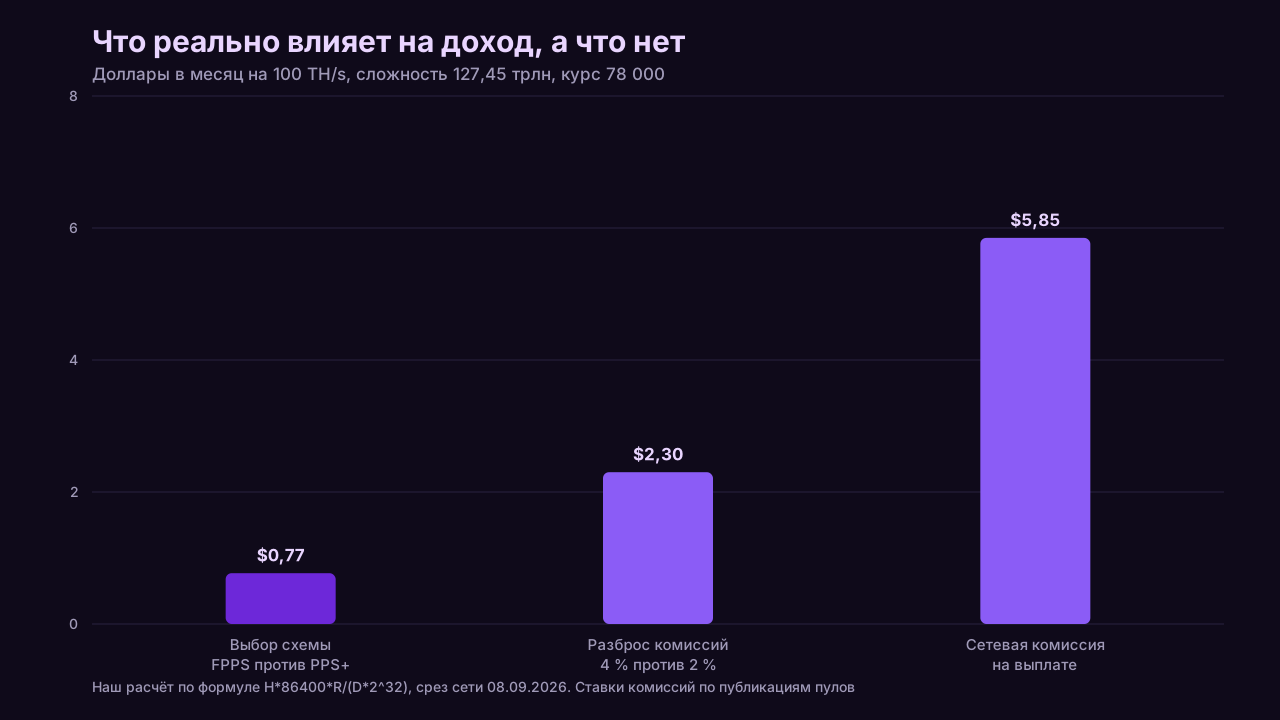
Ignoring SOLO, the distance between the top and bottom rows is about 2.3 dollars a month on 100 TH/s. On a 10 PH/s farm that becomes roughly 230 dollars a month, on 100 PH/s roughly 2,300. Put your own scale into the calculator, because the linearity holds only until a pool starts quoting you a tiered rate for volume.
Why FPPS and PPS+ differ by exactly the transaction fee share
FPPS pays a fixed rate covering both the subsidy and transaction fees, averaging the latter over a historical window. PPS+ guarantees only the subsidy and hands out transaction fees as they actually arrive, distributed on PPLNS logic. At equal pool percentages, the gap between the two schemes is exactly the fee share of the block reward, which right now is 0.66% of what you get credited.
In money on our machine: 0.66% of 0.001480 BTC is 0.0000098 BTC, roughly 77 cents a month. Not even a coffee.
The mechanics deserve a closer look, because averaging windows differ between pools and are published officially:
- Luxor uses a 144 block lookback and trims the 5th and 95th percentiles so freak blocks cannot spike or sink the rate.
- Foundry USA computes the rate as 1 plus (sum of block fees / sum of subsidies) over the UTC contract day, excluding the three fattest and three emptiest blocks.
- Braiins distributes fees as a daily average.
- F2Pool includes previous-day averaged fees in FPPS, while its PPLNS hands out the real fees of the blocks actually found.
- ViaBTC in PPS+ pays the subsidy at a 4% rate and the transaction fees separately on PPLNS at 2%.
That last point matters more than it reads. At ViaBTC two different rates sit on one payout, so comparing it to an FPPS pool by a single percentage is simply wrong.
The historical caveat, without which this section misleads. The fee share has not always been microscopic. On 8 May 2023, riding Ordinals and BRC-20, fees in individual blocks exceeded the subsidy for the first time since 2017: block 788695 produced 6.71 BTC in fees against 6.25 BTC of subsidy, and the daily fee share reached 42.59% by CryptoSlate's methodology (btcoak.com gives 40.8% for the same day). On 20 April 2024, halving day plus the Runes launch, the fee share of daily miner revenue hit 73.8 to 75% depending on the source, with an average transaction fee of 127.97 dollars. On days like that the FPPS versus PPS+ choice was worth tens of percent of revenue, not cents. We covered what gets deducted from a payout beyond the headline percentage, and how it has moved historically, in a separate piece: what pools actually deduct beyond the advertised fee.
We deliberately avoid quoting a single "correct" fee share even for today. mempool.space gives 0.66% over 4320 blocks and 0.57% over 144 blocks, while Glassnode and Newhedge showed 0.40 to 0.56% on daily windows in early September. Nobody is wrong here: the denominators and the windows differ. Anyone quoting one number without naming the window and the date has simply picked the one they liked.
Why PPLNS pays the same average on a different schedule
Over the long run PPLNS pays roughly what the PPS family pays minus the fee, but it pays in bursts. A pool credits you only when it actually finds a block, and your share is computed from the shares sitting in the window at the moment of the find. The quarterly average converges. Any given week can land well above or well below expectation.
The window size decides how hard the ride is. The officially published windows from our survey:
| Pool | Window | What is officially stated |
|---|---|---|
| ViaBTC | last 5 difficulty rounds | ViaBTC Fees, credited after 6 block confirmations |
| Ocean (TIDES) | 8 times current difficulty worth of shares | TIDES docs, a share is rewarded 8 times on average while in the window |
| AntPool | last N difficulty rounds, N not published | AntPool GitBook |
| F2Pool, Binance, EMCD | described qualitatively as "last N shares", no number for BTC | official pool help pages |
| Braiins | PPLNS/Scoring not used for BTC since December 2023, FPPS only | Braiins Academy FAQ |
| Foundry USA, Luxor | FPPS only, no PPLNS offered for BTC | Foundry Pool FAQ, Luxor Docs |
The practical read. PPLNS variance matters most to anyone whose revenue swings turn into a cash gap: monthly electricity bills paid on the edge, hosting contracts with fixed payments, investor distributions on a schedule. If your hashrate is small and you need the money predictably, PPLNS variance works against you even when the average is half a percent higher. If you run a large site with two months of cash buffer, the average matters and the schedule does not.
There is a second PPLNS effect people rarely price in: joining and leaving. When you arrive, your shares start filling the window from zero while the pool pays out on blocks found against a window you are barely in. When you leave, your shares linger in the window and keep earning. Over a long stretch that evens out. If you hop between pools frequently, you systematically pay for the ramp and never collect the tail. Not one of the 12 pools in our survey publishes an official page answering "what happens to my shares if I disconnect before a block is found", so what we describe here is generic PPLNS mechanics, not any pool's stated policy.
One more thing PPLNS will not save you from. F2Pool's Terms of Service state plainly that if a valid wallet address is not provided within 6 months of written notice, accrued rewards may be treated as Forfeited Rewards. It is the only pool of the 12 where we found such a rule spelled out. We did not find it at the others, which is not the same as it not being there.
SOLO: doing the lottery math honestly
At 100 TH/s and difficulty 127.45 trillion, the probability of finding a block is roughly 0.0000155 per day, about 0.046% per month and about 0.56% per year. Mean time to a find is around 64,600 days, roughly 177 years. The expected value is identical to pool mining. It is just distributed between you and the 176 years you will not live through.
The math, ours, from the same inputs:
```
p_block = your hashrate / network hashrate = 1e14 / 9.3073e20 = 1.0744e-7
blocks per day network-wide = 144
p_per_day = 144 * 1.0744e-7 = 1.547e-5
mean wait = 1 / 1.547e-5 = 64,632 days = 177 years
p_per_year = 1 - exp(-1.547e-5 * 365) = 0.0056 = 0.56%
```
If a block does land, it carries 3.125 BTC of subsidy plus that block's fees, roughly 244,000 to 248,000 dollars at the 08.09.2026 price, minus whatever the SOLO service charges. We have no confirmed SOLO fee rates for the major pools, so we quote none.
Three things that usually go unsaid:
- The 177 year figure assumes today's difficulty. In eleven days mempool.space estimates a retarget of about plus 5.24%, which stretches the wait proportionally.
- The exponential distribution has no memory. Three years without a block brings you no closer to one.
- The median is about 31% shorter than the mean, but 123 years instead of 177 changes nothing about the conclusion.
SOLO makes sense in exactly two situations: you run industrial-scale hashrate where the expected wait drops to months, or you are knowingly buying a lottery ticket and treating it as entertainment rather than a business plan. You can check the expected wait for your own capacity in the same calculator.

What eats the difference besides the pool fee
The fee is the most visible line and nowhere near the most expensive one. On small hashrate, the payout threshold and the network fee comfortably outweigh the entire gap between schemes.
| Deduction | How it works | What it costs on 100 TH/s |
|---|---|---|
| Pool fee | percentage of credited amount, F2Pool charges 4% FPPS against 2% PPLNS | 2 percentage points is about 2.3 dollars a month (our calculation) |
| Fee share gap (FPPS vs PPS+) | FPPS includes averaged fees, PPS+ passes through actual ones | about 0.66% of credit, roughly 0.77 dollars a month (our calculation) |
| Payout threshold | below the threshold, the money is not on your wallet | at 0.001 BTC a payout lands every 20 days or so, at Ocean's 0.01048576 BTC roughly every 213 days (our calculation) |
| Network fee on payout | Luxor charges 0.000075 BTC on top of the 0.001 BTC threshold, paid by the user | withdrawing monthly, that is about 5% of monthly revenue (our calculation) |
| Withdrawal fee separate from crediting fee | NiceHash takes 2% service fee on crediting and a separate withdrawal fee from 0.0001 BTC | two deductions instead of one |
| Auto-conversion spread | Kryptex App officially describes a bid-ask spread between the average market rate and the purchase rate, growing with volatility, percentage not published | not disclosed at Kryptex or EMCD |
| Downtime | an hour without hashing is an hour without credit, identical under FPPS and PPLNS | 1% of uptime is about 1.15 dollars a month (our calculation) |
Look hard at the Luxor network fee row. 0.000075 BTC against a monthly payout of 0.00148 BTC is 5.07% of revenue. That is more than the entire spread between F2Pool's most and least expensive scheme, and about seven times the FPPS versus PPS+ difference in fee treatment. The scheme acronym has nothing to do with it.
On spreads specifically. EMCD officially offers BTC to USDT auto-conversion but publishes no rate or spread anywhere public. Kryptex App describes its spread in words and states honestly that there is no withdrawal fee, while the spread performs the same economic job. Kryptex Pool's fee page mentions an "exchange fee / withdrawal fee" without printing a number. This is an observation, not an accusation: three out of three auto-conversion services we checked decline to quantify the spread, and you cannot price it in advance.
Who pays the network fee is also not documented everywhere. EMCD's ToS clause 4.19 says the party paying the remuneration pays the transaction fee, meaning the service itself. At Luxor it is the user. At F2Pool and ViaBTC no explicit rule appeared on the pages we found, and we are not inventing one.
If you spend your payouts rather than stack them, look at the crypto card reviews too: the exit into fiat can cost more than this entire scheme debate.
How to audit your pool in one evening
Take a single full calendar day and reconcile four numbers: hashrate, what the pool credited, your theoretical entitlement from the formula, and what actually arrived on your wallet. Gaps between the first three come down to fees and luck. The gap between the third and the fourth is thresholds and network fees.
- Record the average accepted hashrate over 24 hours from the pool's own stats, not the spec sheet number on the machine. A 3 to 5% deviation is normal. 15% means you are hunting for dropped workers.
- Compute the theoretical credit with the formula above, using that day's difficulty. Pull difficulty from mempool.space rather than memory: it changes every 2016 blocks.
- Add the transaction fee share if the pool runs FPPS, then subtract the stated pool fee. That gives your expected credited BTC for the day.
- Compare it with what the pool shows in its earnings section. On FPPS and PPS+, a gap above 2% is a question for support. On PPLNS, look at two or three weeks minimum, otherwise you are measuring window variance rather than pool honesty.
- Open the payout history on your wallet and sum what actually arrived over the month. The difference from credited is thresholds, network fees and the conversion spread if there is one.
- Check that your payout threshold is reachable more often than once a month. If it is not, your money sits with the pool rather than with you, and you are carrying counterparty risk for free.
- Find the official page on the pool's site that states the fee and the threshold. If it does not exist and the number lives only at aggregators, treat that as a fact about the pool. Of the 12 pools in our survey, we could not load an official fee page for AntPool, Binance Pool or Foundry USA at all.
- Repeat the reconciliation after the next difficulty retarget, around 19.09.2026. The expected plus 5.24% will cut your daily credit by roughly 5% on its own, and that is not the pool cheating you.
The retarget mechanics that move the denominator in the formula are covered separately: how the difficulty retarget works and what it does to your payout.
So which scheme pays more
At a 0.66% transaction fee share, the FPPS versus PPS+ difference on 100 TH/s is about 77 cents a month, while the difference between a 4% and a 2% pool fee on the same hashrate is about 2.3 dollars. Fee and threshold decide roughly three times more than the acronym does. Choose on percentage, on threshold, and on whether the pool publishes its numbers officially.
Unpacking that:
- The pool fee is the first thing to check. The spread between 2% and 4% on BTC at major pools is real and officially confirmed at F2Pool and ViaBTC at minimum.
- The payout threshold is second. Ocean's 0.01048576 BTC threshold on 100 TH/s means a payout roughly every seven months. For a small miner that outweighs any fraction of a percent in fees.
- Who pays the network fee is third. At Luxor it is 5% of monthly revenue on 100 TH/s if you withdraw monthly.
- The scheme acronym is fourth, and it only starts to matter when the transaction fee share climbs past 10%. Over the past month it stayed between 0.66% and 0.73%.
- PPLNS variance versus a PPS guarantee is a cash planning question, not a profitability one. Answer it with your own cash flow, not with a revenue table.
The honest flip side: if a second Runes event arrives tomorrow and the fee share climbs past 70% the way it did on 20 April 2024, this whole section needs rewriting and FPPS becomes distinctly more interesting than PPS+. That is exactly why we print the formula instead of a verdict. Plug in a fresh fee share and the decision recalculates itself. The form for doing that lives in the profitability calculator, and the current pool comparisons are in the comparison section.
What is missing from these numbers, stated plainly
This piece would not be honest without the list of holes. None of the following could be confirmed as of 08.09.2026, so none of it went into the arithmetic:
- Hashprice on 08.09.2026. Direct hashrateindex.com pages returned 404 and 429. All we have is an end-of-August figure of roughly 39.06 dollars per PH/s per day from a secondhand Yahoo Finance mention citing Hashrate Index. That is not a 8 September reading and we did not calculate with it.
- Braiins Pool's fee. Search results give "2% FPPS" as of May 2026 while the pool's own blog mentions a "1% pool fee" as an upgrade, and the post body would not load. The 1% versus 2% conflict is unresolved. The Braiins payout threshold is also unconfirmed at this snapshot.
- Ocean. The 2% default, 1% with DATUM and the 0.01048576 BTC threshold come from secondary reviews; the official TIDES page confirmed the mechanics but not the figures. The "every 213 days" calculation above rests on an unconfirmed threshold, so read it accordingly.
- Foundry USA. The official page has returned 403 Forbidden for three surveys running. The fee is described as tiers based on a group's quarterly average hashrate, one aggregator says 0% fee, which may well be stale. The threshold is unconfirmed.
- AntPool, Binance Pool, Luxor (the percentage). Sources contradict each other, and official pages either return 404 and 403 or redirect to a login screen. A manual browser check on 29.08.2026 confirmed nothing.
- We did not price electricity, depreciation or hosting. Everything above is revenue before costs, not profit.
Across the two weeks from 25.08 to 08.09.2026, not one of the nine pools we tracked showed a confirmed change to its fee or threshold. The network moved further than any tariff did in the same window: hashrate from 896.89 to 930.73 EH/s, difficulty from 125.81 to 127.45 trillion. That is the real answer to what deserves your attention. Not the payout scheme, the denominator in the formula.
This article contains referral links to mining pools (marked as sponsored). We may receive a reward if you register through them. This does not change the figures or the order of rows in the tables: the terms are taken from the pools' official pages.