

Crypto cards by region: where each card actually works, and what a miner outside the US or EU can really get
Most "best crypto card" roundups are written from one spot on the map. The author lives where the card is issued, fills in the application in ten minutes, and describes the product as if everyone gets those ten minutes. A miner in Kazakhstan, Georgia, Argentina or Nigeria reads the same article, opens the sign-up form, and hits a country-of-residence dropdown that does not contain their country. At that point the cashback rate, the fee schedule and the monthly limits stop mattering.
POOL BTC does not issue cards and is not a mining pool. It is an independent comparison site covering pools, wallets, cards and calculators, so this piece is not walking you toward a house product.
You will not find a directory here saying "card X is available in 74 countries". Those lists rot in weeks: issuers change sponsor banks, regulators shut programmes down, individual countries drop out of coverage with no announcement. What follows is the mechanism behind availability and a method for checking it yourself. Specific facts about specific cards are here, all of them gathered from official issuer pages on 20.09.2026 and linked, but you should still check them on the issuer's own page on the day you read it, not in a six-month-old review.
The short version
- Between the card a review describes and the card you can actually hold there is one field in the application: country of residence. Everything else is secondary.
- Availability is not decided by the issuer alone. It comes out of a chain: programme operator, licensed issuing bank, payment network, local regulator. Any one of the four can close the door.
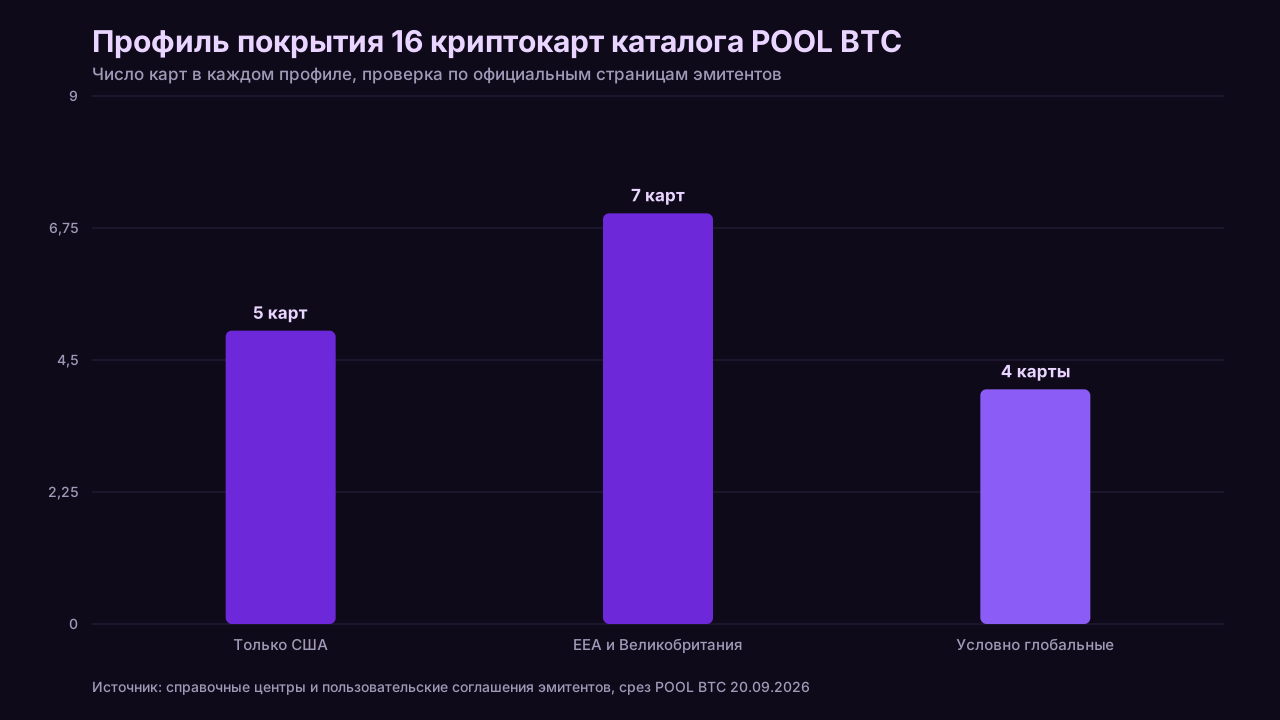
- Coverage falls into three shapes in practice: US only, European Economic Area plus the UK, and nominally global programmes with a long exclusion list.
- Residency outweighs citizenship. A utility bill in your name usually opens more doors than a passport does.
- A card does not move countries with you. Changing your registered address triggers re-verification, and sometimes closure.
- If no card is available where you live, the real task is not finding a card. It is building an off-ramp: a route from BTC to the money you pay your power bill with. The card is the last step on that route, and it is optional.
Why a card that exists is not a card you can get
The product exists, but it is issued to a specific person at a specific address. Four independent filters sit between those two facts: the issuer's licence, the payment network's country rules, the sponsor bank's own risk policy, and local crypto regulation. One of them is enough to stop an application, even when the product is marketed as global.
It helps to see the stack, because a reader normally sees only the top layer.
The top layer is the programme operator, the exchange or fintech whose brand is printed on the plastic. Below it sits a bank or licensed e-money institution that actually issues the card and holds the funds. Below that is the payment network, with its own rules by country and merchant category. Running alongside all three is the local regulator, which can bar crypto card programmes inside a country regardless of what the other three want.
Two things follow.
One brand does not mean one product. The same card in two regions can be two separate legal products with different fees, different cashback mechanics and different rules. We checked 16 cards from our catalogue against official issuer pages on 20.09.2026, and six of them run separate regional programmes.
- Coinbase Card: a US programme, where the card is issued by Pathward, N.A. under licence from Visa U.S.A., and a separate EU and UK programme with its own country list.
- Crypto.com Visa Card: at least five issuing entities by region, among them Community Federal Savings Bank for the US, Foris MT Limited for the EU, ForisGFS UK Limited for the UK and Foris Asia Pte. Ltd. for Singapore.
- Bybit Card: the global and CIS programmes run on Mastercard, Peru and Asia Pacific run on Visa, and the Australian version is issued by a separate entity, Fly Wallet Pty Ltd, supervised by ASIC.
- RedotPay: the terms split explicitly into a Hong Kong programme and a Singapore programme, and your country of residence decides which one you get.
- Gnosis Pay: inside the EEA the account is held by the Portuguese entity Gnosis P. Tech, Unipessoal Lda, outside it by another one, and the card issuer runs separate cardholder terms for each case.
- Wirex: in the EEA the card is issued by Transact Payments Malta Limited, in the UK by Wirex Limited under an FCA licence, and a separate Wirex One product runs alongside with its own country list.
How this breaks comparison tables is covered in our piece on what actually gates crypto card cashback.
The marketing page is almost never the source of truth about regions. The country list lives in the help centre, in the verification article, or inside the cardholder agreement, and it often disagrees with the landing page. Read the document, not the banner.
What actually gates issuance
Five things decide it: where you physically live, which KYC documents you can produce, whether you hold a local tax ID, whose phone number you use, and what the sanctions screening returns. You can prepare for the first four. The fifth is invisible: it comes back as a decision without a reason attached.
Residency, not citizenship
Programmes ask where you live, not which passport you hold. A citizen of an eligible country living elsewhere is routinely rejected, and the reverse happens too. Proof of address usually means a document carrying your name and address: a utility bill, a bank statement, a tenancy agreement, a registration certificate. How old that document may be, and which types count, differs by issuer.
There is a trap here specific to mining. The farm address and the residential address are often different, sometimes in different countries. Programmes care about the second one.
KYC documents
The market minimum is consistent: photo ID, a selfie or video liveness check, proof of address. Differences start after that. Which ID types are accepted, whether a domestic ID works or only an international passport, and whether the verification vendor supports documents from your country at all. That last one breaks more applications than people expect. The country sits in the list, but the vendor cannot read its driving licence.
Here is what the issuers publish, across 16 cards from the catalogue, as of 20.09.2026. "Not published" means exactly that: the requirement may well exist, but the company does not disclose it, so you cannot prepare for it in advance.
| Card | Verification vendor | ID documents | Tax number |
|---|---|---|---|
| Coinbase Card | name not disclosed; the company lists possible vendors: Jumio, Onfido, Shufti, Refinitiv, Unico, Persona | by country; for the US a driving licence, national ID, passport, passport card, residence permit, visa, work permit | IRS Form W-9 with an SSN or TIN is mandatory for Coinbase Inc. customers |
| Gemini Credit Card | not published | passport, passport card, driving licence, state ID, green card | SSN mandatory under the Bank Secrecy Act |
| Fold Card | Persona, since 14.07.2026 | government-issued photo ID | SSN mandatory, ITIN explicitly not accepted |
| BitPay Card | Onfido | passports from 195-plus countries, driving licences in some locations, US immigration visas; temporary documents rejected | SSN or a country identification number |
| Venmo Debit Card | not published | US passport, driving licence, state ID, ITIN assignment letter, DHS card, Tribal ID | SSN or ITIN, both accepted |
| Gnosis Pay | Sumsub | passport, national ID, residence permit, driving licence in some regions | not published |
| Bleap | not published | passport or national ID, front and back | not published |
| Deblock | not published | only documents issued by Schengen, EU, EEA, Monaco, Andorra or Switzerland with a machine-readable zone; residence permits for third-country residents in France | not published |
| Fiat24 | Sumsub | biometric passport or chip ID, national ID in mainland China | not published, but you must declare that you are not a US Person |
| Bitpanda Card | Sumsub | a matrix by citizenship and residency: EEA ID cards, EEA driving licences, passports; for the UK passport, driving licence, EEA ID card | a TIN has been requested since January 2026, citing the DAC8 directive |
| Nexo Card | Sumsub and Jumio at different stages | passport, national ID, residence permit, driving licence; EEA residents cannot use a driving licence | TIN collected at sign-up, depending on country |
| Wirex | not published for retail accounts | passport, national ID, driving licence or another government document | not published |
| RedotPay | Sumsub | passport, national ID, driving licence; residence permits usually rejected | not published |
| Kast | not published | passport, national ID, driving licence | SSN requested from US residents during onboarding |
| Bybit Card | not published, verification is in-house across Standard, Advanced and Pro tiers | passport, national ID, residence permit, driving licence; student, work and tourist visas rejected | not published |
| Crypto.com Visa Card | not published | passport preferred, national ID and driving licence accepted; for US citizens and residents only a state ID or driving licence works, a passport does not | SSN or a country identification number |
Sources: issuer help centres and cardholder agreements, checked 20.09.2026. Seven of the sixteen name their verification vendor; the rest do not.
Tax identification number
Some programmes require a tax ID: an SSN or ITIN in the US, a national tax number across the EU, local equivalents elsewhere. This is a reporting requirement, not paperwork theatre. Without a local tax number the application usually stops, even when everything else lines up.
Phone number
The phone number looks trivial until the form refuses your country code. Some programmes want a number issued in the same jurisdiction as your address. Virtual numbers get filtered more aggressively every year. There is a second-order problem too: the issuing bank may only deliver transaction confirmation codes to numbers in certain countries, and you discover that after the card is already in your hands.
Sanctions screening and source of funds
Screening against sanctions and PEP lists happens at application and repeats afterwards. For miners the sharper question is source of funds. When money from selling mined BTC lands on a card account, compliance may ask where it came from. Keep the evidence ready in advance: worker statistics, pool payout history, hosting contracts, electricity invoices. What each company accepts differs, and the market splits three ways here. Four programmes out of sixteen publish a detailed document list: Gnosis Pay, Bitpanda, Nexo and Crypto.com. Six more (Bleap, Deblock, RedotPay, Kast, Wirex, Bybit) warn that the request will come but publish no list of accepted documents, and RedotPay gives you 14 days to answer. The remaining six (Coinbase Card, Gemini, Fold, BitPay, Venmo, Fiat24) publish no card-specific policy at all. That is useful to know too: you will be preparing blind, against general account rules.
| Gate | Who imposes it | Can you prepare | Where the answer lives |
|---|---|---|---|
| Country of residence | issuer and regulator | no, short of moving | supported countries article |
| Proof of address | issuer | yes | which documents, how recent |
| Identity document | verification vendor | yes | accepted ID types per country |
| Tax ID | legislation | sometimes | tax reporting section |
| Phone number | issuer and bank | partly | sign-up requirements |
| Sanctions screening | sponsor bank | no | cardholder agreement |
| Source of funds | compliance | yes | issuer AML policy |
Region tiers: US only, EEA and UK, global-ish
Cards cluster into three tiers: US-only programmes, programmes built for the European Economic Area and the UK, and nominally global programmes carrying a long exclusion list. There is no fourth tier called "available everywhere". Even the widest programmes name countries and territories where the card is not issued or not serviced.
US only. These require US residency, a tax number, and for credit products a credit file. A non-resident cannot get one, even holding an account with the same American exchange. Cashback in this tier often looks generous, and those are exactly the numbers that get copied into international roundups where they mean nothing.
EEA and UK. After the EU-wide crypto asset regime came in, several programmes split their product into a European version and a rest-of-world version. One card on the outside, two sets of fees, limits and reward rules underneath. The UK sits on its own rulebook and frequently appears as a separate line.
Global-ish. Usually exchange-linked cards or products built on stablecoin infrastructure. The country list is long, and the exclusions come from three sources: sanctions, missing licences, and local prohibitions. For a miner outside the US and the EU, this tier is where the realistic options are.
| Tier | Typical requirements | Check before applying | Cards in our catalogue |
|---|---|---|---|
| US only | US residency, SSN or ITIN, sometimes a credit file | tax number rules | Coinbase Card, Gemini Credit Card, Fold Card, BitPay Card, Venmo Debit Card |
| EEA and UK | address in an EEA state, local ID, often a local IBAN | separate EEA fee pages | Gnosis Pay, Bleap, Deblock, Fiat24, Bitpanda Card, Nexo Card, Wirex |
| Global-ish | country not on the exclusion list, exchange KYC passed | the excluded countries page | RedotPay, Kast, Bybit Card, Crypto.com Visa Card |
The split is a rough one and its edges are ragged. Gnosis Pay issues outside the EEA as well, including Argentina, Brazil, Colombia and Mexico, but not in the UK and not in the US. Nexo covers the EEA and the UK plus Argentina separately. Bitpanda limits the card to euro-area countries, excluding Cyprus and Liechtenstein, and runs UK customers through a separate entity. Wirex keeps its European programme next to Wirex One, whose country list is far wider and includes the US. So the tier column answers which licence the programme sits on; it does not replace the country list on the issuer's page.

Custodial cards versus self-custody spending when you move country
The difference shows up the day your address changes. With a custodial card the service holds both the money and the access, so a change of country is a compliance event that can restrict the account. With self-custody, moving does not touch your access to the coins, but converting them into local money is entirely your problem.
The clean way to think about it is to ask who can stop the money. On a custodial card the issuer, the sponsor bank and the regulator all can. With self-custody nobody can, but you also cannot pay at a till directly: something has to sit between the wallet and the checkout.
There is a middle option, usually marketed as a non-custodial card. Funds stay in a smart contract or in the user's own wallet, and the card debits them at the moment of payment. Worth being precise about what non-custodial covers here: it describes custody, not issuance. The fiat leg, the card itself and the settlement behind it, still belongs to a licensed issuer, so KYC and regional restrictions apply exactly as before.
Who owns mined coins at each stage, and what an account freeze looks like from a miner's side, is unpacked in the piece on custodial versus self-custody mining payouts. One conclusion from it matters here: keep the place where payouts accumulate separate from the place where you spend, so a regional card problem never becomes a savings problem.
What happens to a card when you relocate
A card does not follow you across a border. The address on your profile is attached to a legal product rather than to your current location, so updating it triggers re-verification. Three outcomes are common: the new address is accepted, the account is migrated to a different regional product, or the account is closed and the balance returned.
A workable sequence when relocating:
- Before the move, check whether the new country is served by the same programme and the same legal entity.
- Find out whether the programme supports migrating an account between regions, or requires closure and a fresh application.
- Draw the balance down in advance. Do not leave an amount on the card you would miss if access paused.
- Export statements for the whole period. Once an account closes, the history usually goes with it.
- Update the address through the official form. Do not quietly keep using the card from the new country.
- Expect re-verification with a document showing the new address, and expect a gap: that document may not exist in your name for the first few months.
- Only after the new status is confirmed, put working amounts back on the card.
A different scenario is not relocating but travelling for a long stretch. Regular spending from a country other than the one on file reads to fraud systems as a compromised card, and the block arrives without warning. A travel notice helps where the programme supports one. A second way to pay helps everywhere.
Fees that only appear outside the home region
Spending abroad adds three layers that are absent at home: currency conversion by the payment network, a cross-border fee from the issuer, and whatever the ATM operator charges. On top of that sits the crypto-to-fiat conversion, if the card sells the asset at the moment of payment. The real cost of a purchase is the sum of all four, and the published fee table typically shows one.
The first two get confused constantly, so it is worth separating them.
Currency conversion happens at the network level, using the network's own rate, when the currency of the purchase differs from the currency of the account. A cross-border fee is charged by the issuer for the fact that the merchant is registered in another country, even when the currency matched. So a euro purchase on a euro account can still cost more if the merchant sits elsewhere.
Then there is dynamic currency conversion. When a terminal or ATM offers to charge you in your card's currency, the terminal side picks the rate, and it is nearly always worse than the network rate. The correct answer to that prompt is to pay in the local currency.
| Cost layer | Who charges it | When it appears | How to check in advance |
|---|---|---|---|
| Crypto to fiat conversion | programme issuer | at payment, if the card sells the asset | product fee page |
| Spread inside the sale price | programme issuer | always, rarely itemised | often unpublished, measure it yourself |
| Currency conversion | payment network | purchase currency differs from account currency | network rates are published openly |
| Cross-border fee | issuer | merchant registered abroad | issuer fee schedule |
| ATM operator surcharge | ATM owner | cash withdrawal abroad | the ATM screen before you confirm |
| Dynamic currency conversion | terminal | offer to charge in your currency | decline it at the screen |
Specific per-card numbers are deliberately absent here, because they differ by region and change. For an example of what an honest line-by-line teardown of one product looks like, see Coinbase Card fees and limits. Current pricing for the rest sits in the crypto card catalogue.
Which payment network the card runs on, and why acceptance depends on it
The network decides where the card is physically accepted. Visa and Mastercard have the widest reach, American Express is noticeably thinner outside the US and a handful of large markets, and domestic networks work only inside their own country. A crypto card on a narrow network is a narrow card, whatever the reward rate says.
Three consequences, all of which land hardest on people living outside the issuer's home market.
Small-merchant acceptance differs from chain-retailer acceptance. Even where a network operates, individual merchant categories may not take it, and the gap widens outside major cities.
Online payments hit a different check. Merchants look at the card's issuing country, and some decline cards from certain jurisdictions regardless of the network on the front.
Finally, a growing share of crypto cards are virtual only and live inside a mobile wallet. Then the question is not the network but whether your region supports adding the card to Apple Pay or Google Pay. Those wallets have their own country coverage, and it does not match the issuer's.
| Card | Payment network | Format |
|---|---|---|
| Coinbase Card | Visa | physical and virtual |
| Gemini Credit Card | Mastercard | metal card, details available in the app |
| Fold Card | Visa | physical and virtual |
| BitPay Card | Mastercard | physical and virtual |
| Venmo Debit Card | Mastercard | physical; no separate virtual product in official sources |
| Gnosis Pay | Visa | physical and virtual |
| Bleap | Mastercard | virtual confirmed officially, no direct wording about a physical card in the help centre |
| Deblock | Visa | virtual, physical or both |
| Fiat24 | Mastercard | virtual only, stated explicitly by the issuer |
| Bitpanda Card | Visa | physical plus up to three virtual cards |
| Nexo Card | Mastercard | physical and virtual |
| Wirex | Mastercard in the current EEA and UK programme | physical and virtual |
| RedotPay | Visa in both programmes | physical and virtual |
| Kast | Visa | physical and virtual |
| Bybit Card | Mastercard in most regions, Visa in Peru and Asia Pacific | physical and virtual, physical availability depends on the region |
| Crypto.com Visa Card | Visa | physical and virtual |
Sources: official issuer pages and cardholder agreements, checked 20.09.2026. The sample splits evenly: eight cards on Visa, eight on Mastercard, though Bybit and Wirex vary by region and issue date, so they are counted under their main programme. One of the sixteen is virtual only (Fiat24) and one is physical only (Venmo).
Alternatives when no card is available in your country
The working pattern is simple: convert BTC into local currency through a channel that is legal where you live, then spend with an ordinary bank card. A crypto card is not the only way to spend mined coins, and often not the cheapest. The question narrows to one thing: which off-ramp in your jurisdiction is reliable and reasonably priced.
The main channels:
- Exchange withdrawal to a local bank account. The most predictable route wherever the exchange supports local fiat rails. It requires full KYC and a willingness to explain where the coins came from.
- P2P marketplaces. These work where bank rails do not. The price is counterparty risk, a wider spread, and the chance of receiving payment from a third party, which looks suspicious to your bank.
- Stablecoin off-ramps. Typically BTC into USDT, then out to local currency. This adds a layer of risk: the stablecoin issuer and the transfer network itself.
- Licensed cash exchange offices. Legality and pricing vary enormously by country.
- A card issued in another jurisdiction where you hold genuine residency. Not to be confused with buying someone else's card, which breaks programme rules and ends in a frozen balance.
| Channel | What it gives you | Main risk | Where it usually fits |
|---|---|---|---|
| Exchange to bank | predictability and a paper trail | KYC and source-of-funds questions | countries with local fiat rails |
| P2P | works without bank integration | counterparty and dirty inbound payments | countries without direct rails |
| Stablecoin off-ramp | fast, often around the clock | stablecoin issuer and network risk | regions with deep USDT liquidity |
| Cash exchange | no bank required | legality and rate | locally, case by case |
| Card from another jurisdiction | normal spending while travelling | requires real residency | dual-residency situations |
Which exchanges support which fiat directions is compared in the exchange section. The legal side of any specific country is outside the scope here: rules change, and they should be checked against local law rather than any review.

How a miner should sequence it: payout wallet, off-ramp, card
The order most people use is backwards. Decide where pool payouts land first, then how those coins become local money, and only then ask about a card. Starting from the card means shaping your entire custody setup around a product that can become unavailable for reasons that have nothing to do with you.
- Choose the payout address. The difference between an exchange deposit address and a wallet you control is laid out in custodial versus self-custody payouts: exchange addresses can stop crediting, and they freeze along with the account.
- Set the payout threshold so network fees do not eat the transactions. This affects take-home income more than any cashback difference between cards. What is left after pool fees and electricity can be modelled in the mining calculator.
- Pick the off-ramp before the balance accumulates. Check withdrawal limits and document requirements while nothing is urgent, not on the day the power bill is due.
- Check card availability using the method below. If no card is available, the first three steps already form a complete setup.
- If a card is available, keep spending money on it, not savings. A card is a spending tool.
- Re-check the terms quarterly. Regional rules change more often than fee schedules do.
A method for checking availability in about twenty minutes
Availability is verified against primary sources, and it takes roughly twenty minutes per card. The point is to find the issuer's own document rather than someone's review. The order:
- Find the supported countries page in the programme's help centre. Search for supported countries, availability, eligibility. The landing page does not count.
- Identify the legal entity issuing the card, normally named in the cardholder agreement. That tells you whose licence you are using.
- Check whether separate agreements and fee schedules exist for different regions. More than one version means the single fee table you read in a roundup does not apply to you.
- Open the verification article and confirm that documents from your country are accepted, not just that the country appears in a list.
- Check the tax ID requirement and the phone number requirement.
- Find the excluded countries and territories page. It is often separate and ranks poorly in the site's own search.
- Start the application and stop at the country selector. That dropdown is the most honest source on this list.
- Record the date you checked. Repeat next quarter.
If your country is present at step 7 and the form still refuses you, the cause is usually one of three: the verification vendor does not support your document type, the phone number is from the wrong jurisdiction, or screening flagged the application. The first two are fixable. The third is not.
Common questions
Can I apply using a rented or borrowed address?
It breaks the programme's terms. The usual outcome is that the card works until the first review, then the account is blocked with the balance inside, and releasing it requires documents you do not have.
Does a VPN help?
No. Region is determined by documents and profile data, not by IP. A mismatch between IP country and profile country raises a fraud flag on its own.
Does EU citizenship give access to a European card without living in the EU?
Usually not. An address and a supporting document are still required. Citizenship may be asked for on top, but rarely substitutes for residency.
What should a miner do first: hunt for an available card, or build an off-ramp?
The off-ramp. It is needed either way, it works without a card, and it does not depend on someone else's compliance decision.
How often does regional availability change?
Often enough to warrant a quarterly check. Changes usually arrive without an announcement, which makes the date of your last check more useful than the answer itself.
What to take away
Regional availability is not decided in the same place as the cashback rate. It comes out of the chain of issuer, bank, network and regulator, and any link can shut the door. For a miner that translates into something practical: build from the payout wallet and the off-ramp outward, add a card last, and do not treat it as permanent.
Compare individual products by fees and terms in the crypto card catalogue, work out what survives from payouts after all of these costs in the calculator, and see why an advertised cashback percentage almost never matches the one you earn in what gates crypto card cashback.