
Tpool joins our comparison: the stated terms, and everything we could not verify
We added another pool to the comparison table: Tpool. The reason is narrow. Its stated fee of 0.9% is lower than any other FPPS pool we track, and its BTC payout threshold is among the lowest anywhere. At the same time the pool has almost no public footprint, and that belongs in the same picture.
POOL BTC is not a mining pool and has no relationship with Tpool. We compare other people's terms and work out what those terms cost a miner. Below, the confirmed facts sit in one section and the gaps sit in another. The gap list is longer, and we are not going to soften it.
What Tpool is and what it charges
Tpool is a multi coin SHA256d pool with a single fee of 0.9% across all coins. The coin list covers BTC, BCH, LTC, DOGE, DASH, ETC and ZEC, plus merged mining of Fractal Bitcoin alongside BTC. Merged coins carry no fee at all. On BTC and BCH the payout scheme is FPPS; on LTC, DASH and ZEC the pool states PPS.
The fee comes off automatically, so the balance a miner sees is already net. The pool states that it covers the on chain network fee on payouts rather than deducting it from the miner. Support runs through a chat widget on the site and a Telegram channel.
Thresholds and payout window
| Coin | Payout threshold |
|---|---|
| BTC | 0.0001 |
| BCH | 0.001 |
| LTC | 0.001 |
| DOGE | 20 |
| ZEC | 0.1 |
| FB (Fractal Bitcoin) | 0.1 |
Payouts run daily between 06:00 and 17:00 Moscow time. The cutoff works like this: at 04:00 Moscow time your balance has to be above the threshold and a withdrawal address has to be set. Miss the cutoff and you wait a day.
The pool reports its own BTC hashrate at 7.99 EH/s against a network total of 988.90 EH/s. The chart on its site runs unbroken from 10.08.2026 and stays inside a 7.5 to 8 EH/s band throughout. That number comes from the pool itself and has no independent confirmation, which is the subject of a later section.
How much does 0.9% actually save against 4%
At 100 TH/s the gap between a 4% fee and a 0.9% fee works out to roughly $3.59 per month. Scale that up and it becomes about $359 a month at 10 PH/s and about $3,595 at 100 PH/s. For a single miner the amount barely registers. For a multi petahash farm it lands in the same range as a month of rack rental.
The gross figure comes from the standard expected revenue formula:
```
Revenue = (H / (D × 2^32)) × 3.125 BTC × 86,400 × 30 × price
```
where H is hashrate in H/s, D is network difficulty, 3.125 BTC is the block subsidy, 86,400 is seconds in a day and 30 is days in the month.
Plug in 100 TH/s, difficulty of 127.45 trillion and a BTC price of $78,349 (network snapshot from 08.09.2026, mempool.space) and you get about $115.96 gross per month. The rest is arithmetic:
| Pool fee | Taken from $115.96 | Miner keeps |
|---|---|---|
| 4% | $4.64 | $111.32 |
| 3% | $3.48 | $112.48 |
| 2% | $2.32 | $113.64 |
| 0.9% | $1.04 | $114.92 |
The formula covers the subsidy only and ignores transaction fees inside blocks, which FPPS pools also distribute. On the 08.09.2026 snapshot those added roughly 0.66% to block rewards over a 4,320 block window, so they shift the comparison between tariffs very little.
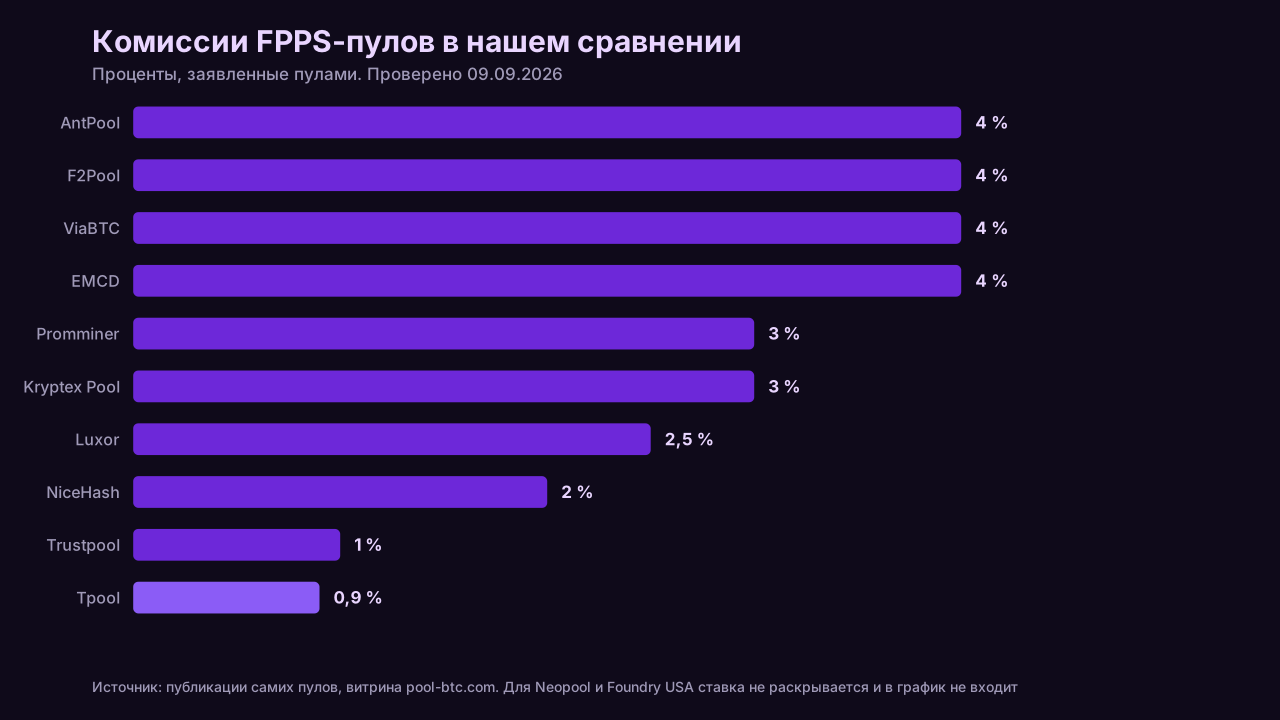
Where Tpool sits among the FPPS pools we track
| Pool | Fee | BTC threshold |
|---|---|---|
| AntPool | 4% | 0.005 |
| F2Pool | 4% | 0.005 |
| ViaBTC | 4% | not confirmed |
| EMCD | 4% | 0.0001 |
| Promminer | 3% | 0.0001 |
| Kryptex Pool | 3% | 0.001 |
| Luxor | 2.5% | 0.001 |
| NiceHash | 2% | 0.0001 (withdrawal) |
| Trustpool | 1% | 0.001 |
| Tpool | 0.9% | 0.0001 |
| Foundry USA | not disclosed | 0.01 |
Several rows here are shaky on their own terms. When we checked, the official fee pages for AntPool, Luxor and Foundry USA either returned errors or never publish a percentage in the first place. We went through those discrepancies in detail in our Trustpool, Foundry and AntPool fee comparison.
Which matters more, the fee percentage or who pays the network fee
For small and mid sized hashrate, the second one. In article 127 we calculated that the on chain fee attached to payouts costs roughly $5.85 per month at 100 TH/s. That is more than the entire spread between 4% and 0.9%, and more than the difference between payout schemes.
The mechanics are simple. A percentage fee is taken once from revenue and scales with your hashrate. A network fee does not scale with hashrate at all: it depends on mempool congestion and transaction size. At 100 TH/s a daily payout is a tiny amount, and the on chain fee eats a visible slice of it. At 10 PH/s that same transaction costs the same absolute amount and disappears into the noise.
Tpool says it absorbs the network fee. If that holds in practice, small operations gain more from it than from the drop from 4% to 0.9%. There is exactly one way to verify it: make a payout and compare the amount debited from your pool balance against the amount that lands in your wallet. To sanity check your own monthly revenue and see how quickly a given threshold fills at your hashrate, use the mining profitability calculator.
One more note on the low threshold. At 0.0001 BTC and roughly 0.0015 BTC of monthly revenue at 100 TH/s, payouts arrive every couple of days. At a 0.005 BTC threshold, which is what AntPool and F2Pool use, the same hashrate waits more than three months for a first payout. The total is the same either way, but until then the money sits on the pool's balance sheet rather than in your wallet.

What we could not confirm
This is the section the article exists for. Here are the gaps as of 09.09.2026, each of which bears on whether you should point real hashrate at this pool.
The pool does not appear in public hashrate distribution trackers. It is absent from the pool list on mempool.space. On miningpoolstats it shows up only as an ad banner, not as a row in the share table. There is a plausible technical explanation: a pool that writes no recognizable tag into the coinbase transaction has its blocks filed under Unknown, and aggregators cannot attribute them. That explanation is a hypothesis, not a finding. We cannot independently confirm the stated 7.99 EH/s and are relying entirely on the pool's own dashboard.
The operator is not disclosed. No legal entity, no jurisdiction, no launch year, no named team anywhere on the site. Contacts are an email address and a Telegram handle. For a service that takes in hashrate and holds miner balances, that is a substantive gap rather than a presentation quirk.
The documentation section is broken. The help, terms and faq pages return 500 and 404 errors. The question and answer block is only reachable on the home page, and most of the confirmed detail above comes from there. There was no publicly readable terms of service at the time of our check.
No independent reviews exist. Tpool is not mentioned on BitcoinTalk, on Reddit, or in the 2026 pool roundups we searched. Not favourably, not unfavourably. An absence of complaints is not a clean record; it is an absence of data.
Stratum endpoints are not published. They appear in the dashboard after registration. That is not unusual, but it does mean you cannot assess server geography or latency before signing up.
Nothing is stated about KYC or two factor authentication. No verification requirements, no country restrictions, no account security description on any page we could reach.
The referral program contradicts itself
The home page describes the referral program as "up to 50% of the pool fee" earned on the hashrate of people you invite. The FAQ block on the same page describes it as "0.2% to 0.5% of the referral's revenue," paid by the pool and not deducted from the invited miner.
Those are two different bases. One is a share of the pool's fee, the other is a share of a miner's revenue, and they do not convert into one another. Averaging them would be meaningless, so we quote both wordings as they stand. We do not know which one is in force.
On the "neural network technology" claim
The site says it runs neural network based technology that increases profitability. The honest response is to explain the mechanics rather than to accuse anyone of anything.
Revenue under FPPS comes from four quantities: your hashrate, current network difficulty, the block reward including transaction fees, and the percentage the pool withholds. The first three are set by your hardware and the network; the fourth is set by the tariff. Pool software does not move any of them. What software does affect is different: stale share rates, connection stability, how fast new work reaches your machines after a block is found. Those are real and measurable, and improving them shows up in a stale share percentage rather than in a profitability multiplier. If the phrase refers to stack optimisation of that kind, it would be worth describing concretely. As published, it is not.
How to vet a new pool before committing hashrate
Short answer: with test hashrate and arithmetic, not by reading promises on a landing page. The check takes about a week and costs far less than moving a whole farm to an unknown operator.
- Point a small share of your hashrate at the pool for several days. One machine, or a subset of workers, gives you usable statistics within three days.
- Compare the hashrate shown in the pool dashboard against what the machines themselves report. A few percent of drift is normal given averaging windows; a consistent 5% or larger gap is a question worth asking.
- Recalculate your accrual by hand using the formula above and compare it against what the pool credited. Under FPPS the credit should be predictable day to day, with no unexplained dips.
- Wait for a real payout to your own address and compare three numbers: the amount debited from your balance, the amount in the transaction, and the amount that arrived. That is how the "the pool pays the network fee" claim gets tested.
- Ask support specific questions: which payout scheme applies to your coin, the full list of stratum endpoints and ports, whether 2FA exists, which regions are served. How fast and how concretely they answer is itself a data point.
- Check whether blocks the pool finds show up in public aggregators, and if they do not, ask why. An answer about a missing coinbase tag is verifiable. An answer about commercial confidentiality is not.
Who this might suit, and who it does not
On paper, Tpool's terms favour small and mid sized operations most: low threshold, daily payouts, network fee absorbed by the pool. At that scale those three parameters move more money than the fee percentage does.
Everything else argues the other way. No disclosed operator, no independent hashrate confirmation, no reviews, broken documentation pages. If your hashrate is your main asset, that combination is reason enough to wait until a public track record exists.
We added the pool to the comparison as an entry with a full account of what is known and unknown about it, not as a recommendation. Compare the terms side by side in the pool comparison table, and always run the numbers on your own inputs: the profitability calculator and our breakdown of what a payout actually costs cover both halves of the calculation. If you cash out to fiat, the crypto card comparison is worth a look too, since conversion spreads often cost more than the entire pool fee.
What happens next on our side: we watch for Tpool appearing in mempool.space tables, for the documentation pages to come back, and for the operator to be named. The moment any of that changes, the comparison entry gets updated.

This article contains referral links to mining pools (marked as sponsored). We may receive a reward if you register through them. This does not change the figures or the order of rows in the tables: the terms are taken from the pools' official pages.