
Who builds Bitcoin's blocks: hashrate share, Stratum V2 and Job Declaration pool by pool
Three pools found close to 60% of Bitcoin blocks over the month to 9 September 2026. The machines are spread around the world, but the choice of which transactions go into a block is made by far fewer people. Most miners never think about this when they pick a pool. It is still worth a few minutes, and one table.
POOL BTC is not a mining pool. We compare other operators' terms, so there is nothing here to sell and nobody to accuse. The mechanics of Stratum V2 are covered in Stratum V2 and who actually picks the transactions in a block. This page is narrower: which pool stands where today, and what that means when you choose one.
Which pools control most of Bitcoin's hashrate right now?
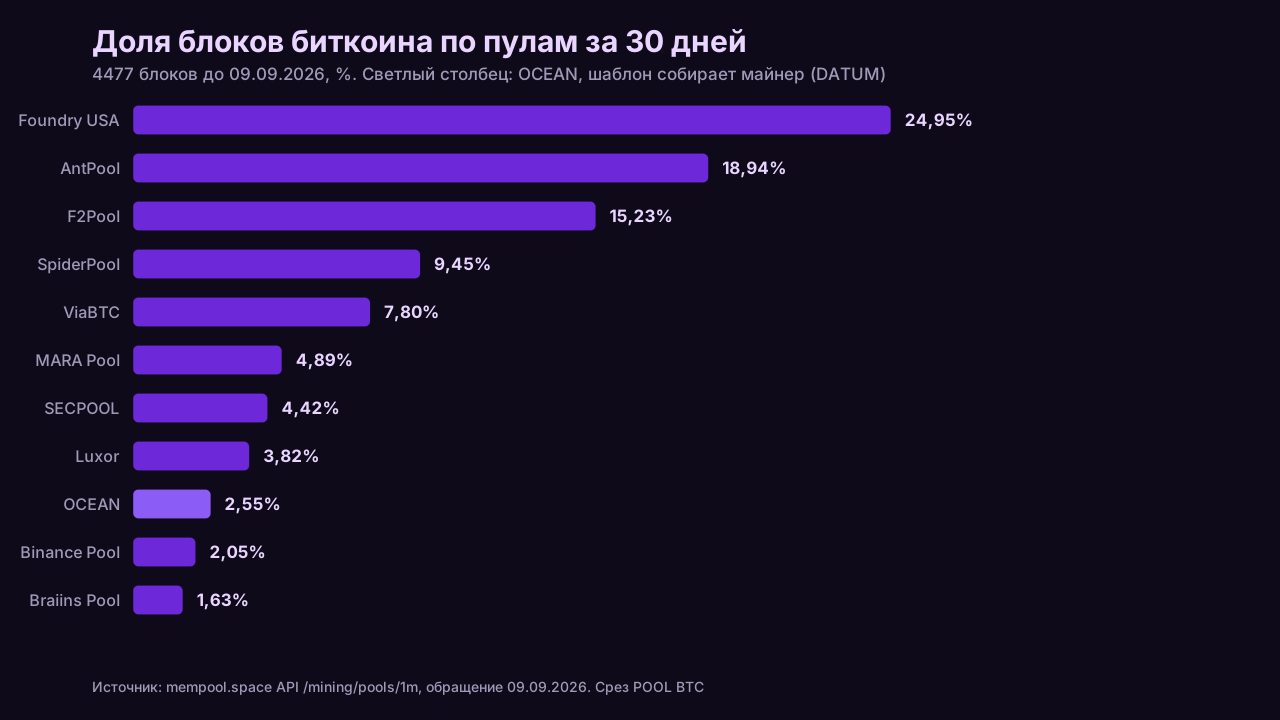
Over the 30 days to 9 September 2026, Foundry USA found 24.95% of blocks, AntPool 18.94% and F2Pool 15.23%, per mempool.space. Those three come to 59.12%. Add SpiderPool and ViaBTC and five pools found 76.37% of all blocks. The rest is split among smaller pools: on 22 August mempool.space counted 133 pools with hashrate in total.
mempool.space does not measure hashrate directly. It counts blocks over a window and attributes each block to a pool by its coinbase tag. This is the usual proxy for hashrate, and shares move a little depending on the window and the source. A second tracker gave a similar picture: Hashrate Index at block 965,040 on 1 September showed Foundry USA at 25.22%, AntPool at 18.14% and F2Pool at 14.84%.
Shares also shift within weeks. On a 7-day window mempool.space had F2Pool ahead of AntPool on 10 August (17.95% against 17.46%). On the 7-day window to 9 September AntPool led with 18.46% and F2Pool had 15.03%. A share you read a month ago is already out of date.
D-Central put the pool-level Nakamoto coefficient at 3 for the first half of 2026: three pools are enough to cross half of all blocks found. The number is not new to anyone who follows mining, but it is the right frame for the table below.
What is Job Declaration, and how is it different from Stratum V1?
Job Declaration is the part of Stratum V2 that lets a miner build the block template and declare it to the pool. Under Stratum V1 the pool builds the template and the miner only hashes it. With Job Declaration the pool still counts shares and pays rewards, but it stops deciding alone which transactions go into the block.
The Stratum V2 specification says this directly: pools that opt into the Job Declaration Protocol "are only responsible for accounting shares and distributing rewards". A Job Declarator Client runs on the miner's or farm's side and a Job Declarator Server runs at the pool.
The distinction that matters for choosing a pool: "supports Stratum V2" and "lets you build your own template" are two different claims. Stratum V2 also has an encrypted transport and a compact binary format. A pool can adopt those, skip Job Declaration, and still honestly say it runs V2. The layers are explained in article 135, so here is only the short comparison.
| Stratum V1 | Stratum V2 without Job Declaration | Stratum V2 with Job Declaration | Ocean DATUM | |
|---|---|---|---|---|
| Who builds the block template | Pool | Pool | Miner or farm | Miner, through own node and DATUM Gateway |
| Channel encryption | No | Yes | Yes | Works on top of V1 |
| What the miner needs | Stock firmware | V2-capable firmware or software | Job Declarator Client plus V2 setup | Full Bitcoin node plus DATUM Gateway |
Which pools support Stratum V2 and Job Declaration?
In our data, miner-built templates are available at two places: Ocean through DATUM, and DMND through Job Declaration. Braiins Pool is sometimes listed too, but the sources disagree about it. Foundry USA, AntPool, F2Pool, SpiderPool and MARA joined the Stratum V2 Working Group in May 2026, but had not opened V2 access to users when we checked.
| Pool | Block share, 30 days to 09.09.2026 | Stratum V2 status | Can the miner build the template | Where the status comes from |
|---|---|---|---|---|
| Foundry USA | 24.95% | Stratum V2 Working Group member since May 2026 | No user access found | news.bitcoin.com via research on 09.09.2026 |
| AntPool | 18.94% | Working Group member since May 2026 | No user access found | Same |
| F2Pool | 15.23% | Working Group member; no live V2 endpoint in the connection guide | No | f2pool.io guide, checked 20.08.2026 |
| SpiderPool | 9.45% | Stratum V2 Working Group member since 7 May 2026 | No user access found: support.spiderpool.com says nothing about V2 | stratumprotocol.org, support.spiderpool.com, checked 16.09.2026 |
| ViaBTC | 7.80% | Not documented | No documentation found | support.viabtc.com, checked 20.08.2026 |
| MARA Pool | 4.89% | Working Group member since May 2026 | No user access found | news.bitcoin.com via research on 09.09.2026 |
| SECPOOL | 4.42% | Not documented, only Stratum V1 endpoints found; not a Working Group member | No data. In b10c's 2024 measurement SECPOOL templates matched SigmaPool's by about 97% | secpool.com, b10c.me, checked 16.09.2026 |
| Luxor | 3.82% | Disputed: third parties call it "SV2-ready", Luxor's own docs say nothing | Not confirmed | docs.luxor.tech, checked 20.08.2026 |
| OCEAN | 2.55% | Not V2; runs its own DATUM protocol on top of V1 | Yes, through DATUM | ocean.xyz/docs/datum |
| Binance Pool | 2.05% | Not documented: the pool's help pages list only Stratum V1 endpoints; not a Working Group member | Not confirmed | Binance Pool help center, checked 16.09.2026 |
| Braiins Pool | 1.63% | V2 works (requires Braiins OS) | Conflicting: aggregated research on 09.09.2026 says Job Declaration is live, Braiins docs checked on 25.08.2026 call template choice a future goal | academy.braiins.com; research on 09.09.2026 |
| DMND | 0 blocks in the 30 days to 16.09.2026; 1 block in its whole history | Native V2 pool, public since November 2025 | Yes, Job Declaration | Aggregated research on 09.09.2026 |
Put the two columns next to each other and the pattern is plain. The pools that found about three quarters of blocks have signed up to the standard but have not handed template building to their users. The options where a miner really builds the template add up to a few percent of blocks. Aggregated estimates put hashrate on any form of V2 at 15-20% of the network and hashrate using Job Declaration at 3-5%. Neither figure comes from official statistics.
V2 status changes when pools update their infrastructure. We recheck this table once a quarter, next in December 2026. The last column names the source for each pool. A note on DMND: the pool is open to anyone, but according to mempool.space it found no blocks in the 30 days to 16.09.2026 and one block in its whole history.

Why is hashrate concentration a risk for the miner, and not only for the network?
Because the pool operator decides what your hardware signs. Any demand placed on that operator, a regulator's or a commercial one, applies to all hashrate pointed at it, yours included. If the pool starts filtering transactions, stops serving a region or shuts down, you find out after it happens and move your machines in a hurry.
This is an observation about structure. We have no public evidence that any pool in the table above filters transactions systematically, and we are not suggesting it.
The case people usually cite is F2Pool. On 20 November 2023 developer 0xB10C, who runs miningpool-observer, reported six transactions from addresses on the OFAC sanctions list that were missing from blocks of several pools, and said some of them were likely false positives. F2Pool co-founder Chun Wang acknowledged that the pool had filtered such transactions, and a few hours later wrote that he would disable the patch until the community reached a more comprehensive consensus. The published reports give no exact list of the filtered transactions. Sources: CoinDesk and TheMinerMag, 22.11.2023.
A pool closure is the more down-to-earth version of the same risk. SBI Crypto held 2.2% of network hashrate on 30 June 2026, announced the shutdown on 2 July and stopped accepting shares on 31 July. Its customers had four weeks to move, and the pool named Luxor, Braiins and NeoPool as places to go. Other criteria for picking a pool are in our guide to choosing a Bitcoin mining pool.
For the network the risk is a different one: a few operators, and the jurisdictions they sit in, can shape what goes into most blocks. The larger that group's share, the less it matters that the machines themselves are spread across the world.
How can you check who really builds the block templates for a pool?
Start with public block explorers. mempool.space attributes each block to a pool by its coinbase tag, so you can open a pool's recent blocks and see where the coinbase reward goes. If differently named pools keep paying to the same addresses or produce near-identical templates, one operator may be building templates for all of them.
The steps:
- Open the pool's page on mempool.space and list its blocks for the last week.
- In a few blocks, look at the coinbase transaction: the tag and the output addresses.
- Do the same for the other pools on the list and compare addresses and tags.
- Compare the transaction sets of neighbouring blocks from different pools. Matching order and composition across "different" pools is a warning sign.
- Check whether the pool itself says where its templates come from, and whether it offers Job Declaration or DATUM.
Such cases are on record. Developer b10c compared block templates across pools from 1 June to 12 September 2024. Poolin and BTC.com templates matched AntPool's by about 99% and 98%, SECPOOL and SigmaPool matched each other by about 97%, and Braiins Pool and Ultimus by about 89%. On 23 August 2024 Binance Pool switched from SpiderPool's templates to AntPool's, and from mid-July 2024 Braiins Pool openly proxied Foundry USA's jobs. The data is two years old, and we found no newer study of that scope. Source: b10c.me, "Block Template Similarities between Mining Pools".
There is a hard limit here. A block built by a miner through Job Declaration looks the same on chain as a block from a pool template. No public metric says what share of blocks was built on the client side. The 15-20% and 3-5% estimates describe connections, not blocks already mined.
Does a pool's decentralization affect your earnings?
Not directly. Your payout depends on the payout scheme, the fee and your share of work, not on who built the template. We found no official figures from Braiins or Ocean showing more income from Stratum V2 or DATUM. The money differences are indirect: fee, variance at small pools, and the cost of running your own node.
Where it does show up:
| Factor | What changes for the miner | Data |
|---|---|---|
| Fee | Ocean's site lists 2%, or 1% for miners using DATUM | ocean.xyz, checked 25.08.2026 |
| Fee | Braiins Pool: 2.5% | Checked 25.08.2026 |
| Variance | A small pool finds blocks rarely. On PPLNS or TIDES your income swings with its luck. On FPPS it does not | Mechanics of the payout schemes |
| Own infrastructure | DATUM needs a full node plus Gateway; Job Declaration needs a Job Declarator Client | ocean-vs-braiins, pool-shutdown-stratum reports |
| Custody | Ocean pays from the coinbase directly to miners; Braiins holds balances and pays out on FPPS | ocean-vs-braiins-2026-08-25.md |
Neither bitcoin.org nor Ocean publishes what running your own node costs in money, so we give no estimate of our own. The requirements are published, though: DATUM Gateway needs a fully synced node that does not prune the blockchain, and bitcoin.org puts the chain at roughly 740 GB as of 16.09.2026. On top of that: a 64-bit Linux system, fast storage, and about 1 GB of RAM beyond the node's own needs plus 1 GB per thousand Stratum connections (datum_gateway README on GitHub).
The quickest way to see whether a lower fee covers the extra variance is to run both options through the mining profitability calculator with your hashrate and power price. Payout schemes are compared in FPPS vs PPLNS, and Ocean and Braiins side by side in Ocean vs Braiins.
How do you factor decentralization into choosing a pool?
Pick on money first, then use decentralization to decide between pools that are close. Check the pool's current block share, whether it really offers miner-built templates rather than just a V2 badge, how it holds your balance, and what running your own node would cost you. A checklist follows.
- Calculate net income on 2-3 candidate pools in the calculator. If one of them loses clearly on money, decentralization will not save it.
- Look up each pool's block share for the last 30 days on mempool.space, not in a review from last year.
- If control over transaction selection matters to you, check for Job Declaration or DATUM specifically. Working Group membership does not count.
- Find out how payouts work: straight from the coinbase or from a balance held by the pool.
- Estimate the cost of your own infrastructure. With one or two ASICs at home, a full node plus Gateway is real work.
- If you run enough machines, consider splitting hashrate between two independent pools and configuring a backup pool.
- Recheck the V2 status every quarter. It changes after infrastructure updates, and large pools announce it separately.
Frequently asked questions
Does a large block share mean a pool censors transactions?
No. A large share shows what a pool could do, not what it does. We found no public evidence of systematic filtering at the pools in the table. The risk is about the system as a whole, not about the conduct of a particular operator.
Is it enough for a pool to be in the Stratum V2 Working Group?
For template choice, no. Membership is a commitment to adopt an open standard. By the time we checked, the large members had not opened V2 access to users, and Job Declaration is a separate component on top of that.
Can I build my own template without new firmware?
With Ocean's DATUM, yes. It works on top of Stratum V1 with stock firmware, but it needs a full Bitcoin node and DATUM Gateway on your side. Job Declaration in Stratum V2 needs a V2 setup and a Job Declarator Client.
Why do different trackers show different pool shares?
They use different windows and methods: some report the share of blocks found over a week or a month, others a current hashrate estimate. On 1 September Hashrate Index and a 7-day Simple Mining window gave close numbers for the top three, and on other days they did not.
What we could not confirm as of 16.09.2026
- Whether Braiins Pool offers Job Declaration to users now: the sources contradict each other.
- Binance Pool's official V2 status. A third-party source says support is ready but not shipped; the pool itself does not say so.
- Fresh, 2025-2026 measurements of template overlap between pools.
- The exact list of transactions F2Pool filtered in 2023.
- Primary sources for the 15-20% and 3-5% hashrate estimates.
In short
Three pools find about 60% of blocks, and the pools that decide templates for three quarters of blocks have not handed that decision to miners yet. For a small miner this changes the choice of pool only at the margin. If control over block content matters to you, look for Job Declaration or DATUM by name and check the block share on the day you connect.
This article contains referral links to mining pools (marked as sponsored). We may receive a reward if you register through them. This does not change the figures or the order of rows in the tables: the terms are taken from the pools' official pages.